Where can AI help healthcare operations?
AI automation can assist healthcare teams with document intake, administrative search, scheduling support and operational exception handling. Begin with a bounded workflow, authorized data and human review of consequential outputs. Evaluate errors, staff effort and integration reliability before expanding. Administrative automation should not be treated as evidence that a system is ready for diagnosis or clinical decision-making.
Healthcare workflows involve patients, clinicians, administrators and external organizations. A small information error can propagate between systems and create additional work or inappropriate action. The implementation question is therefore about the whole process, not just model accuracy.
This article addresses operational software design. It does not provide clinical recommendations or a legal determination of compliance. Applicable requirements depend on the organization, data, jurisdiction and intended use.
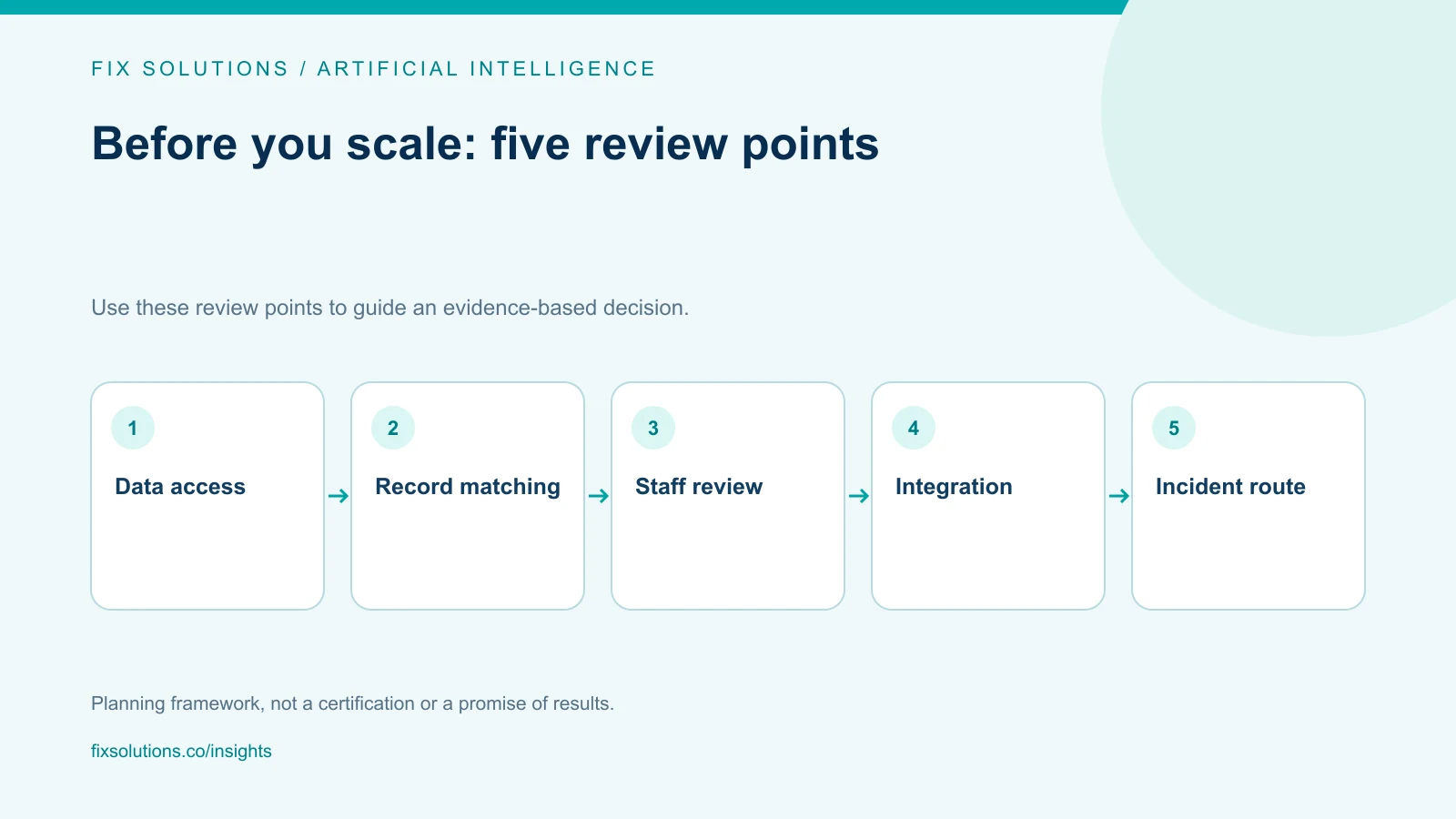
Prioritize workflows by value and consequence
Start with a process that has enough volume to measure, a clear owner and a way to review outputs. Avoid selecting a task simply because the source material is unstructured. Sometimes a better form, a rules engine or an integration resolves the problem more reliably.
| Opportunity | Potential assistance | Required human or system control |
|---|---|---|
| Administrative document intake | Extract and classify required fields | Staff validation before important record updates |
| Appointment operations | Identify missing information and scheduling exceptions | Confirm booking rules and patient communications |
| Internal knowledge search | Retrieve approved procedures with references | Source permissions and current-document ownership |
| Revenue operations support | Flag incomplete records for review | Authorized staff make coding and financial decisions |
| Operational reporting | Summarize trends from validated data | Reconciliation with authoritative records |
The same interface can support very different risk levels. Summarizing an internal procedure for an administrator is not equivalent to recommending treatment for a patient. Keep those use cases separate in the scope, evaluation and approval process.
Document intake: extraction is only the first step
Define the record that must be produced
List the required fields, accepted formats and destination system. Identify which values can be checked against an existing record and which require interpretation. A document may be legible while still belonging to the wrong person or containing inconsistent information.
Use validation rules outside the model where possible. Required-field checks, allowed codes and duplicate detection can make an extraction workflow more dependable. Show the original document alongside extracted values so a reviewer can investigate discrepancies without switching tools repeatedly.
Treat confidence as a routing input
A confidence score is not proof that a field is correct. Test how it behaves on your document types, including poor scans and unfamiliar layouts. Determine which outputs can proceed automatically and which require review based on observed error patterns and consequences.
The OCR Document Intelligence workflow illustrates capture, validation and approval as connected product capabilities. The value comes from making the approved information useful in the next step, not simply generating structured text.
Scheduling support: preserve operational rules
An assistant can help identify missing appointment information, summarize scheduling constraints or prepare a staff-facing response. It must still respect appointment types, clinician availability, location rules, eligibility and the organization's escalation process.
Do not infer permission to contact a patient from permission to read a scheduling record. Sending, rescheduling and cancellation should each have an explicit policy. The system should distinguish a proposed action from a confirmed action in both its interface and audit trail.
When booking is allowed, verify the final state after the calendar update. Handle concurrent changes and retries so the same request cannot create duplicate appointments. A timeout should trigger a reconciliation check before repeating a consequential operation.
Internal knowledge search: keep answers tied to approved sources
An internal assistant can help staff locate procedures, policies and operational guidance. Its source collection should have document owners, effective dates and a process for removing obsolete material. Otherwise, fluent answers may simply make outdated instructions easier to find.
Require references that a user can open. Make the assistant state when the approved material does not answer the question. Permission-aware retrieval is essential: searching across departments should not expose records merely because they were included in an index.
Implementation note: distinguish policy retrieval from clinical advice in the product wording and access model. A label alone does not prevent misuse, but clear task boundaries and restricted capabilities help align the system with its intended purpose.
Design data handling before connecting real records
The US HHS summary of the HIPAA Security Rule describes safeguards for electronic protected health information within the rule's scope. Whether and how it applies requires assessment of the actual organization and arrangement; using a particular cloud service does not by itself establish compliance.
Before integration, map which records enter the workflow, where they are processed, who can access them and what is retained. Include prompts, model outputs, logs, evaluation examples and support exports in that map. Sensitive information can leak through diagnostic tooling even when the primary database is well controlled.
- Use authorized, representative test data; avoid casually copying production records into experiments.
- Define access at the record and role levels.
- Review vendors, contracts and processing arrangements with the responsible specialists.
- Limit retention and document deletion procedures.
- Protect logs and evaluation datasets as deliberately as the application data.
- Maintain a tested incident and service-recovery process.
These are planning considerations, not an exhaustive compliance checklist. Coordinate them with the organization's security, privacy, legal and clinical governance functions where relevant.
Integrate with the existing health technology environment
Many projects fail at the handoff between an AI output and an operational system. Map identifiers, field definitions, status transitions and ownership. A model-generated field should not overwrite an authoritative record simply because its format is valid.
HL7's FHIR overview describes a standard for exchanging healthcare information using defined resources. FHIR can support interoperability, but implementation still depends on supported versions, profiles, terminology, access and local workflow requirements.
Test the real integration contract in a non-production environment. Confirm how the receiving system reports validation errors, handles duplicate requests and exposes final status. Build a manual exception path when an update cannot be completed safely.
Evaluate the workflow with representative cases
Define what an accepted outcome means for each task. For extraction, field-level accuracy matters, but so do document association and correction effort. For scheduling, measure valid completion and exception handling, not merely the number of messages generated.
Include incomplete records, ambiguous identifiers, unusual document formats and downstream outages. Review failures with the people who understand their operational consequences. A rare error may deserve more attention than a common cosmetic problem if it affects the wrong record.
Track the entire task time, including review and rework. If the assistant generates output quickly but staff spend longer verifying it, the pilot has not yet demonstrated an efficiency gain. Capture staff feedback about trust, clarity and the ease of correcting mistakes.
An illustrative intake pilot
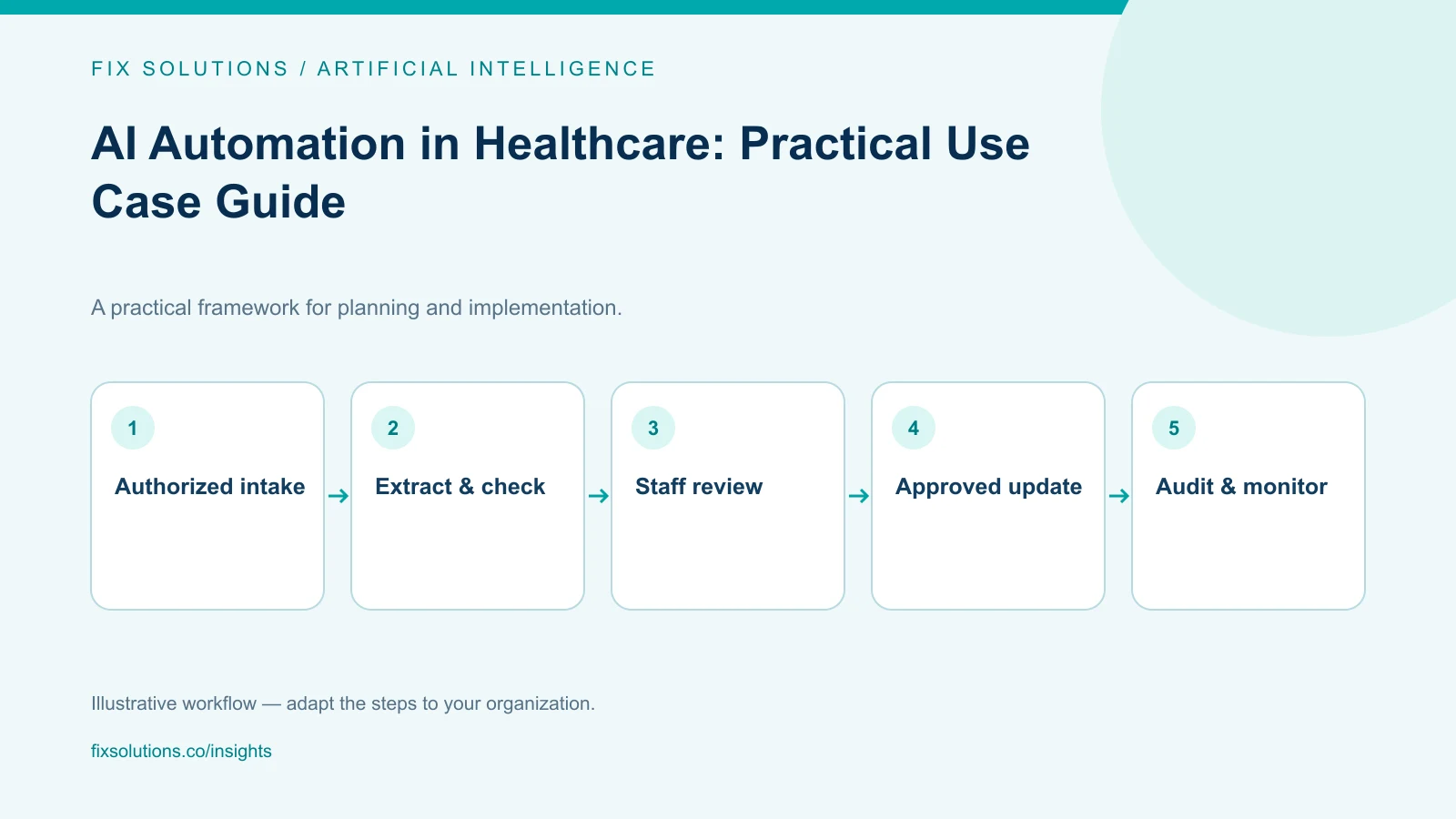
Consider an administrative team receiving documents through several channels. A pilot might cover one document type, one receiving team and a limited intake route. The system extracts a small set of required fields and flags missing information.
Staff review every proposed record before export during the pilot. The team records extraction errors, incorrect associations, review time and integration failures. The application keeps a link to the source document and makes rejected outputs visible for analysis.
Expansion could add another document format only after the first workflow meets its acceptance criteria. It should not automatically add clinical interpretation or autonomous patient communication. Each new capability changes the consequences and therefore the evaluation needed.
Establish ownership after launch
Assign an operational owner who can adjust the workflow and a technical owner who can investigate failures. Define how staff report incorrect outputs, how urgent issues are escalated and when automation should be paused.
Re-evaluate changes to models, prompts, document sources and integrations. A new form layout or changed procedure can affect performance without any application code change. Maintain a review schedule tied to the workflow's risks and rate of change.
Frequently asked questions
Is healthcare AI automation the same as clinical AI?
No. Administrative automation supports operational tasks such as intake, scheduling and internal information retrieval. Clinical applications can involve different intended uses, evidence requirements and regulatory considerations. Define the boundary before development.
Can we start without connecting a live patient system?
Yes. A controlled experiment can use authorized representative examples and a test integration. This can reveal feasibility and review needs before production access is considered. The data still needs appropriate handling and permission.
How do we decide which outputs need human review?
Assess the consequences of an error, the reliability of independent validation and the observed performance on representative inputs. Important updates and uncertain cases may require review even when the model reports high confidence.
Plan a responsible operational pilot
Explore healthcare technology services, AI development and quality engineering to connect the workflow, integration and evaluation plan. Our PoC versus MVP guide can help define the next stage.
Contact FIX Solutions with the process you want to improve, the data constraints and the people responsible for accepting the result.