What does agentic AI mean for an enterprise?
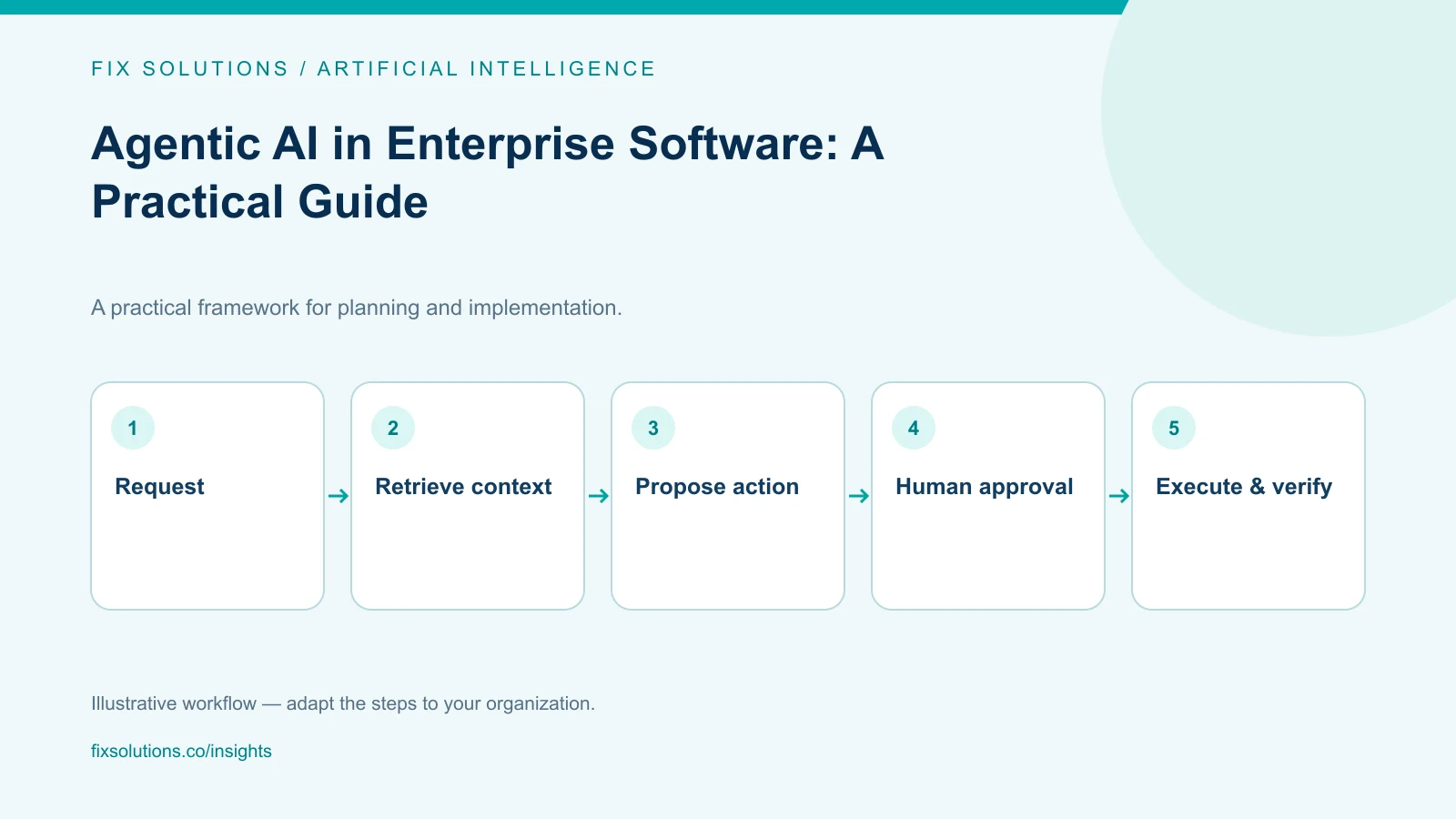
Agentic AI uses a model to select steps and tools while pursuing a defined objective. In enterprise software, it can help investigate requests, retrieve approved knowledge and coordinate actions across systems. Start with a bounded workflow, restricted permissions and explicit approval points. Measure successful outcomes and failure costs before allowing broader autonomy.
A convincing demonstration does not establish that an agent can operate reliably with real customers, inconsistent records and unexpected tool responses. The useful question is narrower: which part of an existing workflow needs flexible reasoning, and what evidence would justify letting a model handle it?
This guide proposes a delivery framework for that decision. The examples are illustrative, not claims about completed client deployments or guaranteed productivity gains.
Distinguish agents from workflows and chatbots
A chatbot is an interface. It may answer questions without changing any external system. A workflow follows an explicitly programmed sequence. An agent can choose its next step based on the information it receives, within limits imposed by the application.
Anthropic's engineering discussion of effective agents distinguishes predefined workflows from model-directed orchestration. That distinction matters because a fixed workflow is often easier to inspect when the business rules are already known.
| Approach | Appropriate situation | Main control |
|---|---|---|
| Search or retrieval assistant | Employees need answers from approved material | Document permissions and source references |
| Deterministic workflow | Inputs and next steps follow stable rules | Validation and explicit transitions |
| Bounded agent | The next useful step depends on intermediate findings | Tool permissions, budgets and approval gates |
| Human-led process | Consequences require judgment the system cannot validate | Accountable human decision |
For example, checking an invoice against a purchase-order number is not automatically an agent problem. A reconciliation workflow may be sufficient. Investigating why several records disagree can require flexible retrieval, but the final financial adjustment can still remain with an authorized employee.
Select an enterprise use case worth testing
Begin with an observable business outcome
Describe the completed task in language operations teams recognize. “Prepare a support escalation with the right account history and evidence” is more useful than “deploy a multi-agent platform.” Identify the person who accepts the output and the source of truth used to judge it.
Record the current process before introducing AI. Capture handling time, exception frequency, rework and the percentage of cases that reach a useful conclusion. A time-saving claim is weak if the proposed system simply transfers more correction work to another team.
Prefer reversible actions first
Good initial candidates include drafting internal summaries, assembling investigation evidence or suggesting a next step. Posting externally, changing permissions, approving payments and deleting records introduce different consequences and should not share the same approval policy.
- Read-only stage: retrieve permitted records and summarize them with references.
- Draft stage: prepare proposed updates without committing them.
- Approved execution: apply a reviewed change through a restricted tool.
- Limited automation: execute narrowly defined low-impact actions after evidence supports it.
These stages are a proposed rollout sequence, not a universal maturity model. A regulated or high-impact workflow may remain at the draft stage permanently and still provide value.
Design the surrounding system before the prompt
Give each tool a small, clear contract
Tools should expose specific business actions rather than unrestricted access. A function that creates a draft support note is easier to govern than a general database connection with write permissions. Validate arguments outside the model and reject requests that violate the caller's authorization.
Use a separate identity or scoped credential for each operational boundary. Do not assume that because an employee can see an assistant, the assistant should inherit every permission in the organization. The application must enforce access even when generated text asks for something broader.
Separate evidence from instructions
Retrieved documents, emails and web pages are untrusted inputs. They can contain misleading instructions as well as useful facts. Keep the agent's operating rules separate from retrieved material, and require the execution layer to verify whether a proposed action is permitted.
Document-level permissions also need to survive retrieval. A vector database does not remove the need for tenant isolation, record ownership or revocation. Recheck authorization when a tool fetches the underlying record, especially if access can change after indexing.
Make actions observable and recoverable
Log the task identifier, authorized user, model and prompt versions, tool requests, approval decisions and final outcome. Protect sensitive information in those logs and define retention rules with the organization responsible for the data.
Give write operations idempotency keys where appropriate. If a timeout happens after a downstream service commits a change, retrying should not create duplicate orders or messages. After execution, read the relevant state back and confirm the intended result instead of trusting a success-shaped response.
Build an evaluation set that exposes failures
An evaluation set should represent the decisions the agent will actually face. Include routine cases, incomplete information, contradictory evidence, unauthorized requests and downstream outages. Keep a held-out set separate from examples used to adjust prompts.
| Evaluation question | Suggested evidence |
|---|---|
| Did the task reach an acceptable outcome? | Business-owner review against a written rubric |
| Did the answer rely on permitted evidence? | Source references and permission checks |
| Were actions appropriate? | Tool traces and approval records |
| Could the process recover? | Retry, timeout and rollback exercises |
| Is the workflow economically useful? | Cost per accepted task, including review and rework |
Engineering note: count a confident but incorrect action as a failure even when the conversation appears polished. User satisfaction and fluent language are insufficient acceptance criteria for a system that changes business records.
Compare the agent against a simpler baseline. That might be retrieval plus a fixed workflow, a form with rules, or the existing human process. If flexible orchestration adds latency and unpredictability without improving the outcome, simplify the design.
An illustrative support-operations pilot
Suppose an operations team wants help resolving incomplete onboarding requests. The first release retrieves approved customer records, identifies missing information and drafts an internal checklist. It cannot contact customers or change account status.
The pilot owner defines what a complete checklist looks like, which sources are authoritative and which requests must be escalated. Reviewers label unsupported claims and missing steps. The engineering team tracks whether the checklist actually reduces investigation time after corrections are included.
Only after that evidence is available should the team consider a tool that creates a draft follow-up message. Sending the message remains a separate permission. This prevents a successful drafting experiment from silently becoming authority to communicate externally.
When an input is ambiguous, the desired behavior is not necessarily another tool call. The system should be able to stop, identify the missing information and return the task to a person. Define that outcome explicitly so abstention is not treated as a failure of initiative.
Plan operating costs and ongoing ownership
Budget beyond inference. Retrieval infrastructure, integration maintenance, evaluation, monitoring, human review and incident handling can determine whether the workflow is viable. A model with a lower price per token may still cost more per accepted outcome if it needs more retries or corrections.
Assign owners for the workflow, technical service, data sources and approval policy. Establish who can change prompts or tools and what evidence is required before releasing those changes. Treat a model upgrade as a behavior change that needs regression evaluation.
The NIST AI Risk Management Framework provides a voluntary framework for organizing AI risk work. It does not certify an implementation or replace context-specific assessment. Use it as a reference when defining responsibilities and review processes.
A rollout checklist for the first production release
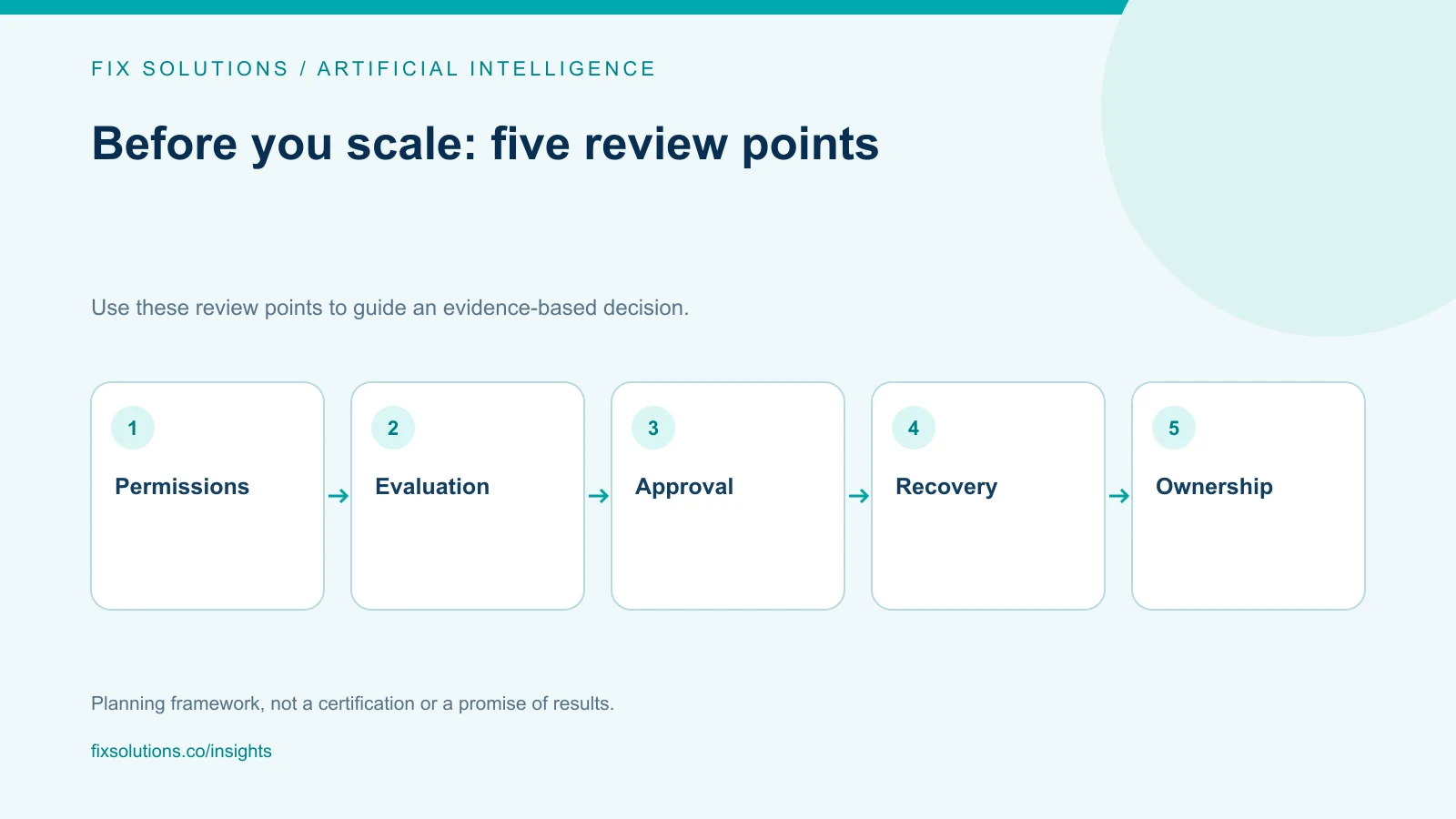
Before exposing the agent to a wider user group, conduct a review with engineering and the team that owns the work. A production launch should leave behind usable operating instructions, not just a demonstration recording.
- Write the allowed objective and prohibited actions.
- Confirm the data sources and their access rules.
- Test tools with invalid input and partial failures.
- Review the held-out evaluation results and unresolved gaps.
- Set request limits, execution budgets and escalation conditions.
- Practice disabling the agent while keeping the business process available.
- Schedule a review of real outcomes and user corrections.
Agree on stop conditions before the pilot starts. An unauthorized data exposure, repeated unrecoverable updates or an unexpected review burden may justify pausing the automation. A pause is useful evidence about the design, not a reason to redefine success after the fact.
Frequently asked questions
Does an enterprise AI agent need multiple models or agents?
No. Begin with the smallest design that can complete the task reliably. Add separate agents only when their responsibilities, coordination costs and evaluation benefits are clear. Multiple agents can introduce more failure points and make root-cause analysis harder.
Can agentic AI work with legacy enterprise applications?
Yes, where reliable integration interfaces and appropriate access controls are available. A legacy system may need an API adapter, event stream or supervised handoff. The agent should not bypass business rules merely because direct integration is inconvenient.
What should we measure before increasing autonomy?
Measure accepted task completion, unauthorized-action attempts, unsupported claims, review time, recovery success and total cost per accepted outcome. Choose thresholds according to the consequences of the workflow rather than adopting a generic accuracy target.
Turn a bounded use case into a delivery plan
Start with a defined decision, an accountable owner and a baseline. FIX Solutions can help scope AI development services, connect the surrounding enterprise software systems and establish quality engineering checks.
For an earlier-stage idea, compare the stages in our AI proof-of-concept and MVP guide. When the workflow is ready to discuss, request an AI consultation.