Should you build an AI PoC or an MVP?
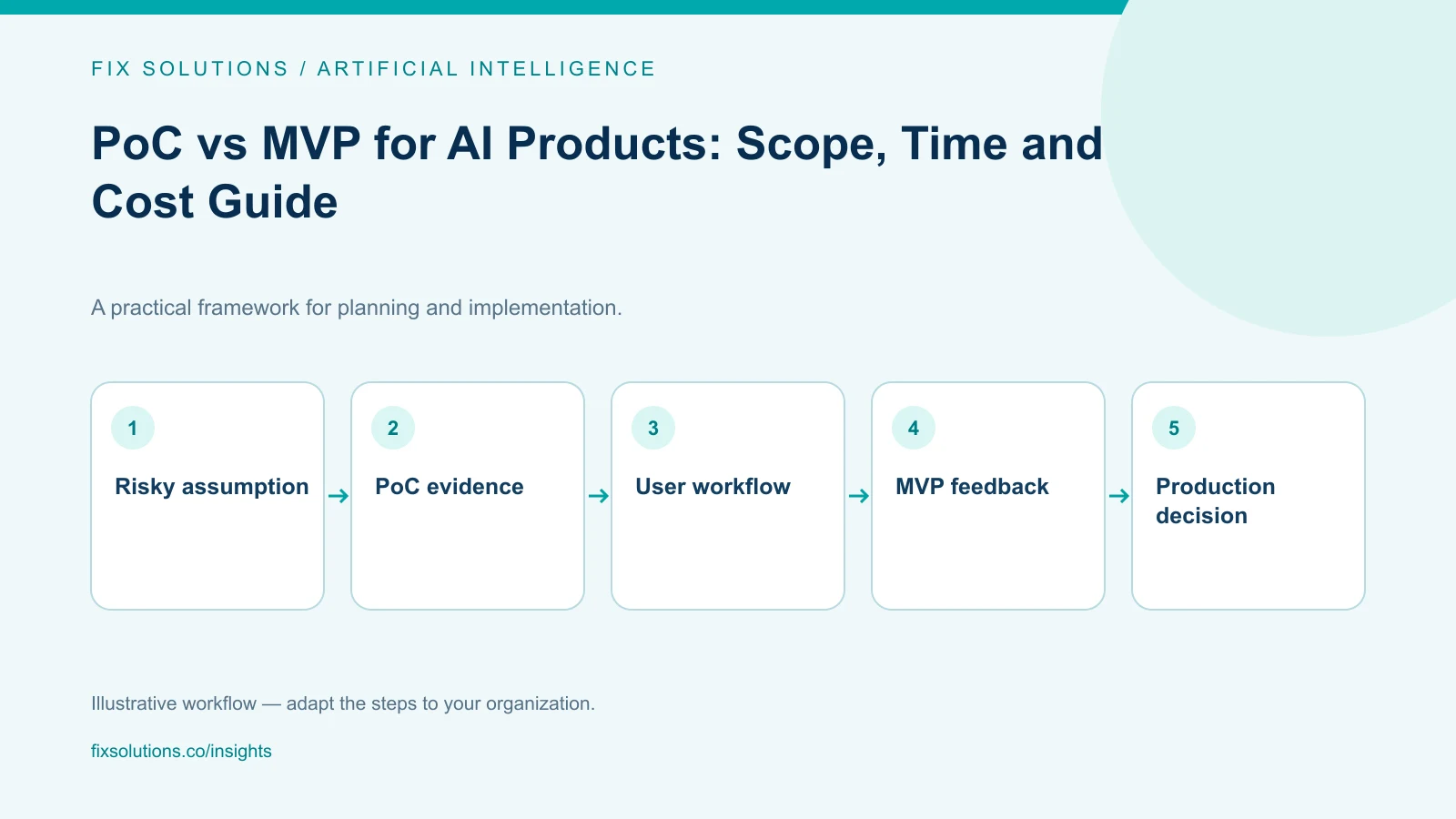
An AI proof of concept tests whether a technical approach can work; an MVP tests whether a small, usable product solves a real user problem. Build a PoC when feasibility is uncertain. Build an MVP when the core approach is credible and you need evidence about adoption, workflow value and operating economics. Neither stage automatically proves production readiness.
Confusing these stages leads to misleading budgets. A demonstration that answers a few questions from a prepared document is not the same delivery scope as a product with accounts, permissions, monitoring, support and a reliable review process.
The right starting point depends on your riskiest assumption. It might concern data access, answer quality, customer demand or integration feasibility. Identify that uncertainty before choosing a technology stack or requesting a fixed launch date.
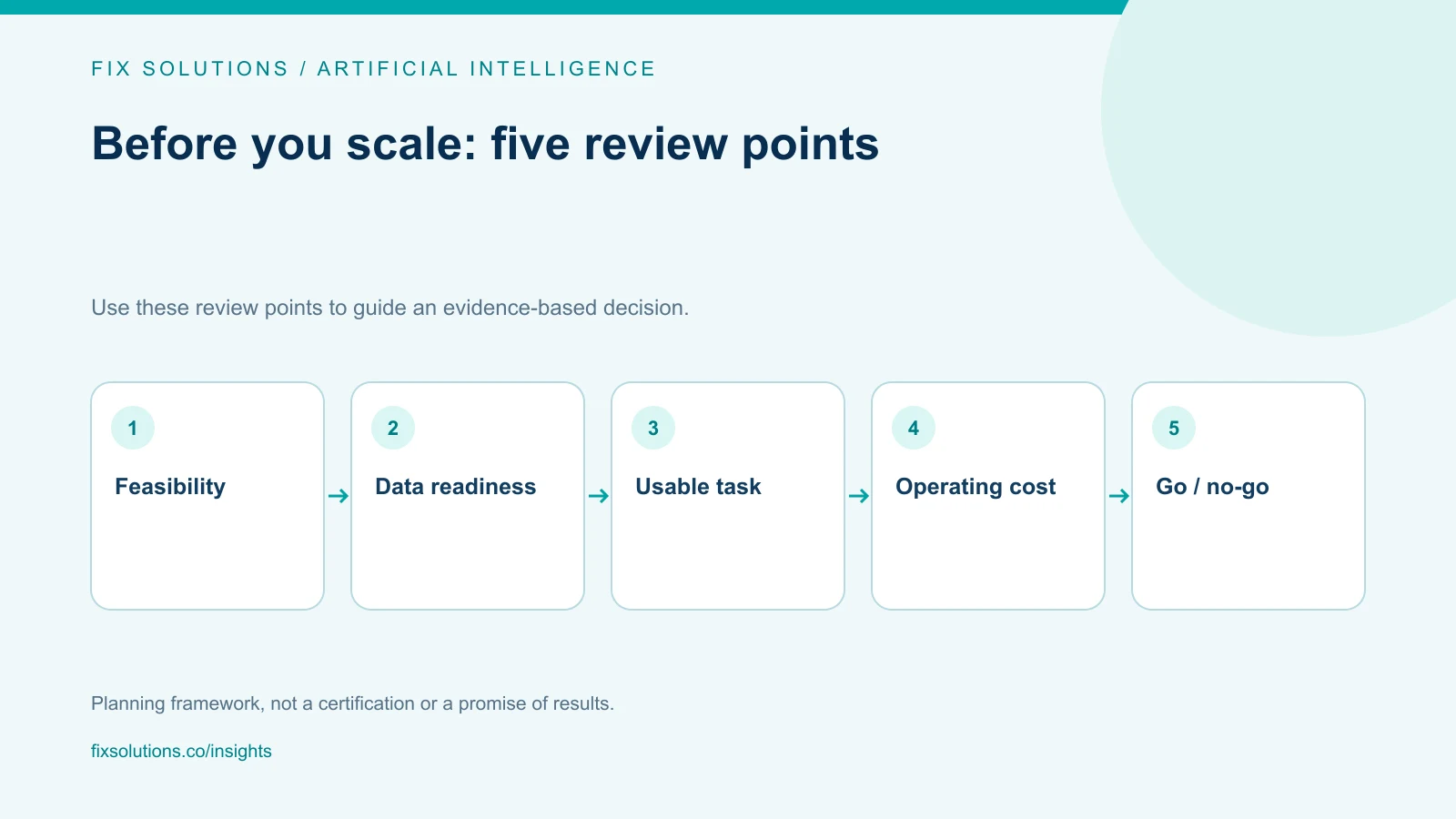
Compare the deliverables, not just the names
| Stage | Primary question | Typical output | Evidence needed |
|---|---|---|---|
| Discovery | Which problem is worth solving? | Problem statement, users, constraints and baseline | A clear user need and testable assumptions |
| Proof of concept | Can the approach meet a technical requirement? | Experiment, evaluation set and findings | Representative results against an agreed threshold |
| Minimum viable product | Will users adopt a useful workflow? | Small usable product with essential controls | Usage, accepted outcomes and operational feedback |
| Production expansion | Can the service operate sustainably at wider scale? | Supported service and rollout plan | Reliability, ownership, capacity and economics |
An MVP is “minimum” relative to a coherent user outcome. It should not omit controls essential to the intended users. A product handling confidential records may need role-based access and auditability from its first release even if reporting and configuration remain basic.
The Government Digital Service's alpha-phase guidance describes prototyping to test risky assumptions. It is a useful reference for evidence-driven exploration, although its delivery phases are not identical to every commercial PoC or MVP engagement.
Define the PoC around one uncertainty
Write a testable question
Replace “Can we use AI for documents?” with a question such as: “Can the system extract the required fields from representative supplier invoices with a review burden our operations team can support?” The narrower question identifies the data, evaluation and decision the experiment needs.
Avoid testing only clean examples selected by the implementation team. Include scans, missing fields, inconsistent layouts and documents the system should reject. Separate the examples used to tune the approach from the examples used to assess it.
Agree on the exit decision
A PoC should end with a recommendation: proceed, revise the approach, collect better evidence or stop. Define that decision before work begins. Otherwise, a team can continue adjusting prompts indefinitely without learning whether the opportunity is viable.
- List the minimum representative data needed.
- Define accepted, rejected and human-review outcomes.
- Set the quality, latency and cost measures.
- Record known exclusions and expected failure modes.
- Identify who will accept the evidence and approve the next stage.
Keep the experiment reproducible. Save the evaluation examples, configuration and relevant model versions. A result that nobody can recreate is difficult to use as the basis for further investment.
Define the MVP around a complete user task
The MVP should let a real user start, complete and recover a useful task. For a document assistant, that might include uploading an authorized file, reviewing extracted fields, correcting errors and exporting an approved result. The model is only one component of that workflow.
Support the minimum operational needs of the selected audience. Explain what happens when processing fails, how users report an issue and who can access the records. Decide whether the product needs a queue, manual review, notifications or a supported fallback.
Keep the first audience narrow
A limited audience reduces variation while you learn. Choose users with a shared workflow and available feedback rather than trying to serve every department. Document the constraints so a successful pilot is not mistaken for proof that every use case is solved.
For product teams beginning from scratch, startup technology support can connect discovery, engineering and initial operations. Existing businesses may instead need the MVP integrated into established enterprise applications.
Estimate time from dependencies and decision gates
No responsible schedule can be inferred from the term “AI MVP” alone. Access to representative data, integration approvals, reviewer availability and security requirements can dominate delivery time. A short model experiment may sit inside a much longer organizational process.
Use a dependency-based estimate. Split the work into data preparation, experimentation, application development, integration, evaluation and rollout. For each stream, identify what must happen before it can start and what evidence allows it to finish.
Planning note: use ranges and assumptions during discovery. A single date can be appropriate once scope and dependencies are stable, but hiding uncertainty does not make the work more predictable.
| Dependency | Question to resolve before committing |
|---|---|
| Data | Are representative, permitted examples available? |
| Integration | Are the API, test environment and credentials accessible? |
| Review | Who can judge output quality and how much time is allocated? |
| Security | Which controls are required for the initial audience? |
| Adoption | Can target users participate in a limited rollout? |
Build a cost model that includes operating work
Separate one-time development from recurring costs. Development includes discovery, data preparation, evaluation design, implementation and integration. Recurring costs include inference, storage, retrieval, monitoring, human review and maintenance.
A simple planning expression is total monthly operating cost = platform costs + model usage + review labor + support and maintenance. Define the units for each term. A per-request price is not a useful business measure if some requests fail and must be repeated.
Calculate cost per accepted outcome
Suppose a hypothetical workflow receives 1,000 documents in a month, but only 800 become accepted outputs without restarting the task. Divide the relevant operating cost by those 800 accepted outcomes, not by 1,000 incoming files. This is an illustration of the method, not a pricing estimate.
Then account for human review. If users must inspect every field, automation may still be worthwhile, but the benefit should be measured against the previous workflow. Do not count processing speed as saved labor when a reviewer remains occupied for the same amount of time.
Test sensitivity to change
Estimate what happens if volume doubles, documents become longer or the percentage needing review increases. Identify which variable drives cost most strongly. This tells the team where an engineering improvement or narrower scope would have the largest practical effect.
Avoid presenting projected savings as realized results. Use a clearly labeled model, state the assumptions and replace them with observations when the pilot produces enough evidence.
An illustrative document-intelligence roadmap
For a supplier-document use case, discovery begins by mapping the current intake and approval process. The team identifies document types, required fields, data-handling constraints and the cost of correcting an error.
The PoC tests extraction and validation against a representative sample. It compares a simple baseline with the proposed approach and measures both accuracy and reviewer effort. It does not need to implement every account-management or reporting feature.
The MVP then supports a narrow operational flow: authorized upload, extraction, review, correction and approved export. The release includes access controls, error reporting and a person responsible for handling exceptions. See the OCR Document Intelligence platform for a related product workflow.
Production expansion considers additional document types, integration reliability, support commitments and monitoring. The evidence from each stage should determine the next scope. A successful extraction experiment does not establish that approvals or financial posting should become autonomous.
Avoid common procurement and delivery traps
A beautiful demo with no evaluation record
Ask to see the test set, acceptance criteria, failed cases and unresolved risks. A demo can explain the intended experience, but it cannot replace evidence about representative inputs. Insist on results that can be reproduced by someone outside the implementation team.
Treating prototype code as production infrastructure
Some prototype code can be reused, but production needs may require different identity, logging, deployment and data-management patterns. Plan that work explicitly. Reuse should be a technical decision, not a promise made before the experiment has revealed the requirements.
Expanding scope before confirming the first outcome
Adding another language, business unit or integration can change the evaluation problem. Record new assumptions and test them. A narrow result should not be generalized merely because the interface looks similar.
Frequently asked questions
Can we skip an AI PoC and build an MVP directly?
Yes, if the technical approach is already credible for your data and constraints. You still need evaluation inside MVP development. Skip a separate experiment only when it would not materially reduce uncertainty before the build.
Is a PoC always cheaper than an MVP?
A narrowly scoped PoC usually contains less product work, but cost depends on the uncertainty being tested. Difficult data preparation or specialist evaluation can be substantial. Compare explicit deliverables and assumptions rather than relying on the label.
What happens when a PoC fails?
Document why, distinguish a weak implementation from an infeasible assumption and decide whether another experiment is justified. A well-designed negative result can prevent a larger investment in an unsuitable approach.
Choose the next stage with evidence
FIX Solutions can help define AI engineering scope, design an evaluation approach and connect it with quality engineering. For systems that will take actions, also review our enterprise agentic AI guide.
Discuss your AI product idea with the workflow, sample-data constraints and the decision you need the next phase to support.