What is multi-channel attribution?
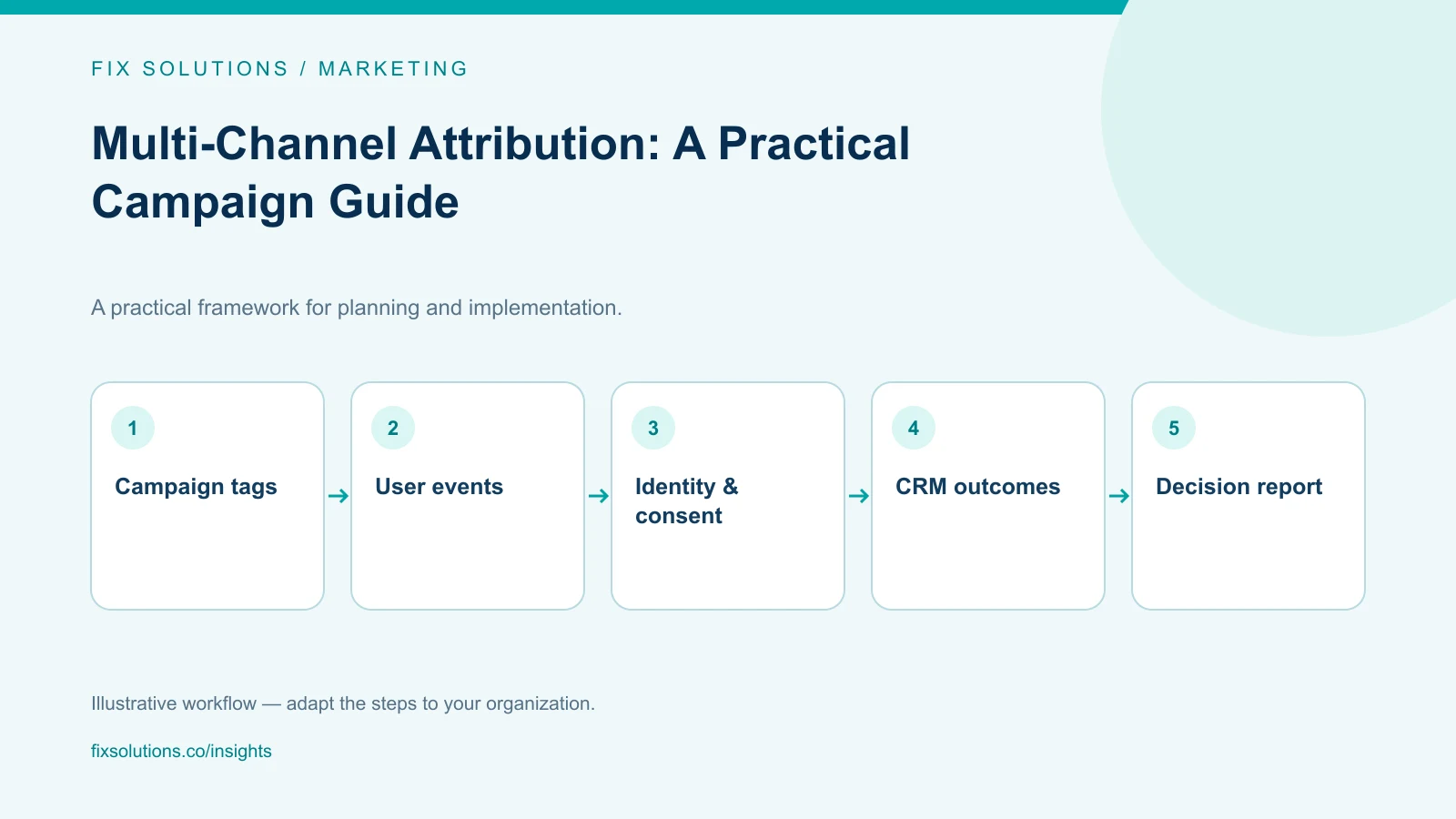
Multi-channel attribution assigns credit for an outcome across recorded marketing touchpoints. A useful implementation starts with consistent campaign names, reliable conversion events and a connection to CRM outcomes. Attribution describes contribution within the available data and model; it does not prove that a channel caused an incremental sale. Use it with sales feedback and experiments when making budget decisions.
When reports disagree, the problem may be measurement definitions rather than campaign performance. One platform may count a click, another a submitted form and a third a qualified opportunity. Comparing those numbers without reconciling their meaning can produce confident but unhelpful decisions.
This guide focuses on building a measurement process that a marketing and sales team can operate together. It avoids assuming that every customer journey can be observed completely.
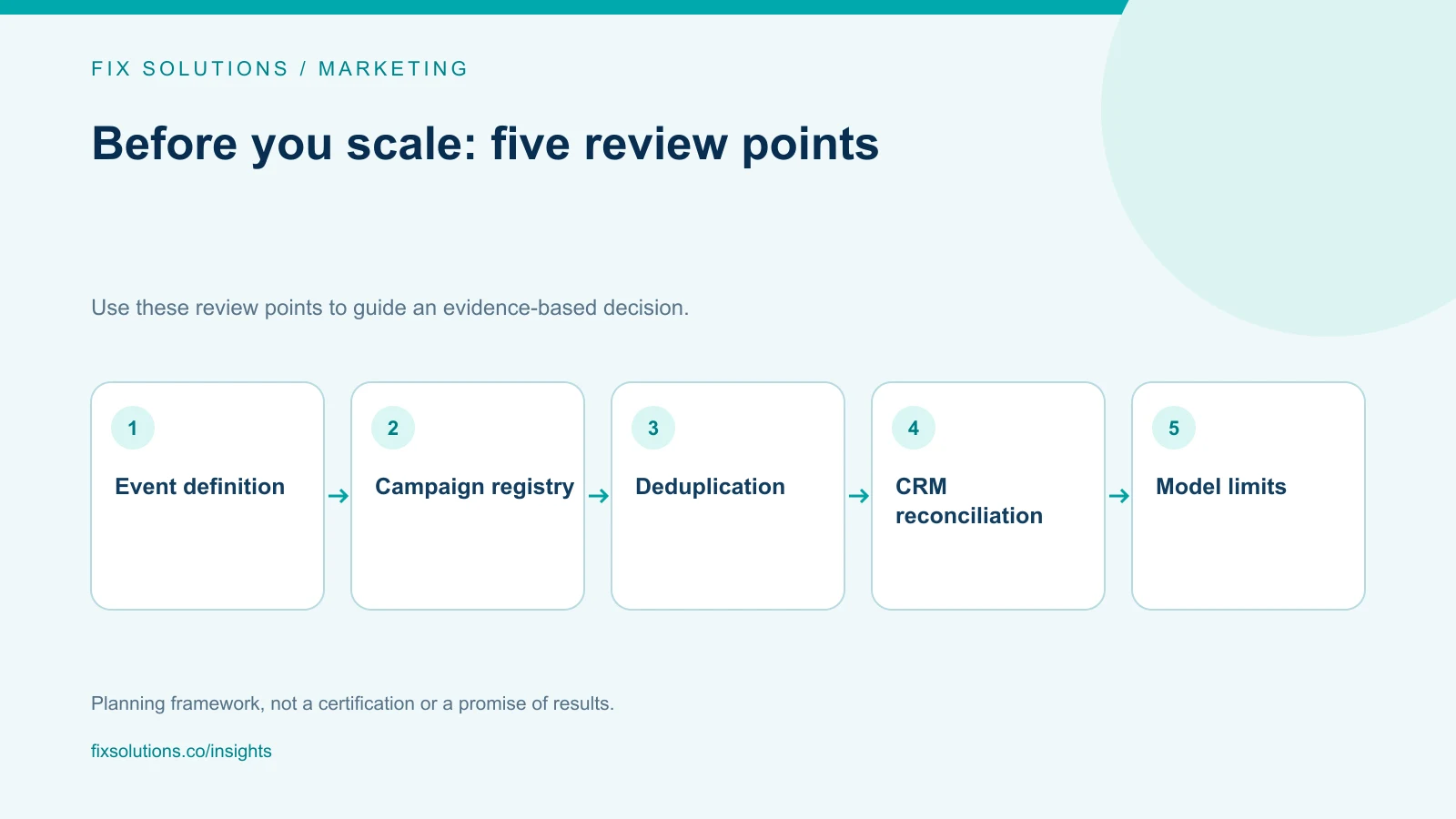
Define the outcome before the attribution model
Decide which business event the report is intended to explain. A newsletter registration, demo request, accepted opportunity and closed sale are different outcomes. Each can be useful, but they should not be treated as interchangeable conversions.
Write a short event dictionary. For each event, define its trigger, required properties, owning system and duplicate-handling rule. Agree on whether a repeated form submission counts as another inquiry or an update to an existing conversation.
Align marketing and CRM stages
The CRM should distinguish inquiry, qualification, opportunity and outcome using definitions that sales can apply consistently. Record why an inquiry was rejected and whether the prospect's need matched the campaign promise.
A CRM platform can make those transitions visible, but the data model needs business agreement. A technically successful integration cannot resolve conflicting definitions of an opportunity.
Establish campaign naming before launch
Google's campaign URL documentation explains how campaign parameters can describe source, medium and other campaign information. Use a controlled naming convention so the same initiative is not fragmented across spelling and capitalization variants.
| Field | Purpose | Illustrative value |
|---|---|---|
| Source | Where the link was distributed | partner-newsletter |
| Medium | Type of distribution | email |
| Campaign | Shared initiative identifier | crm-workflow-guide |
| Content | Creative or placement distinction | header-button |
These values are examples, not a universal taxonomy. Check how the analytics platform groups them. Google's default channel grouping reference shows that classification depends on defined rules; custom naming needs to work with the reporting design.
Keep a campaign registry
Maintain the campaign name, owner, destination URL, audience, launch date and intended outcome in one shared place. Generate links from that record where possible. A simple registry can prevent a large amount of downstream cleanup.
Do not place sensitive personal information in campaign parameters. URLs can be shared, logged and stored in many systems. Use campaign identifiers for measurement and keep personal data within the appropriate protected records.
Instrument the conversion path end to end
Test the path from the campaign link to the final event. Confirm that redirects preserve the required parameters, the landing page loads correctly and the event fires only when the intended action succeeds.
A button click is not the same as a completed form submission. If the form fails validation or the server rejects the request, reporting it as a lead creates a false funnel. Prefer a success event tied to confirmed application behavior where feasible.
Check duplicates and missing events
Single-page navigation, repeated tag initialization and browser retries can generate duplicate events. Ad blockers, consent choices and network failures can produce missing observations. Document both limitations and avoid assuming that every gap represents user behavior.
Create a small test matrix covering desktop, mobile, valid submission, invalid submission, refresh and repeated action. Record the expected event count and compare it with the observed results. This provides stronger evidence than simply seeing an event appear once in a debug view.
Connect anonymous engagement with known outcomes carefully
Marketing data often starts with a browser or session, while sales data belongs to a contact, account or opportunity. Connecting them requires a defined identity strategy and appropriate privacy handling. Avoid treating uncertain matches as verified customer journeys.
Use a stable lead or submission identifier where the workflow permits it. Preserve the original inquiry context when a record is updated or merged. Agree on how one account with several contacts should relate to one opportunity.
Keep data minimization in the design
Collect what the measurement decision needs and review retention with the responsible team. Consent and privacy requirements depend on the context and jurisdiction. Technical tracking capability alone does not establish that a data use is appropriate.
Analytics note: a report should distinguish observed data from modeled or inferred data. A merged journey can look precise even when its identity assumptions are uncertain.
Choose a model that matches the question
Google's attribution overview describes attribution as assigning credit through rules or algorithms. Different models answer different reporting questions and depend on the data available to the platform.
| Reporting lens | Useful question | Main limitation |
|---|---|---|
| First recorded touch | What first introduced this observed relationship? | Earlier unrecorded exposure may be missing |
| Last recorded touch | What preceded the measured action? | It may underrepresent earlier influence |
| Multi-touch model | How is credit distributed across recorded interactions? | Results depend on model and observation coverage |
| CRM source analysis | Which acquisition contexts lead to viable opportunities? | Source maintenance and sales-cycle lag matter |
| Controlled experiment | Did a change create incremental outcomes? | Design, sample and operational feasibility matter |
Not every platform currently offers every model shown here. The table describes analytical lenses rather than a promise about a specific product menu. Verify the current options and definitions in the tool you use.
Reconcile reports before changing budgets
Begin with the event definitions, reporting dates and time zones. Then compare attribution windows, identity rules and conversion counting. A sale reported in the month it closed will not necessarily align with a campaign cohort based on the month the inquiry arrived.
Separate platform-reported conversions from CRM-accepted outcomes. Both may be useful, but they represent different evidence. If several platforms claim the same sale, summing their reports can overstate total business results.
Use a discrepancy log
Record the report, expected relationship, observed difference and likely explanation. Some discrepancies can be fixed, such as duplicate events. Others reflect legitimate model differences or missing visibility. The goal is understandable reporting, not forcing every dashboard to show the same number.
Revisit discrepancies after tagging or CRM changes. Measurement infrastructure evolves with the product, so a report that was reliable last quarter may need review after a new form, domain or sales process is introduced.
An illustrative B2B campaign measurement plan
Suppose a company promotes a CRM workflow guide through search content, an email campaign and a partner event. The primary early outcome is an inquiry with a stated CRM problem. The later outcome is a qualified opportunity recorded by sales.
Each distribution route uses a registered campaign link. The landing page records a successful inquiry only after the form is accepted. A submission identifier connects the inquiry with the CRM record, and sales records fit, next action and rejection reasons.
The review compares inquiries and qualified opportunities by acquisition context, while noting the sales-cycle delay. It does not conclude that the channel with the last recorded click caused the sale. If a material budget decision remains uncertain, the team can consider a controlled distribution test.
Our B2B marketing strategy guide explains how audience, offer and follow-up fit around this measurement plan.
Create reports that support specific decisions
Use a small executive view for business outcomes and a diagnostic view for measurement quality. The executive view might show accepted opportunities, acquisition cost assumptions and progression. The diagnostic view can show missing source values, duplicate events and unassigned CRM records.
Before adding a chart, state the decision it supports. A channel ranking without confidence, volume or maturity context can encourage premature budget changes. A smaller report that explains the limitations may produce better decisions than a comprehensive but ambiguous dashboard.
- Review broken tracking and delayed follow-up promptly.
- Compare cohorts with enough time to progress through the sales cycle.
- Annotate major campaign and measurement changes.
- Retain definitions beside the report.
- Use experiments for causal questions when practical.
Frequently asked questions
Is multi-channel attribution the same as multi-touch attribution?
The terms overlap in common usage. Multi-channel emphasizes different distribution channels, while multi-touch emphasizes multiple interactions. Define the actual model, outcome and observation scope instead of relying on the label alone.
Why do advertising platforms and the CRM report different results?
They may use different event definitions, attribution windows, identity rules and reporting dates. Platforms can also claim credit for overlapping journeys. Reconcile the definitions before interpreting the difference as an implementation failure.
Can attribution prove that a campaign generated incremental revenue?
Not by itself. Attribution assigns credit within observed data and a chosen model. Incrementality asks what would have happened without the campaign and generally requires an appropriate experimental or causal analysis design.
Build measurement into the campaign
FIX Solutions can connect marketing strategy, web and integration development and CRM workflows. Use the technical SEO checklist to verify that campaign destinations remain accessible and usable.
Discuss your measurement setup with the business decision, conversion definitions and reports you need to reconcile.