What makes a B2B marketing strategy useful?
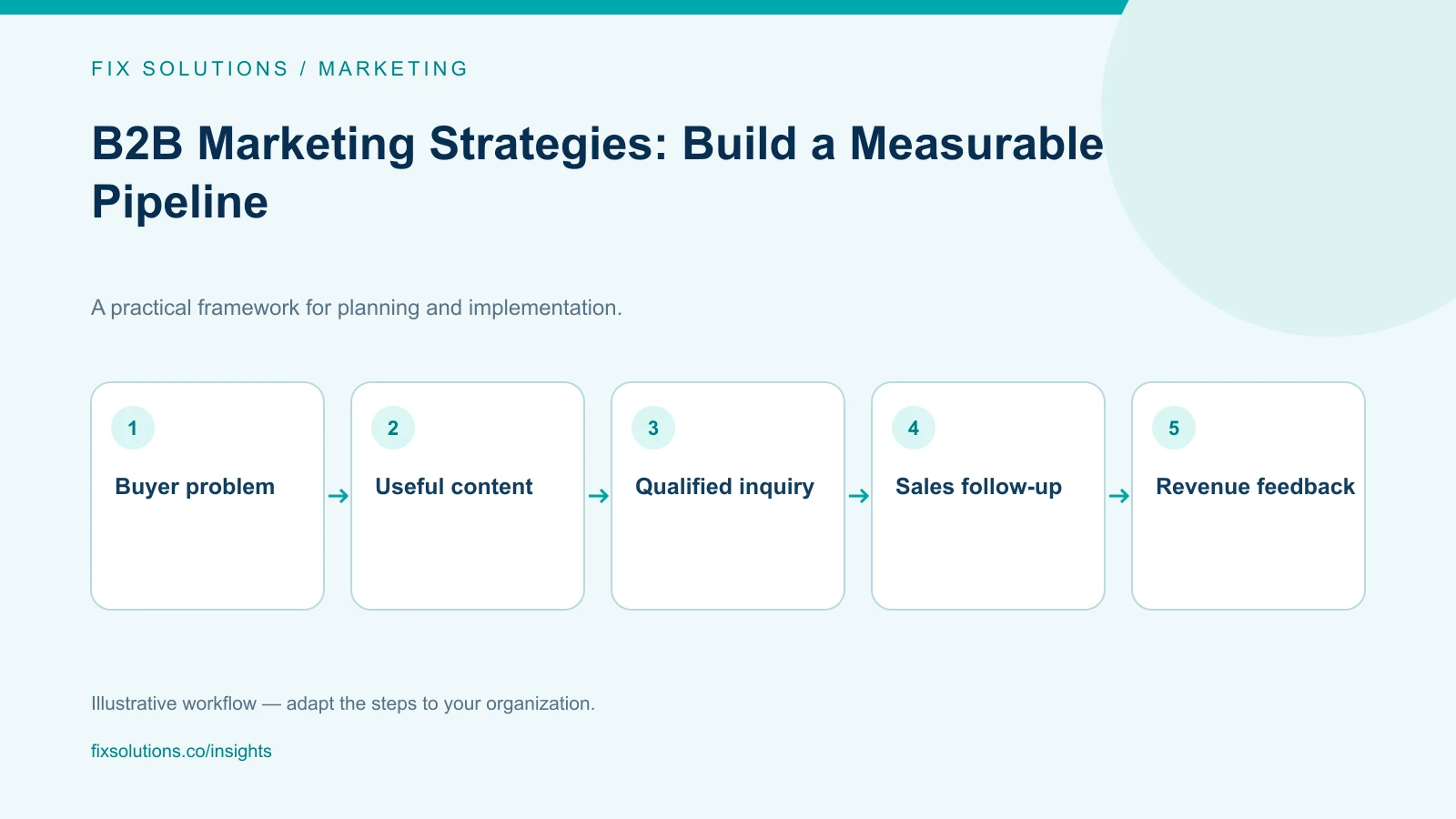
An effective B2B marketing strategy connects a specific buyer problem to useful content, a relevant offer and a measurable sales process. Define the buying group, publish evidence that helps it make a decision, coordinate follow-up in the CRM and measure accepted opportunities rather than traffic alone. Choose channels according to buyer behavior and available delivery capacity.
Business buying often involves several people with different concerns. An operational lead wants a workflow to improve; a technical reviewer wants to understand integration and risk; procurement wants clear commercial terms. A single generic campaign rarely answers all those questions.
This guide proposes a practical planning approach for service providers and technology businesses. It does not assume that paid advertising, account-based marketing or a particular automation platform is necessary for every organization.
Define a narrow buyer and a costly problem
Start with the customers your business can serve credibly. Describe their operating context, the event that triggers a search and the consequences of doing nothing. An industry label alone is not a complete segment: a startup choosing its first CRM has different needs from an enterprise replacing a heavily integrated system.
Use sales conversations, support requests and customer interviews to identify recurring questions. Separate what buyers say they value from what actually delays or prevents a decision. Those barriers often provide the most useful content topics.
Map the buying group
| Participant | Typical concern | Useful content |
|---|---|---|
| Business sponsor | Outcome and economic justification | Clear use case, scope and value model |
| Operational user | Daily workflow and adoption | Demonstration, process example and support plan |
| Technical reviewer | Integration, security and maintainability | Architecture overview and implementation questions |
| Procurement or finance | Cost, terms and supplier suitability | Transparent engagement model and qualification information |
Treat this as a starting hypothesis. Validate the roles for your actual customers instead of assuming every deal follows the same approval chain.
Build messaging around a decision, not a slogan
Explain who the offer is for, what changes and what the next step involves. “Accelerate digital excellence” is difficult to evaluate. “Map one document-approval workflow and identify where extraction, review and integration can reduce manual handling” gives the buyer a concrete conversation.
Support claims with appropriate evidence. Product screenshots should show the real product. Case studies should identify what was measured and under what conditions. If a result is hypothetical, label it as an example rather than presenting it as a customer outcome.
Create a message-to-evidence map
For each important claim, record the evidence that supports it. A statement about integrations may link to supported interfaces or a discovery process. A statement about delivery quality may link to testing practices and acceptance criteria. Remove claims that the organization cannot explain or substantiate.
This exercise also reveals missing sales assets. If prospects repeatedly ask about migration or ongoing support, a short, specific guide may be more useful than another broad thought-leadership article.
Design content for the buyer's next question
Problem understanding
Publish articles that clarify symptoms, constraints and alternatives. These help buyers describe the problem before they select a supplier. Examples include a workflow assessment, a comparison of implementation approaches or a checklist of questions to ask before a project.
Solution evaluation
Provide product walkthroughs, integration explanations, limitations and delivery plans. Explain where the offer fits and where it does not. A buyer who understands the boundaries can have a more productive commercial conversation.
Decision support
Offer a scoped consultation, demo or discovery engagement with clear expectations. State what the buyer should bring and what they will learn. Avoid asking for a meeting without explaining its purpose.
Google's people-first content guidance is a useful reference: content should help its intended audience and provide substantial value, rather than exist only to attract search visits. Apply that principle when prioritizing topics and reviewing claims.
Choose channels as a coordinated system
Search can capture existing demand. Email can continue a relevant conversation with an appropriate audience. Professional communities and events can support discovery and trust. Paid campaigns can test distribution where the offer, measurement and follow-up process are ready.
Do not evaluate a channel only by its cheapest form submission. A low-cost lead may have no buying relevance, while a smaller number of inquiries may produce viable projects. Define the qualification criteria before the campaign begins.
- Use organic search for durable questions your team can answer well.
- Use targeted campaigns for a defined audience and a specific offer.
- Use email to continue useful communication with the appropriate permissions.
- Use events and partnerships when they provide access to relevant conversations.
- Reuse a strong idea across formats, adapting it to each context instead of copying it unchanged.
When account-based marketing fits
Account-based marketing can be useful when the potential customer list is narrow, deal value supports focused work and sales can participate. It requires account selection, relevant messaging and coordinated outreach. It is not simply displaying ads to a list of company names.
If the business lacks a clear segment or a responsive sales process, resolve those issues first. More targeting precision cannot compensate for an unclear offer or a slow handoff.
Connect marketing and sales in the CRM
Define the transition from inquiry to accepted sales conversation. Agree on required information, ownership, response expectations and reasons for rejection. Marketing needs feedback about why a lead is unsuitable; sales needs context about what the person engaged with.
A CRM platform can support this process through shared records, pipeline stages and follow-up visibility. The software works best when the team has already agreed on what the stages mean and who maintains the data.
Keep handoffs small and actionable
Record the buyer's problem, source, relevant engagement and next action. Avoid overwhelming sales with a long activity log that does not explain the current need. Likewise, do not rely on an opaque score without showing the signals behind it.
Review a sample of accepted and rejected inquiries together. This can reveal whether the campaign is attracting the wrong audience, the landing page is setting the wrong expectation or the follow-up conversation is missing necessary context.
Measure pipeline without confusing attribution with proof
| Stage | Useful question | Example measure |
|---|---|---|
| Audience | Are relevant people engaging? | Engagement from the intended segment |
| Inquiry | Does the offer create meaningful interest? | Inquiries with a stated business need |
| Qualification | Can sales pursue the opportunity? | Accepted conversations and rejection reasons |
| Opportunity | Is there a viable project? | Qualified pipeline with consistent stage definitions |
| Outcome | Did the investment support business results? | Won work, cost and quality of acquired customers |
Google Analytics describes attribution as assigning credit to touchpoints. That is different from proving that a channel caused an incremental sale. Treat attribution reports as one source of evidence, alongside CRM outcomes and, where feasible, experiments.
Long sales cycles require patience and cohort discipline. Compare inquiries created during similar periods and allow enough time for them to progress. A current month's pipeline may reflect campaigns and relationships established much earlier.
An illustrative campaign for a document platform
Suppose a business offers document extraction and review software. Rather than target everyone interested in AI, it chooses operations teams handling repeated supplier-document formats. The offer is a workflow discussion using sample document types and approval requirements.
The content sequence explains manual intake problems, shows a review workflow and describes integration questions. The landing page links to the OCR Document Intelligence product, states who it is for and explains what a demo will cover.
The CRM records the document types, approximate workflow volume, receiving system and decision owner. Sales feedback identifies whether inquiries match the intended use case. The next content iteration addresses the most common unresolved question rather than simply increasing publishing frequency.
This is a planning example, not a claim about measured campaign performance. Its purpose is to show how audience, content, offer and handoff can be designed together.
Build a review cadence that changes decisions
A weekly operational review can address broken forms, delayed follow-ups and obvious targeting issues. A broader periodic review can examine pipeline quality, content gaps and channel contribution. Choose a cadence that matches traffic volume and the sales cycle.
Keep a campaign learning log. Record the hypothesis, change, observation and decision. If the sample is too small to support a conclusion, say so. Avoid changing several major variables at once and then attributing the result to the most visible one.
Strategy note: a good dashboard should lead to an action. If nobody can explain what they would do differently when a metric changes, reconsider whether it belongs in the primary decision view.
Frequently asked questions
Which B2B marketing channel should we start with?
Start where the intended buyers already seek information and where your team can support consistent follow-up. Search content, targeted outreach, partnerships or paid distribution can each fit different circumstances. Validate the offer and handoff before expanding channels.
How much content does a B2B company need?
Enough to answer important buyer questions across problem understanding, evaluation and decision-making. A small set of useful, maintained pages can outperform a large collection of repetitive posts. Use actual sales questions to prioritize the next article.
Should marketing be measured on leads or revenue?
Use both leading indicators and business outcomes, with shared definitions. Marketing can influence inquiry quality and pipeline progression, but revenue also depends on sales execution, product fit and delivery. Avoid assigning exclusive credit where the process is shared.
Connect your next campaign to the sales process
Explore FIX Solutions marketing services, review our technical SEO checklist and use the multi-channel attribution guide to plan measurement.
Contact the marketing team with your audience, current offer and the pipeline problem you want to resolve.