What does an AI developer do?
AI developers turn business objectives into software that uses AI, data and existing systems. The role requires sound engineering, evaluation and operational thinking—not just model selection or prompt writing.
An AI developer builds software products and business capabilities that use artificial intelligence. The role connects a business objective to data, models and the systems people rely on. The work may involve integrating a model into a product, building an assistant or creating a machine-learning pipeline.
The title is not standardized: some employers mean application engineering, others expect machine-learning, data or operations expertise. For an executive, the useful question is which outcomes the role must own and what expertise the team needs.
AI development is more than selecting a model or writing prompts. A working system needs suitable data, integration, evaluation, access controls, monitoring and an operating plan.
Begin with a business outcome
Strong AI projects start with a problem that matters to customers or employees. Define who benefits, how the task works today and what evidence would show that an AI-enabled approach is better.
“Add an AI chatbot” is a feature proposal, not an outcome. A stronger objective might help employees find approved procedures with clear sources while preserving the existing escalation route. This framing helps decide whether a language model is appropriate and what quality is required.
An AI developer works with product owners and users to define what the system should and should not do, where human judgment is necessary and how errors affect the business.
The capabilities behind reliable AI applications
Software engineering and systems integration
AI-enabled products still depend on conventional software engineering. Developers need to understand application architecture, APIs, data handling, testing, version control and deployment. They also need to connect model behavior with existing identity, permissions and business workflows.
The model should not become an invisible shortcut around established controls. If a user cannot access a record through the normal application, the AI feature should not reveal it through a generated answer. Access checks should be enforced by the application and connected services, not left to a prompt or assumed model behavior.
Data and model literacy
AI developers need to understand data quality and model behavior. Predictive systems require attention to evaluation data and changing inputs; generative applications also depend on retrieval quality, source freshness and model variability.
Not every project needs a custom model. A managed service, rules-based workflow or conventional search may be more suitable. Compare task performance, data sensitivity, cost, latency, portability and support needs.
Evaluation and product judgment
An AI developer defines how the system will be tested. Evaluation should include ordinary requests, ambiguity, missing or conflicting information and cases that require refusal or escalation.
Average accuracy can hide important failures. Examine error consequences, correction rates, source relevance and performance for different users. Continue evaluation after release as models and processes change.
Security and responsible operation
AI systems can expose sensitive information, be influenced by untrusted inputs or produce output mistaken for fact. Developers should identify controls with security, privacy and operational stakeholders; requirements depend on product and impact.
The NIST AI Risk Management Framework provides a voluntary structure for considering AI risks across governance, context, measurement and management. It is useful as a conversation framework, not as a substitute for applicable laws, organizational policy or expert assessment.
The AI development lifecycle
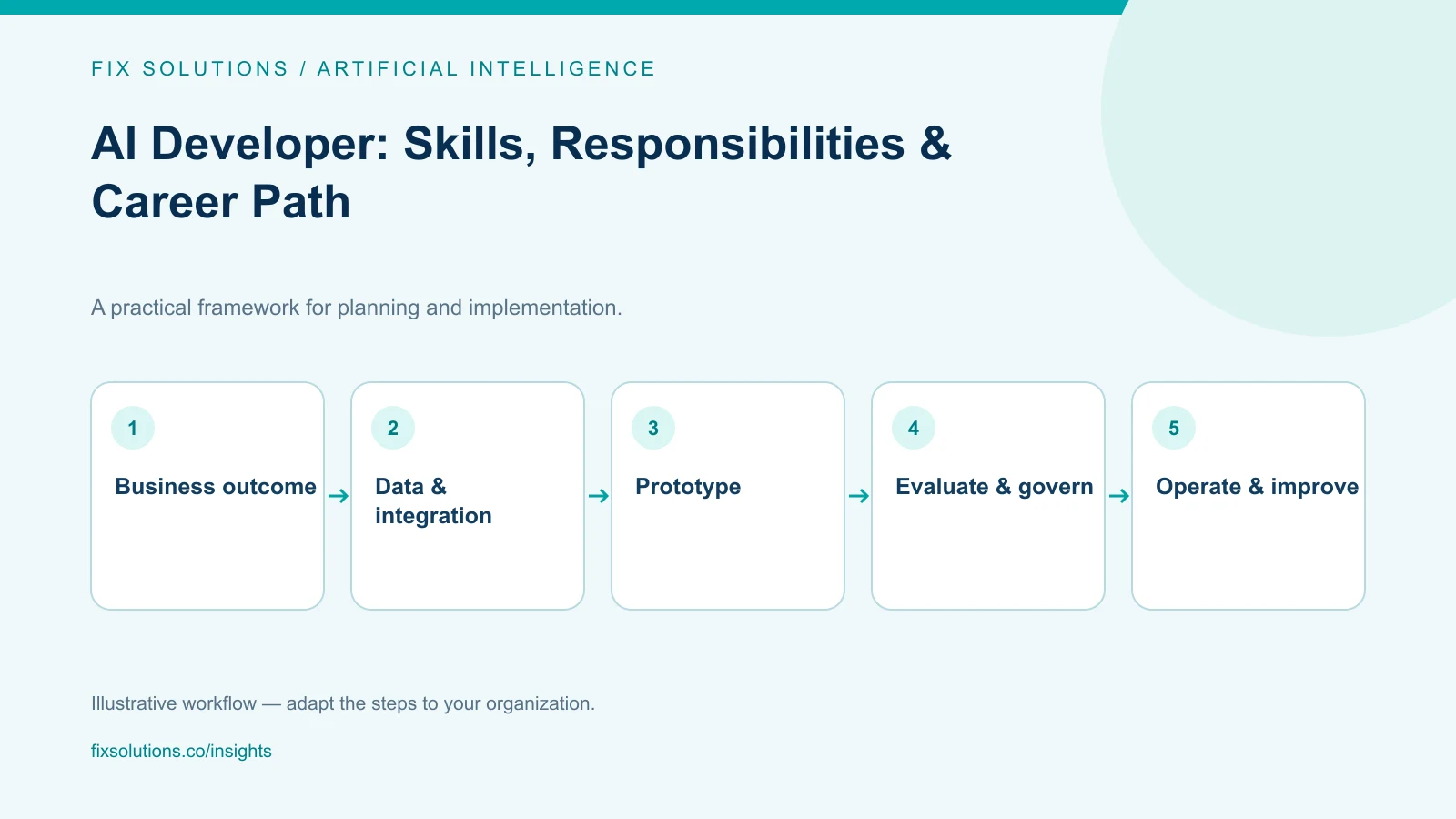
A practical delivery process connects discovery to ongoing operations:
- Discover: clarify the user, workflow, business outcome and existing baseline.
- Select an approach: compare conventional software, search, a managed model and custom development against the task and constraints.
- Prepare the data and integration: establish permissions, data quality, source ownership and system interfaces.
- Prototype: test a narrow workflow with representative users and realistic examples.
- Evaluate: measure task quality, failure consequences, usability, latency and cost.
- Release with controls: define access, human review, monitoring, escalation and rollback.
- Operate and improve: review feedback, model or data changes, incidents and total value.
This sequence is not a reason to delay learning until every detail is known. A prototype can reduce uncertainty, but it should be designed to answer a specific question. A demonstration that succeeds on a few curated examples is evidence of feasibility at most; it does not prove readiness for production.
Building an AI team around the role
An enterprise AI product may need application and data engineers, machine-learning specialists, product and domain experts, security, design and operations. Roles can be combined, but every responsibility needs an owner.
Define the work before hiring: integrate a vendor model, build a predictive capability, add an AI feature or operate a regulated workflow.
An existing software team can build AI skills incrementally, partner with specialists and expand a bounded pilot only when evidence supports the business case.
A practical AI developer career path
For an individual, the path builds on software fundamentals: application development, data, APIs, testing and deployment. Then deliver a bounded AI feature and learn to evaluate it, connect it safely to business data and handle failures.
With experience, developers may shape architecture and operations or specialize in machine learning, model operations or enterprise AI integration.
Employers should reward reliability and knowledge-sharing, not just prototypes, to avoid dependence on one specialist.
How leaders can assess AI development work
Measure task completion, adoption, correction effort, service quality, cost and escalations. Track incidents alongside benefits.
Include model, data, integration, monitoring, support and change-management costs. Consider switching costs.
Define who approves use cases, accepts risk, can pause the service and owns data quality and support.
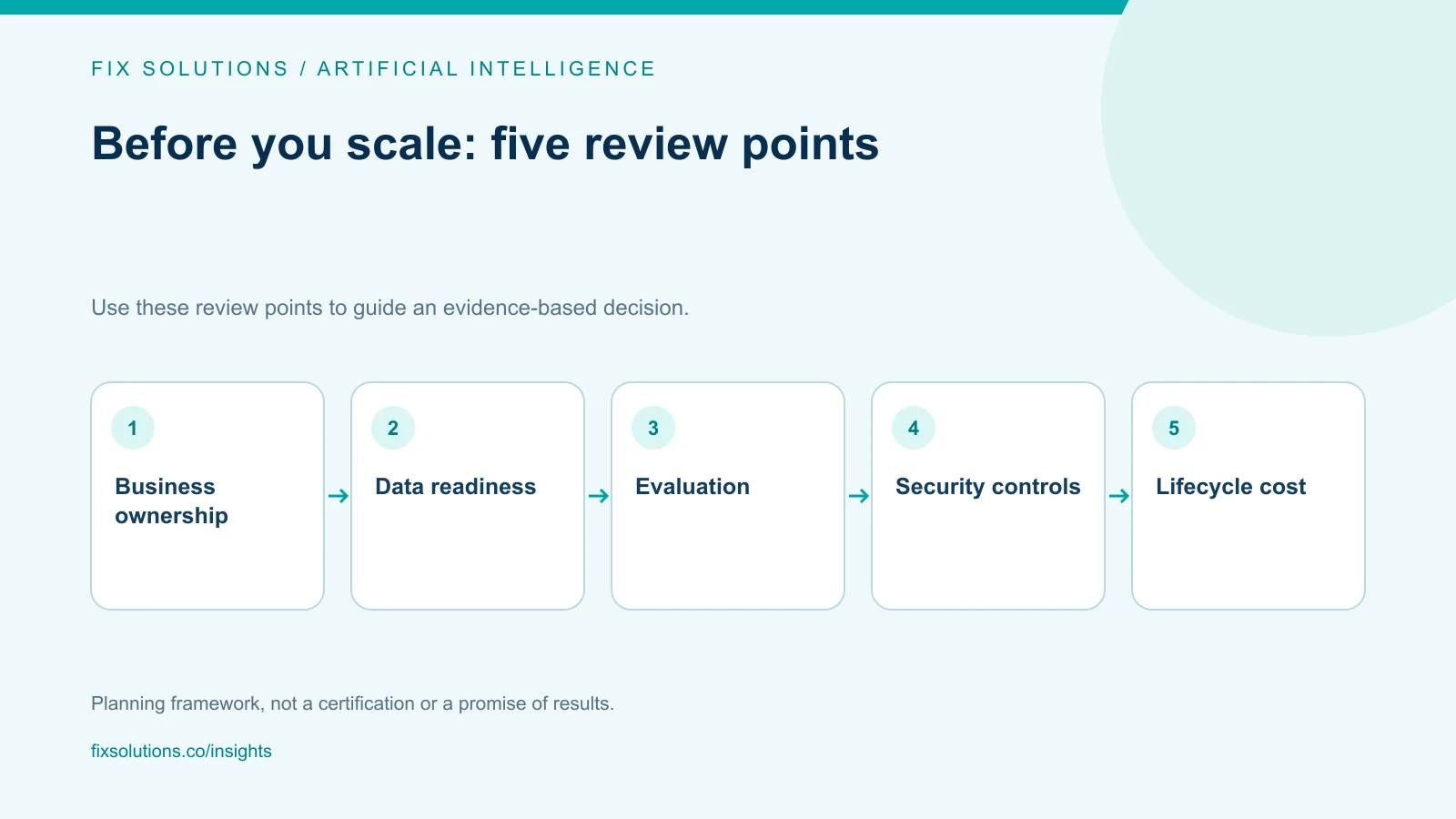
A checklist before starting an AI project
- Is the business outcome specific and owned by a decision-maker?
- Is AI a better fit than search, rules or a conventional workflow?
- Are data sources, permissions and quality understood?
- Can the team test realistic successes and failure cases?
- Are security, privacy and human review considered in the design?
- Is there an owner for operation, monitoring and support?
- Does the expected value justify total lifecycle cost?
Frequently asked questions
Is an AI developer the same as a machine-learning engineer?
Not always. An AI developer may focus on integrating models into applications, while a machine-learning engineer may focus more on training, deploying and maintaining predictive models. Responsibilities vary by employer, so define the required work rather than relying on the title.
Does every company need to train its own AI model?
No. Many use cases can be explored with existing models, retrieval, automation or conventional software. Custom training can be appropriate when the task, data, performance requirements and long-term economics support it.
What should an AI developer deliver first?
The first deliverable should reduce a specific uncertainty: a tested workflow prototype, an evaluation set, an integration proof or a clear feasibility assessment. It should not be treated as a production system until security, quality, operating and support requirements are addressed.
Sources and further reading
Next step
Start with a business workflow and the decision you want to improve. FIX Solutions can help leadership assess the use case, delivery skills and operating controls needed to turn an AI idea into a measurable, maintainable capability.