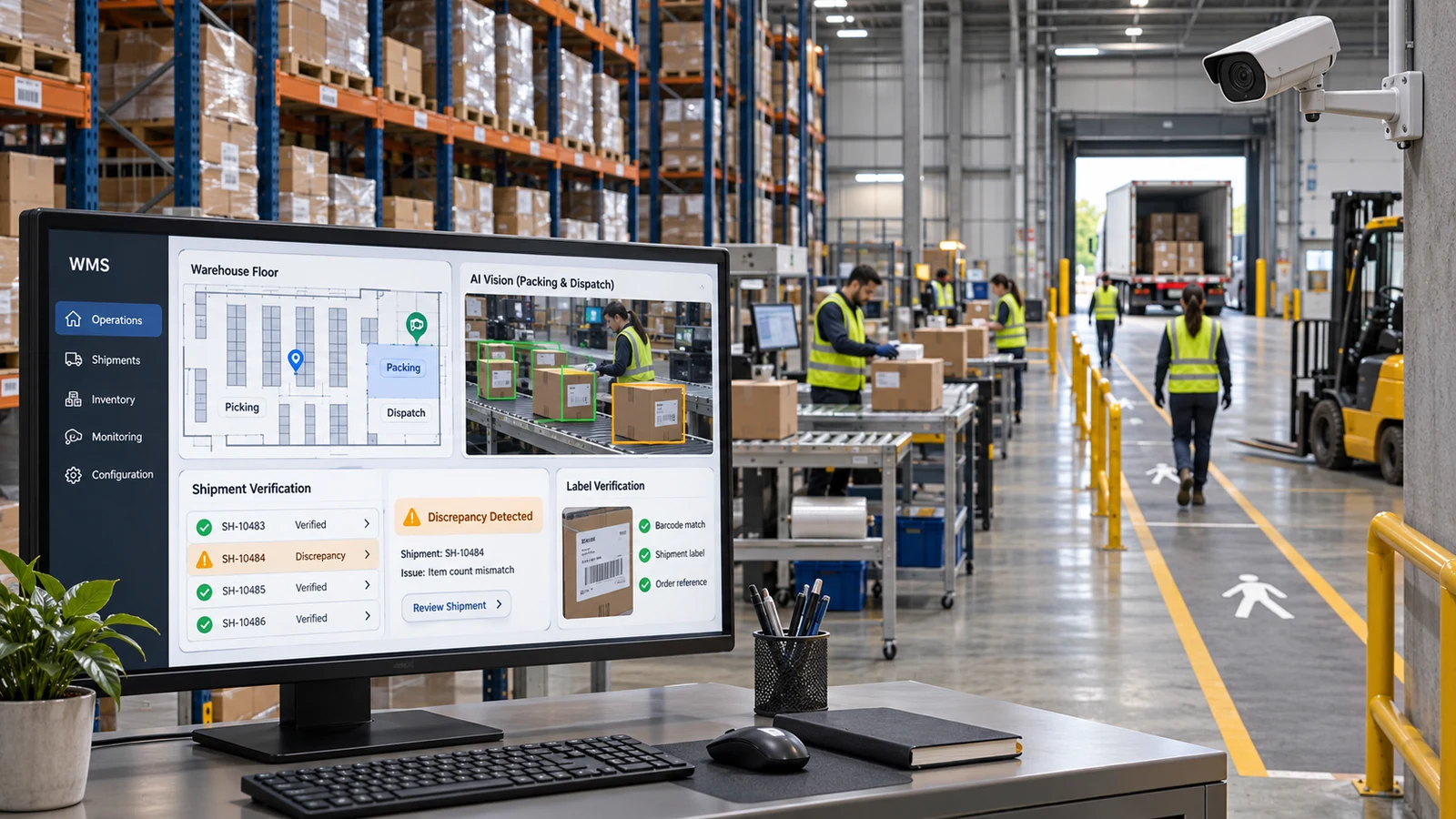
An AI warehouse system connects visual observations with operational records to support loss prevention, shipment verification and faster exception review. FIX Intelligence can support product OCR and abnormal detection at selected warehouse checkpoints.
A carton arrives with fewer products than expected. A pallet leaves through the wrong loading bay. The warehouse management system shows available stock, but the physical count tells a different story.
These discrepancies leave teams searching through transaction records and camera footage. Combining AI vision, optical character recognition (OCR) and warehouse management system (WMS) data can help identify where an investigation should begin.
Why manual scanning leaves operational gaps
Barcode scanning records an item at a particular moment. It provides limited visibility into what happens between scans.
A correctly scanned carton may enter the wrong staging lane. Products may be removed from an open box without an inventory update. A verified pallet may move before dispatch.
AI vision cameras add observation at receiving stations, picking areas and loading docks. Connected to warehouse records, these observations help teams compare expected activity with physical movement.
Manual scanning remains essential. Visual verification adds context where transaction records leave unanswered questions.
How AI warehouse vision works with a WMS
The WMS maintains inventory, location, order and shipment records. A connected vision system supplies observations from monitored areas.
- Capture: Cameras record activity at a defined checkpoint.
- Identify: OCR, barcode reading or computer vision captures relevant identifiers and movements.
- Compare: Integrated software checks observations against expected records.
- Respond: A verified event updates the workflow; a discrepancy creates a review task.
For example, a product code captured at a packing station can be checked against the order being prepared. A mismatch can prompt review before the carton is sealed.
The workflow depends on the integration, camera placement and readability of product information.
Warehouse theft detection AI and asset protection
Warehouse theft detection AI can flag observable events requiring investigation, including restricted-area entry, unexpected exit movements or activity outside scheduled hours.
Configured video analytics scenarios include line crossing, time in area and tailgating detection. These provide specific triggers for review. See the AXIS Object Analytics documentation.
An alert needs operational context. A pallet leaving storage may be part of an authorized transfer. Reviewing footage alongside access records and WMS transactions helps investigators assess the movement.
Small-item loss in convenience store replenishment
Some warehouses open bulk cartons and separate small products for individual convenience stores. These items can be vulnerable to unauthorized employee removal, leaving fewer units in an open box than the WMS records show.
Monitoring picking and repacking stations can document handling activity. Paired with unit-level inventory checks, this evidence helps teams investigate picking errors, unrecorded transfers or theft. Cameras cannot confirm the remaining quantity inside an obscured box.
Retail theft, organized retail crime and illegal dumping
Businesses operating warehouses and stores may use linked incident records to support shoplifting and organized retail crime investigations. Yard monitoring can help staff review suspected illegal dumping near loading bays. Each application needs its own detection rules and investigation process.
Verify shipments before dispatch
At a controlled checkpoint, a suitable system can capture visible identifiers and count qualifying carton movements. Integrated software can compare these observations with the shipment record.
Consider an illustrative shipment requiring 20 cartons. If the process records 19, it can create an exception for a supervisor to investigate before release.
Include the shipment reference, timestamp and relevant images. Reliable counting requires controls for overlapping cartons and repeated crossings. Exterior cameras verify visible characteristics; checking sealed contents requires additional evidence.
Product OCR for more accurate data capture
OCR converts visible text into digital data. Warehouse applications can include product codes, shipment references and suitable label fields.
Machine vision and fixed scanning products support label verification, pack-bench checks and dock-door scanning. See Zebra's machine vision and fixed scanning applications.
FIX Intelligence can support product OCR to capture readable identifiers for comparison with expected product or shipment information. At a repacking station, this can help check whether the visible product code matches the order.
Accuracy depends on lighting, text size, label condition and camera angle. Low-confidence readings should enter a review queue before they affect warehouse records.
Abnormal detection and operational alerts
Abnormal detection works best when teams define the activity requiring attention. Examples include movement through a restricted exit, excessive staging dwell time or handling outside a configured workflow.
FIX Intelligence can support abnormal detection to highlight selected events for review. Scenarios should reflect the facility's layout and procedures.
Each alert should identify the location, timestamp, triggering condition and responsible team. Include relevant footage so staff can assess the event. Unusual movement requires investigation and does not establish theft by itself.
Operational intelligence, tracking and workplace safety
Visual event data can help managers investigate staging delays, loading activity and congestion. Repeated queues at one dispatch lane may justify reviewing its layout or staffing.
Depending on the application, safety monitoring can flag selected visible conditions such as entry into vehicle-only zones or missing hard hats. Supervisors need a clear response process alongside existing inspections, training and physical controls.
Validate operational measurements before using them to change staffing or processes. Tracking across cameras also requires testing where goods become obscured or views overlap.
Automate processes around verified events
A product mismatch can create a packing review task. An unexplained movement can attach footage to an incident. A confirmed shipment match can update a verification status.
Automation should reflect the confidence and consequence of each decision. Creating a record requires different controls from releasing a disputed shipment.
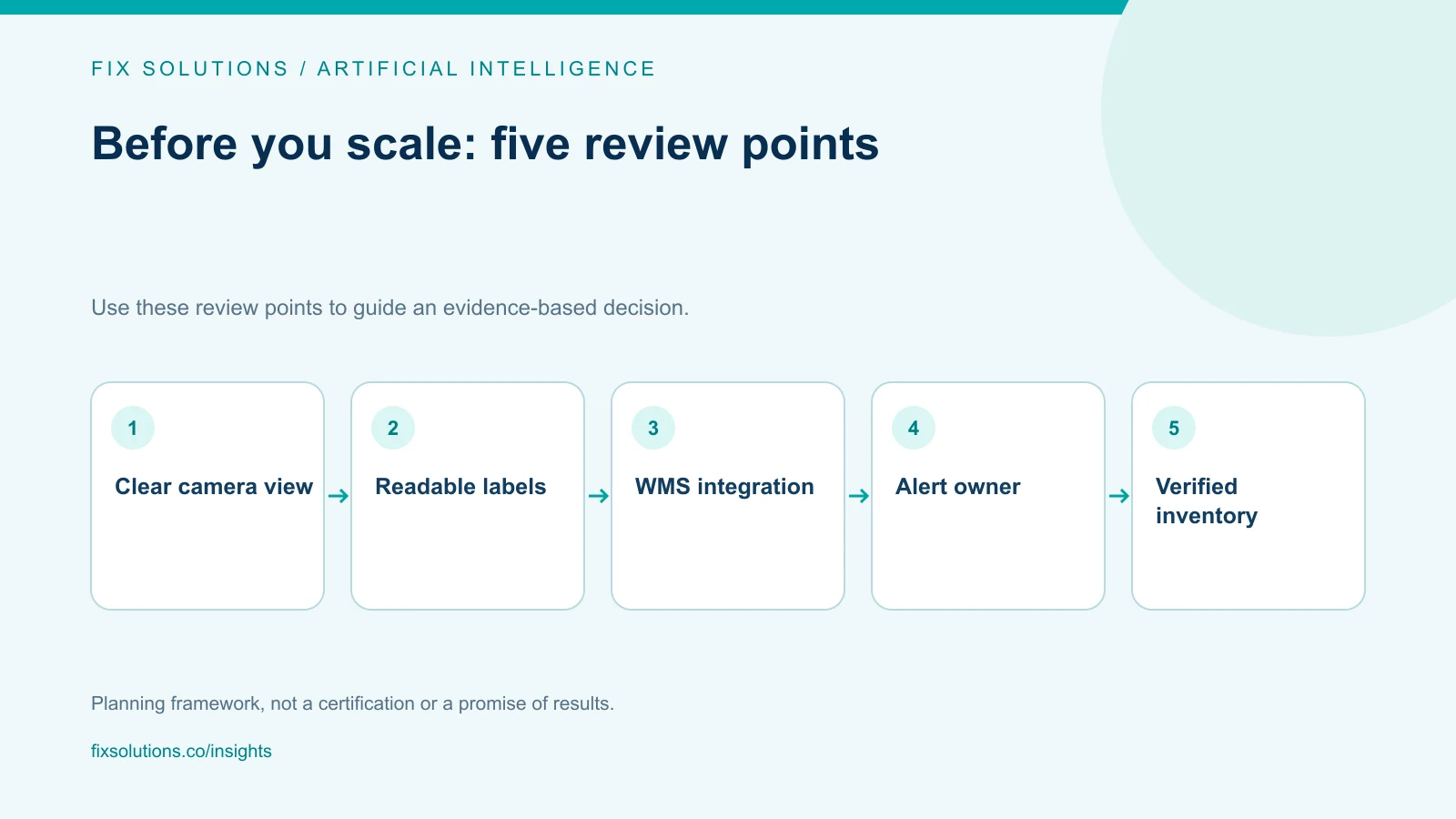
Start with one measurable checkpoint. Track discrepancies found, false alerts, missed events and review time before expanding.
Frequently asked questions
Can AI cameras count small products inside a box?
Only when the products are sufficiently visible and the application supports that task. An exterior view cannot establish quantities hidden beneath other items or inside sealed packaging.
Can FIX Intelligence replace a WMS?
Product OCR and abnormal detection support warehouse monitoring. WMS records remain important for order context, inventory reconciliation and authorized transactions; the integration should define how observations enter those workflows.
Explore warehouse monitoring with FIX Intelligence
FIX Intelligence can support product OCR and abnormal detection for selected warehouse workflows. Combined with inventory checks and an appropriate WMS integration, these capabilities help teams investigate discrepancies and unusual activity.
Bring one recurring problem, such as small-item shortages or dispatch mismatches, to a warehouse AI discussion with FIX Solutions. Define what needs observing, which records should be compared and who will act on exceptions. Explore our AI development services and logistics solutions for related support.