How should an enterprise choose between nearshore and offshore teams?
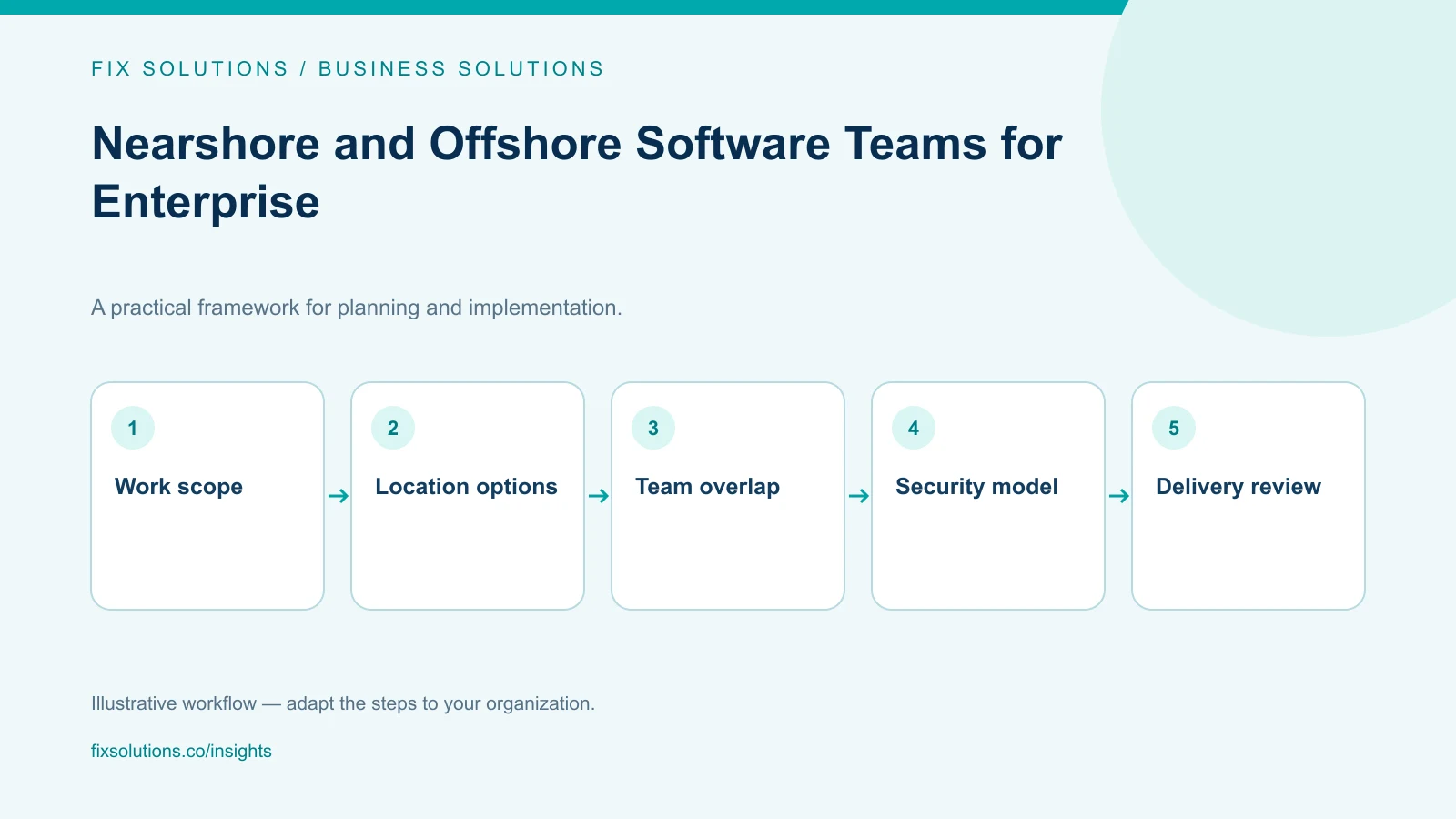
Choose a delivery location by matching the work to collaboration needs, skills, security requirements and continuity—not by rate alone. Nearshore teams can make frequent working-hour collaboration easier; offshore teams can offer access to different talent markets and extended coverage. Either model needs clear ownership, deliberate communication, secure access and a plan for knowledge continuity.
“Nearshore” and “offshore” are relative terms: they describe the distance between the client and delivery team, not a guarantee of quality or savings. A nearby team can still be poorly integrated, while a distant team can deliver effectively when the work is well structured and the collaboration model is designed around the time difference.
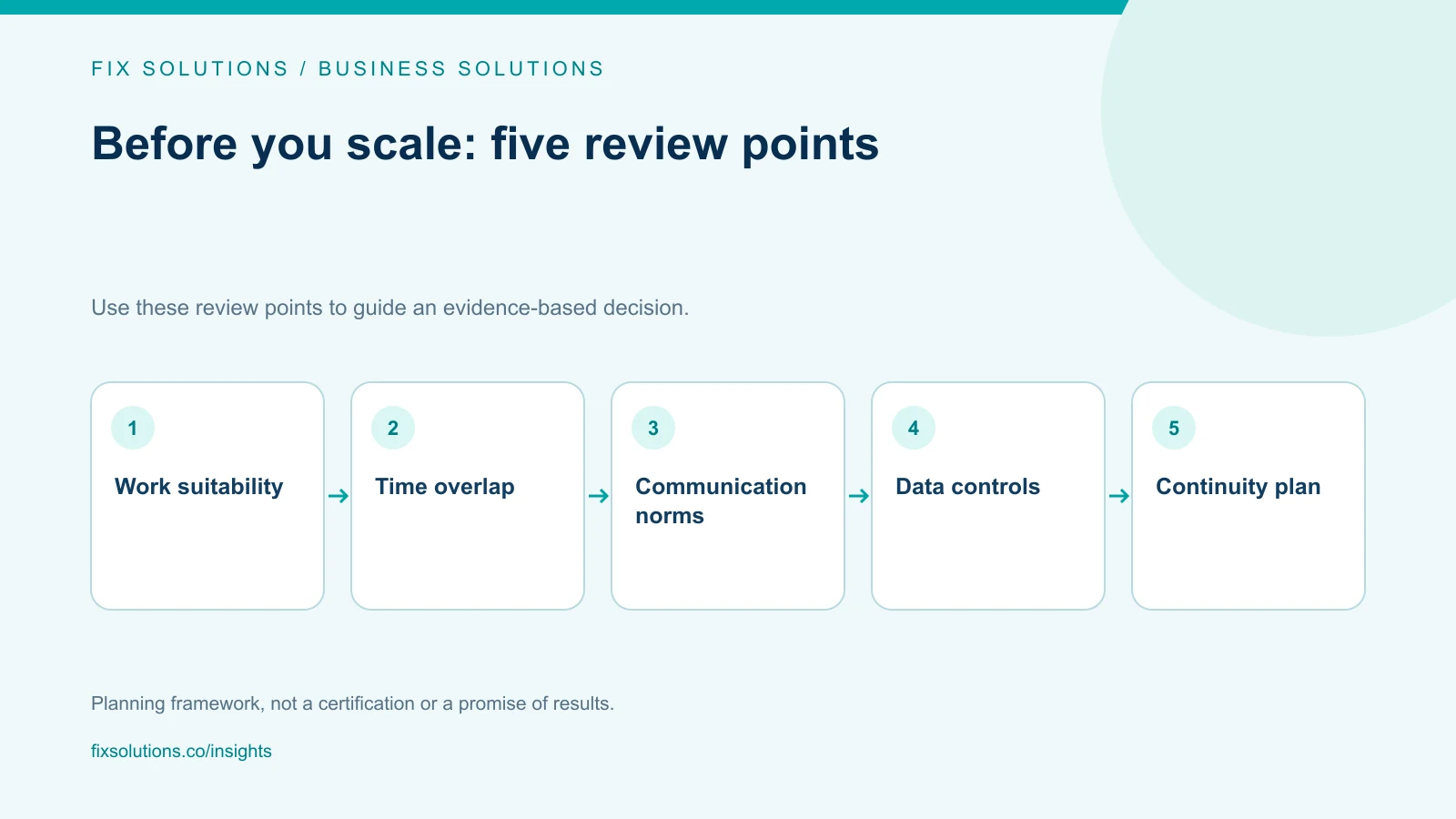
Compare delivery factors that affect day-to-day work
| Factor | Nearshore considerations | Offshore considerations |
|---|---|---|
| Working-hour overlap | Often allows more same-day workshops and reviews | May require planned overlap windows and asynchronous handoffs |
| Talent access | Depends on the regional market and required specialties | Can widen the candidate pool across multiple markets |
| Communication | Real-time collaboration may be easier to schedule | Written context, decision records and handoff discipline become especially important |
| Continuity | Still depends on retention and team structure | Plan for knowledge concentration, turnover and regional holidays |
| Cost | Consider total engagement cost, not just local rates | Account for coordination, travel, compliance and transition costs as well as rates |
These tendencies are not guarantees. Compare specific teams, not generalized assumptions about a country or region. Ask who will actually work on the account, who leads delivery, and how the provider handles staffing changes.
Match the location model to the work
Work that is ambiguous, highly collaborative or dependent on frequent product decisions benefits from accessible decision-makers and overlapping hours. Product discovery, architecture workshops and incident coordination need a reliable route to the people who can clarify requirements or authorize a response.
Work with stable inputs, clear acceptance criteria and well-documented dependencies can be more flexible about location. Examples may include implementing a bounded feature, extending automated test coverage or preparing a migration inventory. Even these tasks require feedback loops; “well-defined” does not mean “no communication.”
Separate work by collaboration pattern rather than assigning a whole department to one geography. A core product team might use a nearshore partner for shared planning and an offshore specialist group for a defined platform capability. This can work if the teams share one backlog, quality practices and engineering leadership rather than operating as disconnected vendors.
Model the actual cost and capacity
Compare total cost of delivery over the engagement. Include rates and fees, internal management, recruitment and onboarding, overlap hours, travel, tooling, data controls, rework, attrition and transition. Estimate the amount of time internal leaders spend clarifying requirements or unblocking work. A lower daily rate may not be a saving if the engagement needs substantially more coordination.
Capacity should be measured as accepted work and reliable capability, not the number of people assigned. Evaluate the provider’s ability to retain a stable team, cover critical roles and ramp responsibly. A plan that scales headcount faster than the enterprise can onboard, review and integrate contributors may increase queueing rather than throughput.
Run a bounded pilot with real work. Agree on a baseline and review cycle, then track delivery predictability, review turnaround, escaped defects, blocked time and stakeholder effort. Treat these measures as signals for discussion, not a simplistic score that ignores task complexity. Record assumptions so leaders can distinguish a location issue from unclear scope, missing access or slow decisions.
Establish collaboration across time zones
Set a small number of reliable overlap hours for decisions that benefit from live discussion. Protect focus time outside those windows. For asynchronous work, specify the information required in a handoff: current status, decision needed, owner, relevant links, risk and next expected update.
Use shared systems as the source of truth. Keep requirements, design decisions, code review, test evidence and incidents in tools accessible to authorized participants. Avoid relying on private messages or recurring meetings to preserve critical context. Use concise written decisions that explain the rationale, not just the conclusion.
Agree on communication expectations early. Define response targets by urgency, who can escalate a blocked dependency, and which events require immediate contact. Account for local holidays and working schedules during release planning. Good distributed teams do not need to be online at all hours; they need predictable handoffs and prompt access to decision-makers when the work requires it.
Secure the delivery environment
Apply the enterprise’s existing information-security and privacy requirements to every location. Determine what data the team needs, where it is stored, who can access it and how access is logged. Use least privilege, managed identities, approved endpoints and monitored repositories. Avoid copying production data into a development environment unless it is explicitly authorized and appropriately protected.
Review contractual, regulatory and customer obligations with the organization’s security and legal teams before transferring data or access across borders. Requirements vary by data type, customer terms and jurisdiction; a vendor’s general assurance does not replace the enterprise’s own assessment.
Include security work in routine delivery: dependency updates, code review, vulnerability handling, secrets management and incident reporting. Define how suspected exposure is escalated and who can disable access. Reassess access when team membership changes, and remove accounts promptly when work ends.
Reduce dependency through shared capability
Keep product ownership and risk acceptance within the enterprise. Pair external contributors with internal counterparts for critical systems, document architecture and operational decisions, and rotate knowledge-sharing sessions around demonstrable tasks. Require the team to show how to build, test, deploy and support its work rather than treating documentation delivery as a final-week checkbox.
Plan for continuity even when the provider promises low turnover. Identify key-person dependencies, maintain current runbooks, ensure more than one person understands critical components, and agree on transition support. Test whether internal staff or another approved team can take over a representative workflow.
Frequently asked questions
Is nearshore always better for collaboration?
No. Time overlap helps with real-time work, but clear ownership, experienced leads and strong written practices matter too. Assess the proposed team and its actual working hours.
Can an offshore team support production systems?
Potentially, if the enterprise approves the access model, support coverage, escalation path and applicable compliance requirements. Production access should be justified by role and tightly controlled.
How long should a pilot run?
Run it long enough to observe normal planning, implementation, review and handoff cycles for representative work. Set the duration and evidence criteria in advance; do not extend a pilot indefinitely because the success conditions were unclear.
Build a global team around shared ownership
Location is one dimension of a delivery system. Clear priorities, secure environments, effective engineering practices and internal capability determine whether a nearshore or offshore arrangement is sustainable. FIX Solutions can help assess delivery scope and team integration through IT development services.