How can an enterprise scale a software team and retain ownership?
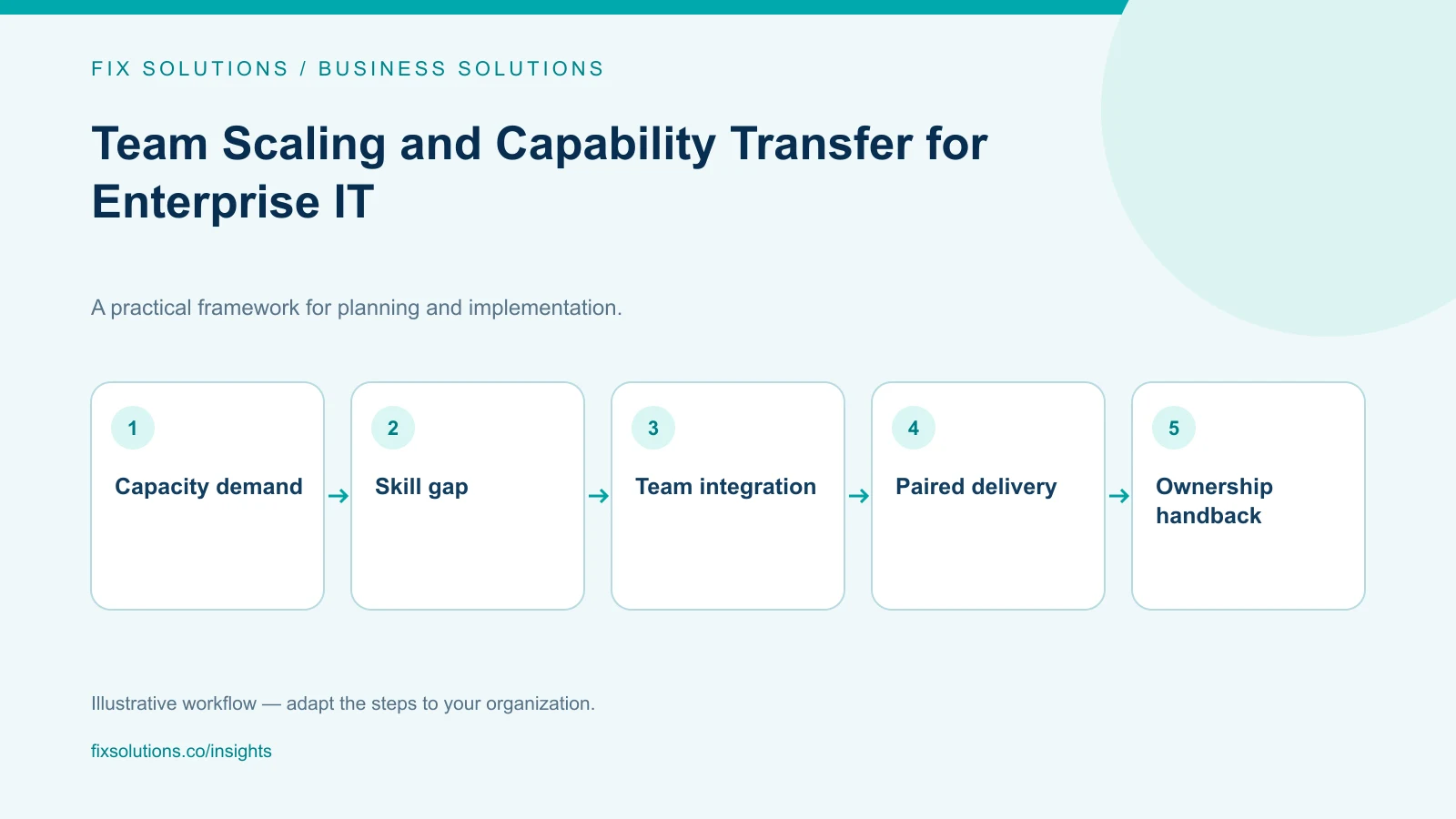
Scale capacity against a specific capability gap, then build knowledge transfer into everyday delivery from the start. Assign internal counterparts, share real work, document decisions in company-owned systems and test whether the in-house team can perform critical tasks. A handover is complete when the receiving team can operate the capability—not when a document is delivered.
External specialists can help a team respond to a temporary delivery peak, add a scarce skill or accelerate a modernization effort. The risk is that added capacity becomes a permanent dependency because architecture decisions, operating knowledge and relationships remain concentrated outside the enterprise. A deliberate transfer plan makes scale reversible and develops the internal team.
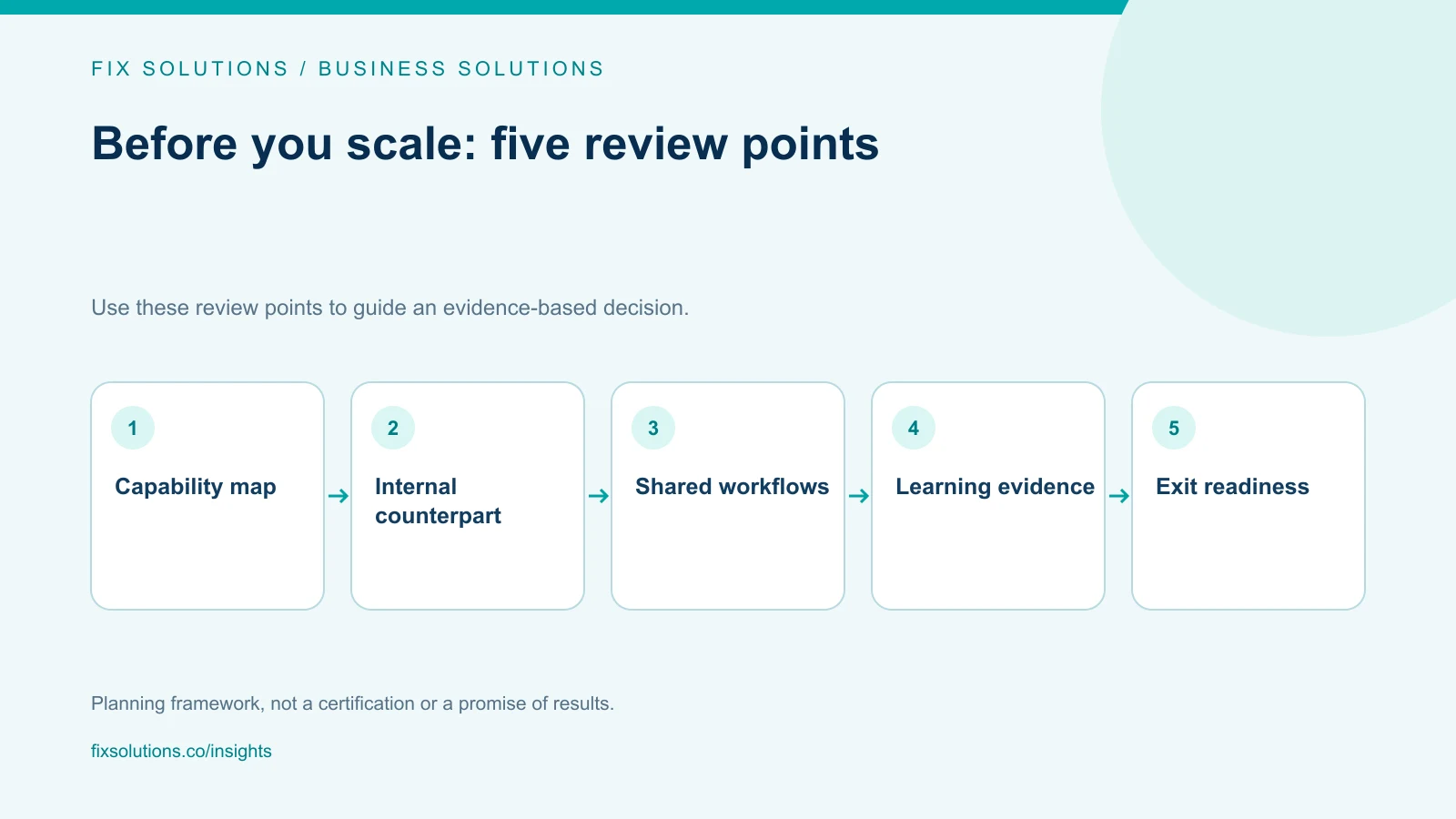
Start with a capability map
Describe the need in terms of work the organization must perform. “We need more developers” is not enough to determine whether the gap is product engineering, cloud operations, test automation, data integration or technical leadership. Map current responsibilities, skills, coverage and ownership against the outcomes the team must deliver.
Separate temporary demand from enduring capability. A migration may require a temporary increase in platform expertise, while the resulting service still needs internal operational ownership. Conversely, an ongoing specialized function may be a candidate for hiring, a managed service or a long-term partnership. Make that choice explicit rather than allowing a short-term contract to decide it by default.
Define what the receiving in-house team should be able to do. Examples include configuring a deployment, diagnosing a production issue, extending a regression test, updating an integration mapping or reviewing a model evaluation. Concrete tasks are easier to teach and verify than broad statements such as “understand the platform.”
Integrate external specialists into normal work
Use the same backlog, repositories, communication channels and review standards as internal staff where appropriate. Give every external role a named internal counterpart with enough time and authority to participate. Pairing should happen on real work: design a component together, review a change together, and later let the internal counterpart lead a similar task.
Create a predictable onboarding path. Explain the business domain, architecture, development environment, data classifications, release process, incident procedures and decision rights. Provide approved access only after the required training and approvals. A person who cannot build or run the system safely will struggle to produce useful work regardless of technical skill.
Protect internal time for mentorship and review. If the in-house team is already at full capacity, knowledge transfer will be displaced by urgent delivery. Include pairing, walkthroughs and operational exercises in the plan rather than expecting them to happen “when there is time.”
Transfer knowledge through repeated practice
Use several complementary methods:
- Pair on implementation. Alternate driver and reviewer roles so knowledge is not limited to watching one person work.
- Record decisions. Keep architecture decisions, assumptions and rejected alternatives in searchable company-controlled documentation.
- Maintain operational guides. Document prerequisites, safe procedures, expected outcomes, recovery steps and escalation ownership.
- Run demonstrations. Ask the delivery team to show how to build, test, release and troubleshoot a representative workflow.
- Reverse the roles. Have internal staff complete a task while external specialists observe and coach.
Documentation supports transfer but cannot replace practice. A runbook may be technically accurate and still fail to explain what to do when an unfamiliar alert occurs. Test it with someone who did not write it, and update it when the real procedure differs from the written one.
Measure transfer as demonstrated capability
Agree on evidence before work begins. For each critical capability, define a representative task and an acceptance condition. For example, an internal engineer can deploy a change to a non-production environment, explain the required approvals and identify the rollback route. An internal QA lead can update an automated test and interpret its failure evidence.
Review progress during normal delivery. Track whether internal staff can take on more of the relevant tasks, whether operational questions are being answered through shared documentation, and whether the team can resolve routine issues without a provider escalation. Do not equate attendance at training with proficiency.
Keep measures proportionate. A capability matrix with a few well-defined tasks may be more useful than a complex skills score. Include qualitative review from the people who will own the system. If progress stalls, investigate whether the work is too restricted, the counterpart lacks time, access is delayed or responsibilities are unclear.
Plan the transition before scaling
Define handback triggers when the engagement is scoped. A transition may follow a calendar date, completion of a milestone, successful operational exercises or a decision to change the sourcing model. Establish which deliverables, access changes, support windows and open risks apply to each scenario.
Maintain enterprise ownership of repositories, cloud accounts, CI/CD configurations, test environments and technical documentation. Avoid provider-only credentials or systems that make a clean transition impossible. Ensure the organization can access source history, build instructions, dependency records and known issue lists.
Before exit, rehearse a realistic handover: in-house staff run a release, handle a known failure, and explain how to request assistance. Transfer open work with status, decisions, dependencies and risk—not just a backlog of tickets. Remove or reduce access according to policy, confirm monitoring ownership and schedule follow-up support if needed.
Common failure modes
Treating transfer as a final-week activity leaves too little time to practice. Start with an ownership plan and repeat it throughout delivery.
Hiring external people without internal counterparts can accelerate implementation while concentrating knowledge. Reserve in-house participation as a delivery dependency.
Measuring headcount instead of capability rewards staffing volume. Measure accepted outcomes and the ability of the receiving team to maintain them.
Letting documentation drift creates confidence without operational readiness. Review guides alongside code and test them during handover exercises.
Frequently asked questions
Does knowledge transfer slow delivery?
It takes planned time, but the cost should be compared with future support, rework and transition risk. Pairing can also improve design review and reduce misunderstandings during delivery.
Should every team member have an internal counterpart?
Every critical responsibility should have an identified internal owner. The exact pairing structure can vary, but an organization should not leave essential system knowledge with one external individual.
How do we know when ownership has transferred?
Use practical acceptance: the in-house team can perform representative build, release and support tasks using approved access and current documentation. Agree on the evidence appropriate to each system.
Scale with a clear path back to in-house ownership
Flexible capacity is most valuable when it strengthens the enterprise’s ability to deliver after the engagement changes. Map the capability gap, integrate partners into real workflows and verify transfer through practice. FIX Solutions can scope team augmentation and structured handback through IT development services.