What is the difference between staff augmentation and managed software services?
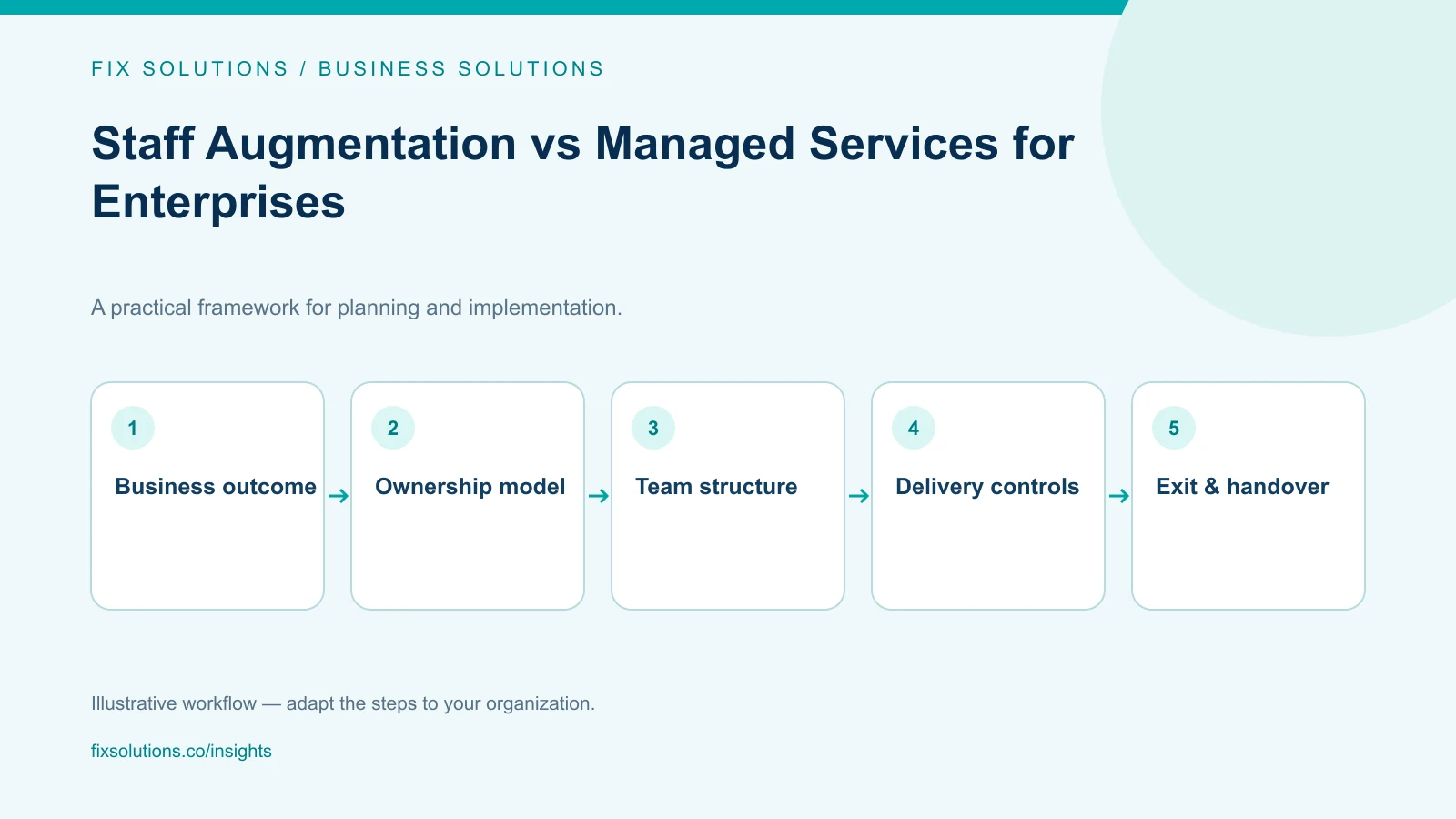
Staff augmentation adds external specialists to a client-directed team; managed software services assign a provider responsibility for a defined service or outcome. Choose based on the ownership your organization can retain, the outcome you need, and the level of delivery governance you can support. The contract label matters less than who makes day-to-day decisions, accepts work and resolves risk.
Enterprises often use both models at once. An internal product group may add a cloud engineer for a migration, while a separate provider owns a test automation service with agreed service levels. Treat sourcing as an operating-model decision, not a contest between “flexible” and “hands-off” vendors.
Compare the operating models
| Dimension | Staff augmentation | Managed software services |
|---|---|---|
| Day-to-day direction | Usually led by the client | Usually led by the provider within agreed boundaries |
| Primary purchase | Individual capacity and skills | A defined service, capability or outcome |
| Client responsibilities | Priorities, task assignment, integration and acceptance | Product context, access, decisions, governance and outcome oversight |
| Provider responsibilities | Supplying qualified people and supporting their employment | Staffing, delivery practices, quality controls and service performance |
| Typical fit | A known team needs temporary or specialist capacity | A function needs repeatable delivery or operational ownership |
These are common patterns, not universal contract definitions. Confirm actual responsibilities in the statement of work, security terms, delivery plan and escalation process. A “managed” contract that leaves priorities, quality ownership and operational support undefined may behave like staff augmentation with extra administration.
When staff augmentation is a good fit
Augmentation can work when the enterprise already has a product owner, engineering leads and an established backlog, but lacks capacity or a specific skill. Examples include adding a platform engineer during a migration, bringing in an automation specialist to improve a test suite, or temporarily increasing development capacity for a committed release.
The client needs to provide meaningful work, timely decisions, development environments, access approvals and technical direction. Without those inputs, additional people may wait for access or create work that does not match product priorities. Before onboarding, name the internal person who will review contributions and explain how the new team members will work with security, architecture and operations.
Augmentation is not automatically cheaper or lower risk. Recruiting, onboarding, management time, coordination across time zones and retention of system knowledge all contribute to total cost. Calculate the cost of the full working arrangement, not only the hourly rate.
When managed services are a better fit
A managed service is appropriate when an organization needs an ongoing capability with defined boundaries and service expectations. Examples might include maintaining a set of integrations, operating a quality engineering function, or delivering a clearly scoped application support service.
The organization still needs to define what “done” means, provide domain and system context, approve consequential changes and monitor outcomes. The provider can own execution without owning the company’s product strategy, regulatory obligations or business decisions. Establish measurable service indicators that reflect user outcomes—for example, agreed response windows, defect escape review or release readiness—not simply activity counts.
Decide using outcomes, not labels
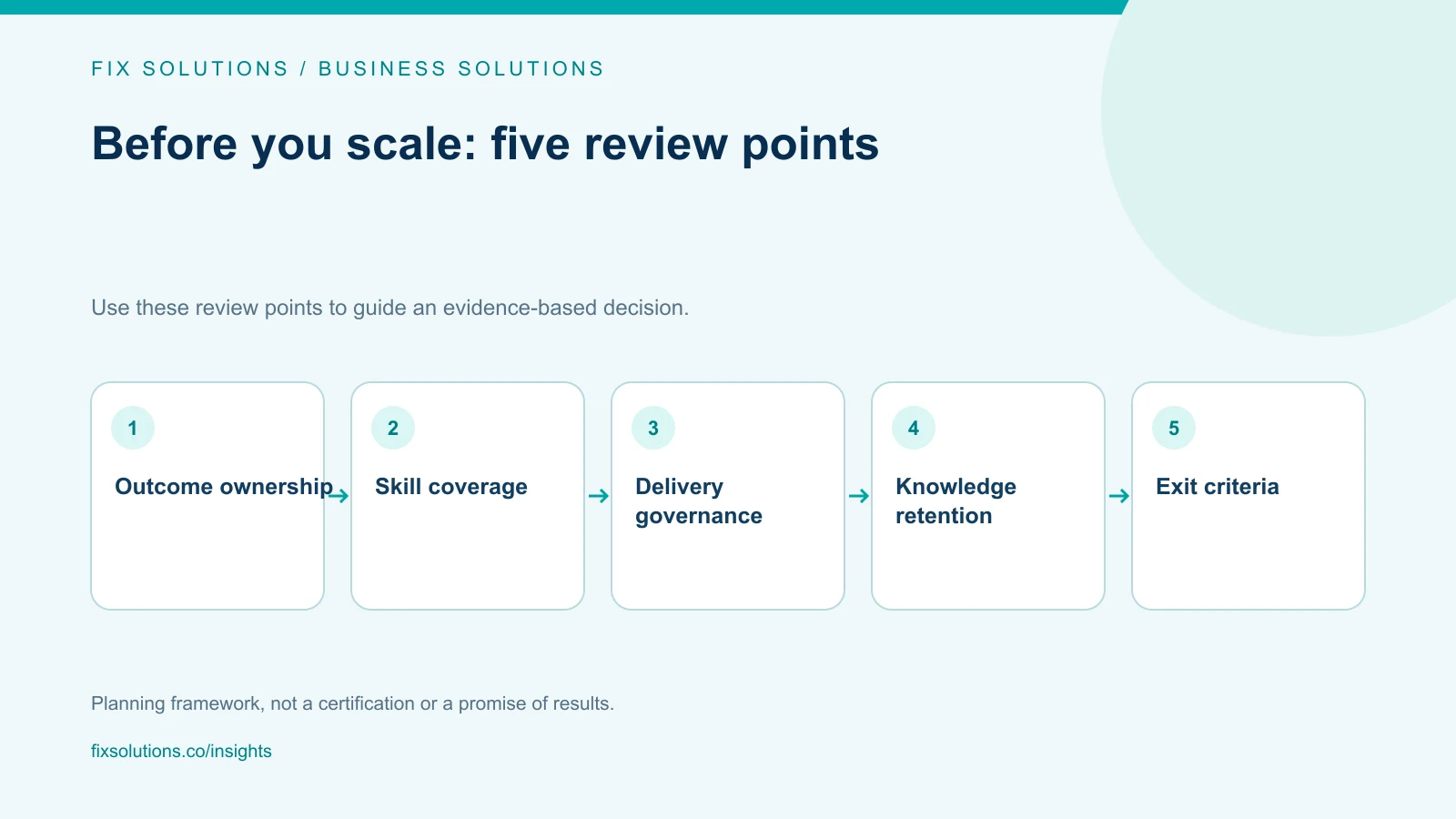
Start with five questions:
- Who owns the result? Identify the role accountable for business acceptance and the role accountable for technical quality.
- How stable is the scope? A changing product backlog may favor embedded capacity; a repeatable service may support outcome-based ownership.
- Which skills are scarce? Distinguish temporary specialist needs from a persistent capability gap that deserves hiring or internal development.
- How much direction can the client provide? Augmentation needs an engaged client lead. A managed service still needs a capable service owner.
- How will knowledge and access be handled at exit? Require documentation, credential revocation and transition support in either model.
Score candidate models against delivery speed, operational risk, total cost, continuity and reversibility. A short pilot can test assumptions, but define its scope and exit criteria before work starts. A pilot that has no production-quality expectations or transfer plan can prove that a team can build a demo without proving the sourcing model will work.
Design contracts and governance around the real work
Document decision rights: who prioritizes, approves architecture exceptions, accepts releases, responds to incidents and authorizes production access. Define ownership of source code, test assets, documentation, build pipelines and work products. Ensure the contract matches the organization’s privacy, security, data-handling and audit requirements.
Set a joint operating cadence that is useful rather than ceremonial. Weekly delivery reviews can surface blocked decisions; periodic service reviews can examine trends, incidents and improvement work. Provide a route for urgent escalation and an agreed way to change scope. Require reporting that shows work accepted, quality signals, dependencies and unresolved risks.
Plan for capability retention and transition
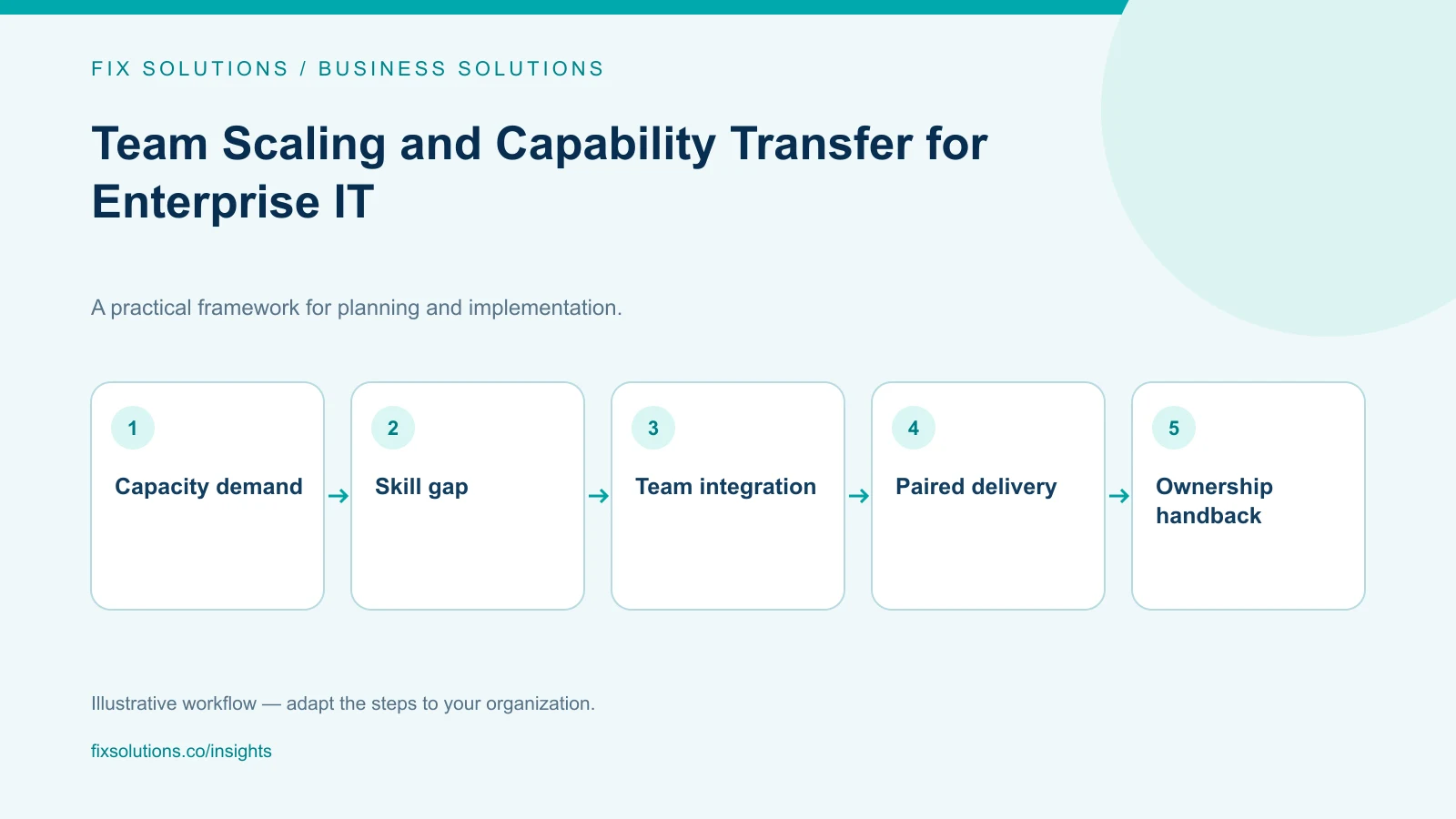
External capacity should strengthen the organization, not make it dependent on undocumented knowledge. Pair external specialists with internal counterparts, store decisions in the organization’s systems, and include walkthroughs in normal delivery. Identify the capabilities that must remain in-house—such as product ownership, architecture decisions, risk acceptance and vendor oversight.
At the end of an engagement, use a checklist: confirm repositories and runbooks are current, demonstrate that internal staff can execute critical workflows, transfer open work and known risks, remove unnecessary access, and resolve outstanding operational ownership. For a managed service, include a service transition plan and practical acceptance tests. For augmentation, make knowledge sharing part of the team’s working agreements.
Frequently asked questions
Can an enterprise combine the two models?
Yes. The models can coexist when interfaces and decision rights are explicit. For example, an augmented engineer may join an internal product squad while a provider separately operates a bounded testing service. Avoid overlapping accountability for the same production outcome.
Which model gives the client more control?
Augmentation usually gives the client more direct task direction, while a managed service gives the provider more control over execution. Neither removes the need for client governance, product decisions and risk oversight. Confirm control in the actual contract.
How should we compare costs?
Include onboarding, internal management, provider coordination, quality assurance, continuity, transition and operational support. Compare the total cost of achieving the outcome, then consider risk and reversibility alongside price.
Choose the model that preserves clear ownership
The best sourcing arrangement makes accountability visible, gives the team the information it needs, and keeps critical knowledge available to the enterprise. Define the outcome and operating boundaries first; select augmentation, managed services or a deliberate combination second. FIX Solutions can help scope an enterprise software engagement and its knowledge-transfer expectations through IT development services.