Alphabet’s market-value shock is not proof that Google Search is disappearing. It is a warning that the economics of search are changing. For businesses, the priority is not to abandon SEO, but to make their expertise discoverable, credible and useful across traditional search and AI-generated answers.
For years, the digital growth playbook seemed straightforward: rank on Google, attract visitors and convert them into customers.
That playbook still matters. But it no longer describes every step of the buying journey.
Customers can now ask an AI system to explain a problem, compare solutions and suggest providers before visiting a company’s website. For CEOs and marketing leaders, this creates a new concern:
What happens when your potential customer receives an answer—but your business is not part of it?
Did Google Really Lose $500 Billion Because Search Revenue Fell?
The distinction matters.
During trading on October 29, Reuters reported that Alphabet was on track to lose more than $500 billion in market value as investors reacted to disappointing search advertising results and rising AI-related spending. That figure described an intraday change in the stock market’s valuation—not lost sales or cash disappearing from the business. Reuters reporting
Google’s own Q3 2026 earnings communication reported 12% year-over-year growth in Search and other advertising revenue, alongside increased search usage. It also described a growing role for AI-powered, conversational and multimodal search experiences. Google’s Q3 2026 earnings remarks
These facts can coexist:
- Search revenue can grow while disappointing investor expectations.
- AI adoption can increase usage while changing monetization.
- A company can remain commercially strong while its share price falls sharply.
The business lesson is therefore more useful than “Google is dying.”
A search platform’s growth does not guarantee that your company will remain visible within it.
Why Does This Matter to Businesses Outside Big Tech?
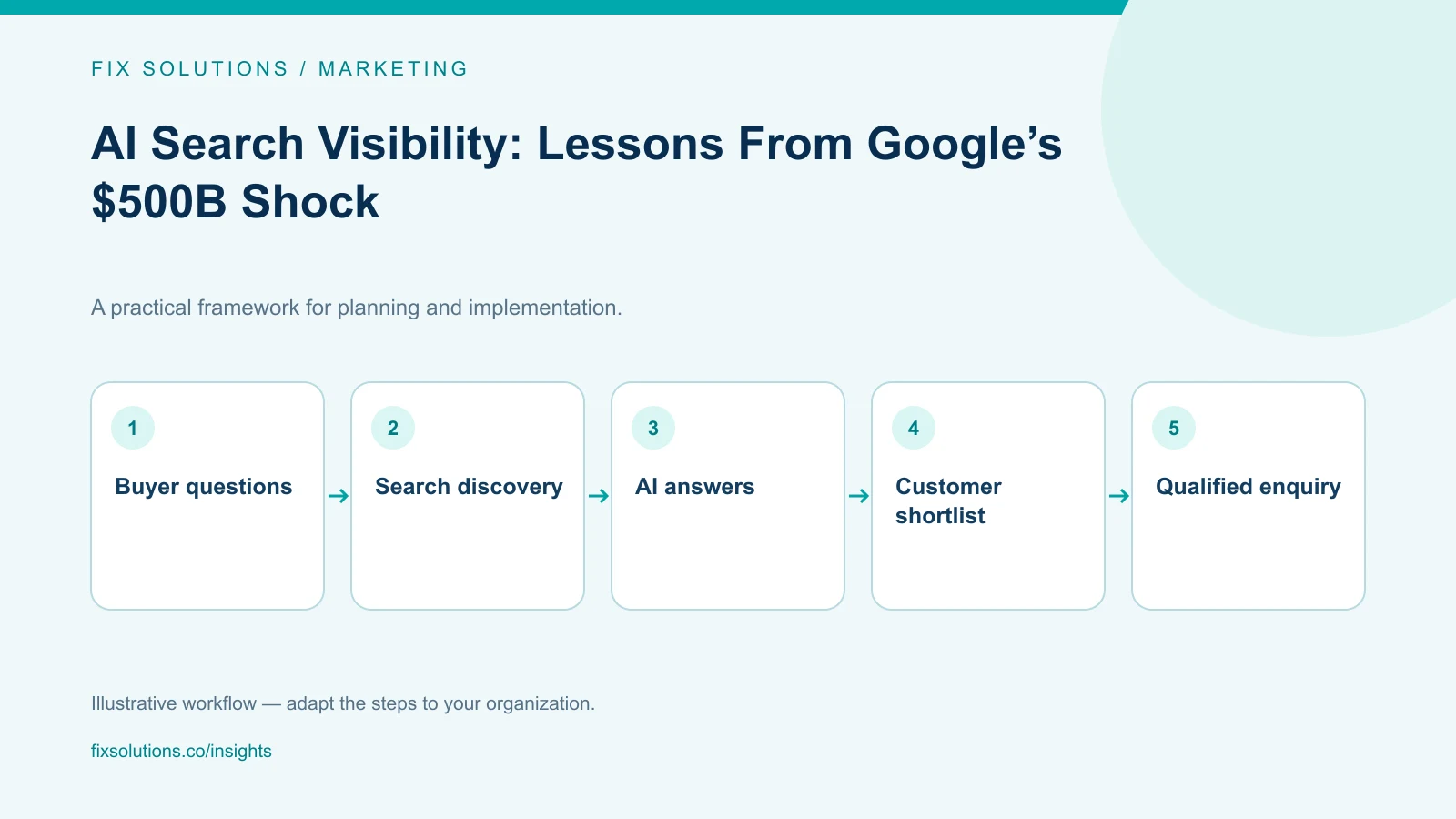
Our interpretation is that the strategic risk lies in where customers form their shortlist.
Consider a buyer researching an HR platform. Instead of starting with a short keyword, they might ask:
“What should a 200-person company consider when replacing spreadsheet payroll with an HRM system that integrates with its ERP?”
That question contains business context, requirements and implementation concerns. A generic page saying “we provide innovative HR solutions” offers little help.
A more useful page explains:
- Which operational problems the software addresses.
- What integrations require.
- How deployment options differ.
- What a pilot should test.
- Which limitations or dependencies buyers should consider.
The opportunity is to answer the questions that shape a purchase—not merely repeat the keywords associated with it.
Three Insights CEOs and Marketing Leaders Should Act On
1. Visibility Is More Than a Ranking Position
A business can rank for selected keywords without being mentioned in the answers its customers use to compare vendors.
Conversely, an AI answer might reference a company without generating an immediate website visit.
That means marketing teams need to distinguish between:
- Search visibility: whether relevant pages appear in search results.
- Answer visibility: whether the brand or its content appears in sampled AI responses.
- Commercial impact: whether those interactions contribute to qualified enquiries and sales.
These measures are related, but they are not interchangeable.
A citation is not a lead. A ranking is not a sale. Both need a path to conversion.
2. Clear Evidence Is More Useful Than More Generic Content
Publishing more pages is not automatically a better strategy.
Before commissioning another broad article, ask whether your existing service and product pages provide enough information for someone to evaluate your business.
Can a prospective customer understand your delivery process? Can they identify the industries you support? Can they distinguish verified experience from marketing claims?
A practical content programme should prioritise:
- Specific explanations of services and use cases.
- Clear comparisons and decision criteria.
- Documented project evidence, where publication is authorised.
- Named expertise and transparent authorship.
- Accurate company, product and contact information.
- Honest descriptions of scope, dependencies and limitations.
These improvements help human buyers assess credibility. They also make your content easier to interpret when discovered through search.
3. AI Visibility Requires Implementation, Not Just a Strategy Deck
A content recommendation has limited value if the website cannot deliver it reliably.
An audit might identify useful material that is difficult to discover, important pages excluded from indexing, inconsistent company information or landing pages that fail to convert.
Addressing these issues can require coordination between marketing, content, development and analytics.
The goal is not simply to produce an “AI-ready” report. It is to implement changes that make the business easier to find, understand and contact.
Does AI Search Replace Traditional SEO?
No. For Google’s AI Overviews and AI Mode, Google explicitly says existing SEO fundamentals remain relevant. Pages must be indexed and eligible to appear with a search snippet to qualify as supporting links. There is no special AI schema or additional machine-readable file required, and inclusion is not guaranteed. Google Search Central guidance
The practical approach is to strengthen the foundation while expanding how you evaluate discovery.
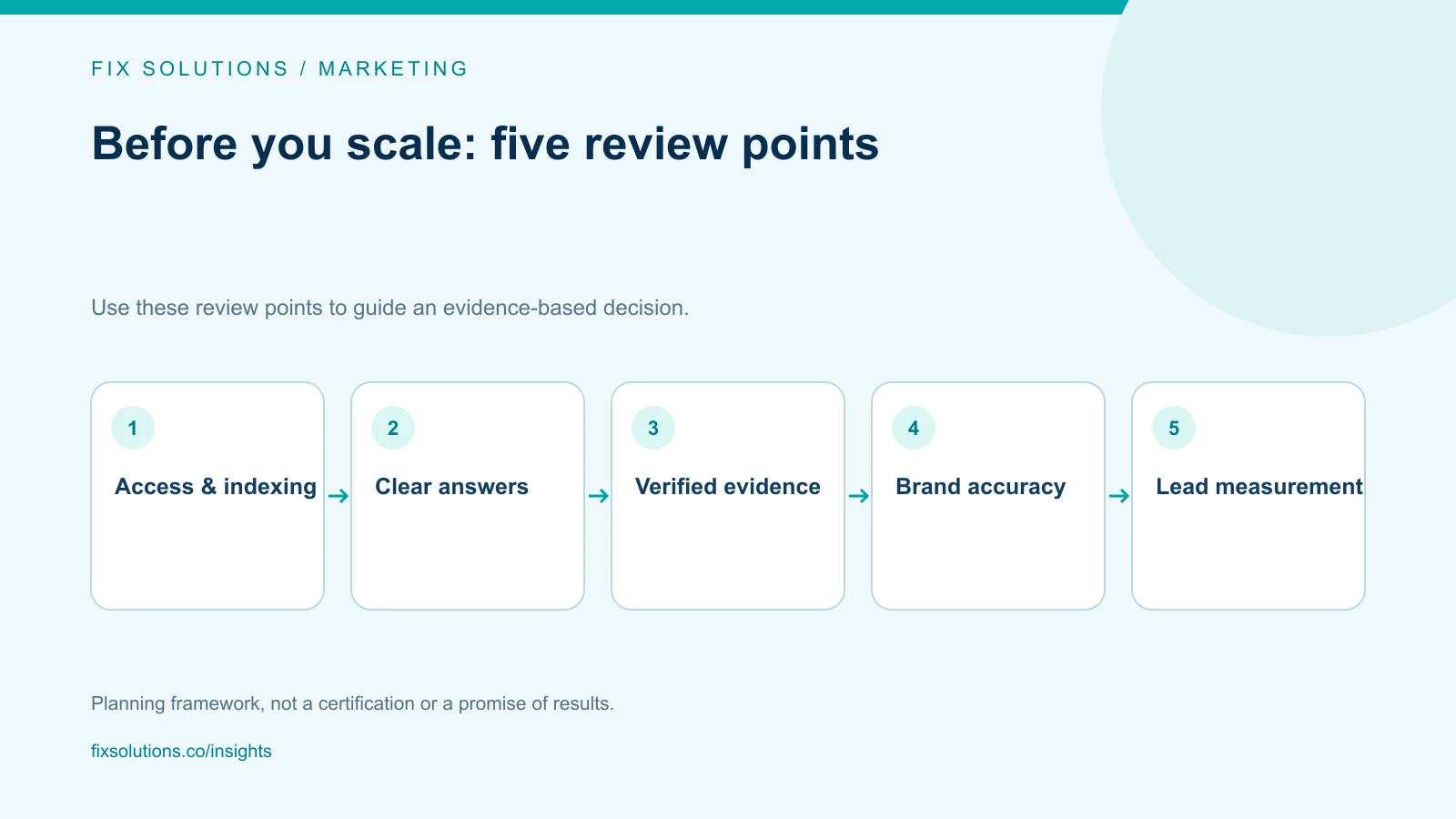
| Business question | What to review | Practical action |
|---|---|---|
| Can people and search systems find our pages? | Crawl access, indexing and internal links | Resolve access issues and improve navigation |
| Is our offering easy to understand? | Product details, use cases and scope | Replace vague claims with concrete explanations |
| Can buyers assess our credibility? | Evidence, authorship and company information | Publish accurate, verifiable supporting material |
| Do relevant answers mention us? | A defined sample of buyer questions | Record mentions, citations and factual accuracy |
| Does visibility create demand? | Landing pages, enquiries and lead quality | Improve CTAs and connect measurement to the CRM |
“Generative Engine Optimization,” or GEO, is a useful label for work around AI-mediated discovery. It should not be presented as a secret shortcut or a replacement for a sound website.
What Should an AI Search Visibility Programme Measure?
Start with a baseline before promising improvement.
A practical evaluation combines three layers.
Discovery
Track relevant organic landing pages, search queries and indexing coverage. Identify which topics already bring qualified visitors and where important pages remain difficult to find.
Answer Presence
Build a defined set of questions based on real buying conversations. Sample responses across relevant platforms, recording the date, language, market and sources shown.
Measure whether your company is mentioned, whether your pages are cited and whether the description is accurate.
Treat this as a sampled visibility study—not a universal ranking. Answers can vary between runs and contexts.
Business Outcomes
Track enquiries, consultation bookings, qualified leads and subsequent opportunities. Where possible, connect website activity with CRM outcomes and ask prospects how they discovered the business.
Avoid treating all direct traffic or unexplained leads as AI-generated demand. Attribution will have gaps, and those gaps should be acknowledged.
How FIX Solutions Helps Businesses Improve AI Search Visibility
FIX Solutions can support both the consulting and implementation work needed to build a more discoverable digital presence.
The engagement starts with your customers, commercial priorities and current website—not a promise to place your brand inside every AI answer.
1. Assess the Current Visibility Gap
We review priority services, customer questions, website structure and available performance data.
The objective is to identify where the business is difficult to discover, where its offering is unclear and where existing content does not support buying decisions.
Output: a prioritised assessment with evidence, dependencies and recommended actions.
2. Build a Search and Content Roadmap
We map high-value questions to the pages best suited to answer them.
Depending on the business, this may include service pages, industry use cases, comparison guides, implementation articles or product explanations.
Output: a content and website roadmap tied to relevant services and conversion goals.
3. Implement the Improvements
FIX can help execute the agreed work, including:
- Technical SEO corrections.
- Website and landing-page improvements.
- Clearer content structure and internal linking.
- Accurate structured data aligned with visible content.
- Conversion forms and consultation CTAs.
- Analytics and CRM integration within the agreed scope.
Output: implemented changes that can be tested and reviewed—not recommendations left in a document.
Explore our marketing services and IT development support to connect strategy with delivery.
4. Measure, Learn and Refine
We evaluate visibility alongside lead quality and commercial relevance.
The purpose is to understand which topics and pages deserve further investment, rather than expanding content volume without evidence.
No agency can guarantee selection, citation or recommendation by an AI platform. The commitment should be to sound implementation, transparent measurement and continuous improvement.
Frequently Asked Questions
Should we stop investing in Google SEO?
No. Maintain the foundations that support discovery, then expand your content and measurement to account for AI-assisted research. Moving the entire budget based on a stock-market headline would confuse a financial event with your own customer acquisition data.
Can FIX guarantee that ChatGPT or Google AI will recommend our company?
No. FIX can help improve discoverability, content clarity, technical accessibility and conversion paths. Selection and presentation remain controlled by the platforms.
Do we need to rebuild our website?
Not necessarily. Some businesses need targeted corrections and stronger service content. Others need structural changes or integration work. An initial assessment should establish the scope before recommending a rebuild.
Your Customers Are Changing How They Search. Can They Still Find You?
Alphabet’s market shock is a headline. Your business’s ability to remain discoverable is an operational decision.
The right response is neither panic nor another round of generic AI-generated articles.
It is to understand what buyers ask, publish information they can evaluate, remove technical obstacles and create a clear next step when they are ready to engage.
FIX Solutions helps businesses connect AI search visibility strategy with practical website, content and marketing implementation.
Book an AI Search Visibility Consultation
Share your website, target market and priority services. Let’s identify what needs to change—and build a practical plan to implement it.