How can bilingual marketing operations help a Vietnamese-American business?
Let the owner communicate in the language and format that is easiest, then turn the request into an approved, accurate campaign through a documented workflow. A voice message in Vietnamese can be a useful brief; it still needs a written confirmation of offer, dates, availability, service area and customer action. Assign language reviewers, agree on turnaround times rather than assuming overnight delivery, and keep advertising accounts and final approval under the business’s control.
A salon owner may be between appointments; a restaurant manager may be overseeing a lunch rush. Writing a detailed English marketing brief can feel like an extra administrative job. A quick voice message in Vietnamese through Zalo, Viber or another familiar channel may be a more natural way to explain a daily special, holiday promotion or new service.
The agency or marketing team still needs to convert that initial idea into clear customer-facing copy. Translation alone is not enough: the team must confirm what is included, when the offer applies, whether the business can fulfill it and which booking or ordering action to use. A bilingual operation can save effort when it creates a reliable bridge from owner knowledge to accurate English-language advertising—not when it removes the owner from the decision.
Language preferences vary among business owners, families and customers. Some owners may prefer Vietnamese for operational details and English for written confirmation; others use both comfortably. Ask each person how they want to communicate rather than assuming a preference from their name, age or background.
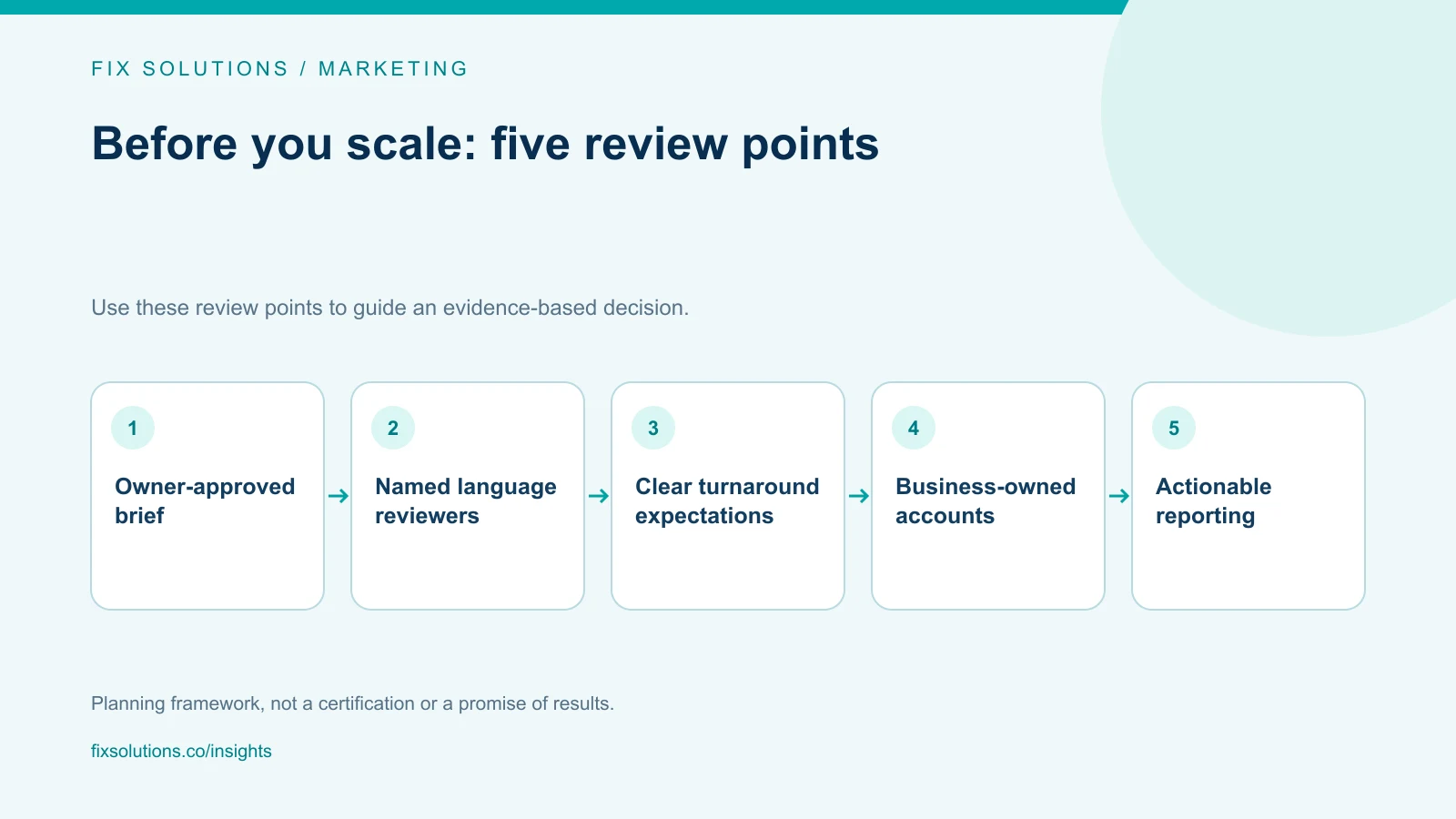
Start with a simple brief owners can send by voice
A useful voice brief can be short if it answers the same essential questions every time. Ask for:
- What is being promoted? A named service, menu item, event or business update.
- Who is it for? Existing customers, new customers, a particular service area or a defined group.
- When does it apply? Start and end date, operating hours, blackout dates and capacity.
- What must customers do? Call, book online, visit, order or use a clearly explained code.
- What must not be promised? Exclusions, limited quantities, unavailable services or price details.
An owner can send a Vietnamese voice note in the agreed business channel. The receiving marketer creates a written summary in the owner's preferred language or languages and reads back the essential terms for confirmation. Confirm numbers explicitly: a price, date or percentage is easy to mishear and costly to publish incorrectly.
Example confirmation
Owner's voice note: “Promote the weekend manicure offer. Start Friday and run while appointments are available. Mention online booking. Do not promise that walk-ins can get the discount.”
Written confirmation for approval: “Friday through Sunday, subject to appointment availability. The promotion applies to advance bookings for the named manicure service only; walk-ins are excluded. Book through [approved link]. Please confirm the price, service duration, location and end date before we create the English ad.”
This example is illustrative. The real campaign needs the actual business's terms, not copied placeholder details.
Make bilingual review a defined responsibility
Decide who is responsible for each step. The owner supplies accurate facts and approves the offer. A Vietnamese-language reviewer checks meaning and nuance where Vietnamese copy is used. An English-language editor reviews the published creative for clarity and local tone. A campaign manager checks targeting, links, schedule and platform policy. One person may hold more than one role, but the responsibilities should remain visible.
Do not treat “native speaker” as a quality guarantee. Dialect, regional phrasing, formality and customer expectations vary. Give the reviewer a description of the business, desired tone, approved terms and words that should remain unchanged. Preserve both the source brief and approved copy so a later revision does not drift from the original intent.
For English ads, check the business name, prices, address, hours, availability and destination. Avoid unsupported claims about health, beauty results, rankings or customer outcomes. Confirm that the landing page or profile matches the campaign: a correct ad leading to outdated hours still frustrates customers.
For Vietnamese ads, ask which audience and register the owner intends. Short literal translations can sound formal, ambiguous or culturally mismatched. An editor should be able to ask the owner whether a phrase is appropriate instead of silently guessing.
Set turnaround expectations that work across time zones
A Vietnam-based team and a U.S.-based business can plan production asynchronously, but an overnight handoff is not guaranteed by geography. Staff schedules, weekends, U.S. holidays, approval delays and incomplete details affect delivery. Agree on service hours, a normal response window and an urgent issue path in writing.
Define separate turnaround targets for:
- A complete, planned promotion received before the agreed cutoff.
- A request missing prices, dates, capacity or a destination link.
- A correction to an active campaign.
- A paused campaign or suspected account-access issue.
- A platform or website outage outside the marketing team's control.
Reserve a predictable overlap period for decisions that cannot wait. Use async notes for routine updates. If a business sends a promotion after the cutoff, the provider should state the next feasible review and publication time instead of promising a same-night launch without checking the details.
Avoid publishing from a voice note alone
A voice message can be the source of a request, not the final approval record. Auto-transcription may mishear names, prices, dates or Vietnamese accents. A marketer should not guess at ambiguous speech. Convert details into text, play back or read back uncertain items, and obtain an explicit approval in a form both parties can retrieve.
Keep the process accessible to the owner. A simple checklist or a short chat confirmation can be better than demanding a new project-management system. The objective is traceability and understanding, not a complicated approval ritual.
Protect accounts, messages and customer information
Use business-owned email addresses, phone numbers and administrator identities for advertising accounts, business profiles, domains and analytics. Add individual team members through the platform's supported access roles rather than sharing passwords or one-time codes in Zalo or Viber. Review permissions when a person or provider changes.
Separate a marketing brief from sensitive customer records. A provider usually needs an offer, service area and approved creative—not a spreadsheet of customer names, appointment history or payment details. If customer information is part of an approved program, agree on purpose, access, retention, transfer and deletion with the appropriate business owner and advisers before moving it.
Zalo, Viber, WhatsApp and social direct messages are distinct services. A voice note sent through one channel does not automatically create a compliant business integration with another. Do not forward personal messages, call recordings or customer contact details across platforms without authorization and a clear business need. Use official business features and check current platform policies.
For customer messaging, explain what messages a customer is opting into, honor preferences and stop unwanted contact. A message used internally to coordinate an advertising campaign is different from a marketing message sent to a customer. Keep those purposes separate. Legal requirements depend on the channel and context; get jurisdiction-specific advice where needed.
The WhatsApp Business Messaging Policy outlines expectations for business messaging and user experience. Platform rules can change; confirm current requirements for the specific product and integration being used.
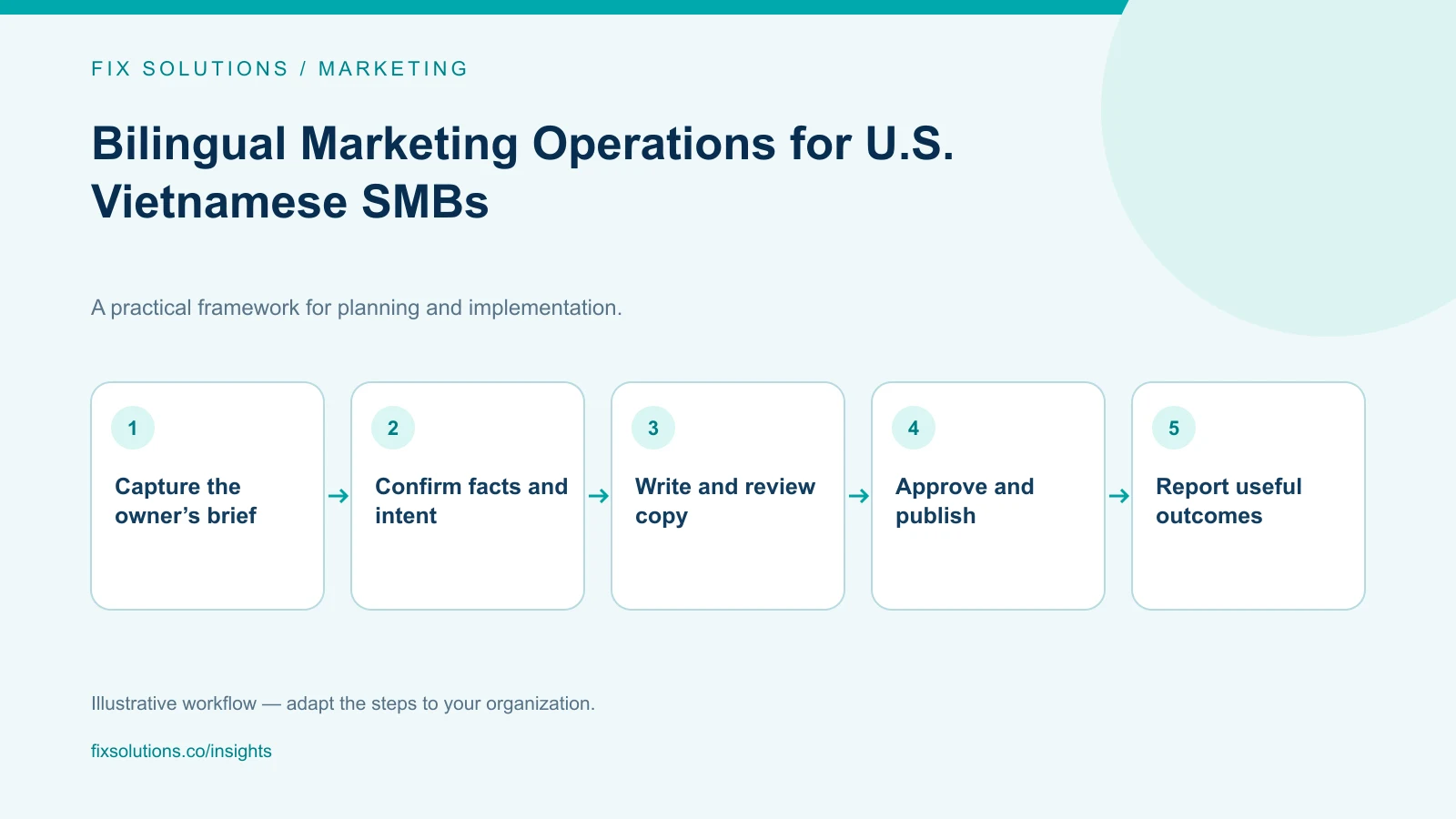
A four-step campaign process
Step 1: Capture the request
Accept a voice note or short written brief through the agreed business channel. Ask the owner not to include account passwords, one-time codes, payment details or unnecessary customer data. Acknowledge receipt and record the request date, intended launch date and designated approver.
Step 2: Confirm the commercial details
The marketer summarizes the offer and asks about anything uncertain: service eligibility, price, dates, appointment or inventory capacity, location, booking link and exclusions. Translate the summary into a version the owner can easily review. Do not write an English ad based on an assumption that seems obvious to the agency.
Step 3: Prepare and approve
Draft the customer-facing language, image or short video, ad destination and audience. Have the assigned language reviewer assess it. The owner checks facts and approves publication. The marketer verifies account, budget, campaign schedule, geography and live link before activation. Retain the approved version and its publication details.
Step 4: Monitor and report
Check campaign delivery and customer-facing links during the promotion. Pause or update a campaign if the business runs out of capacity or an offer changes. Send a concise report that separates media spend, platform-reported results, completed business actions where measurable, and unanswered questions.
Use reporting that helps the owner decide
A bilingual dashboard is not useful if its labels remain unexplained. Report in the owner's preferred language or provide a brief explanation of key terms. Distinguish reach and clicks from calls, bookings, attended appointments, orders and repeat customers. A platform's attribution view may miss word-of-mouth, walk-ins, cross-device searches or customers who call instead of clicking.
Choose a baseline before changing campaigns. Record the normal business period, expected capacity and known seasonal effects. Compare like periods where possible and explain differences. Do not credit an ad for every new customer who appears during the campaign, and do not treat a slow week as proof that the marketing failed without checking other factors.
Set a recurring short review with clear questions: What was delivered? What needs owner approval? What did customers do? What is the next test? A steady cadence builds shared understanding without requiring the owner to monitor the provider every day.
A practical four-week rollout
Week 1: map the communication process. Choose the briefing channel, owner approver, language reviewers, business hours and urgent contact. Agree on how briefs are summarized and approved.
Week 2: pilot one promotion. Select an offer with known dates and capacity. Confirm facts in writing, prepare a small campaign and keep spend within a budget the owner has approved.
Week 3: inspect the handoffs. Note where details were missing, translation was unclear or approval took longer than expected. Improve the checklist and turnaround expectations.
Week 4: review delivery and outcomes. Compare owner time, published work, customer response and any measurable booking or order result with the baseline. Decide whether to repeat, change or stop the workflow.
Frequently asked questions
Can an owner send a campaign brief as a Zalo or Viber voice note?
Yes, as long as the business and provider agree on the channel and the team confirms important facts in a retrievable written summary. Do not send passwords, payment information or unnecessary customer data in a voice note.
Can a Vietnam-based marketing team deliver English ads overnight?
That depends on the team's working hours, brief completeness, review capacity and agreed service level. Plan the deadline in advance, include time for approval and avoid promising a turnaround that has not been staffed.
Does a bilingual workflow eliminate the need for the owner to review ads?
No. The provider can translate and edit, but the business owner remains the authority on its offer, prices, availability and customer commitments. Keep final approval simple and explicit.
Sources and further reading
- Google Ads: Location targeting
- Google Ads: About language targeting
- WhatsApp Business Messaging Policy
For a bilingual marketing workflow, start with one voice-note brief and a clear approval loop. FIX Solutions’ marketing services can help shape a practical operating model.