How can a family business choose marketing software across generations?
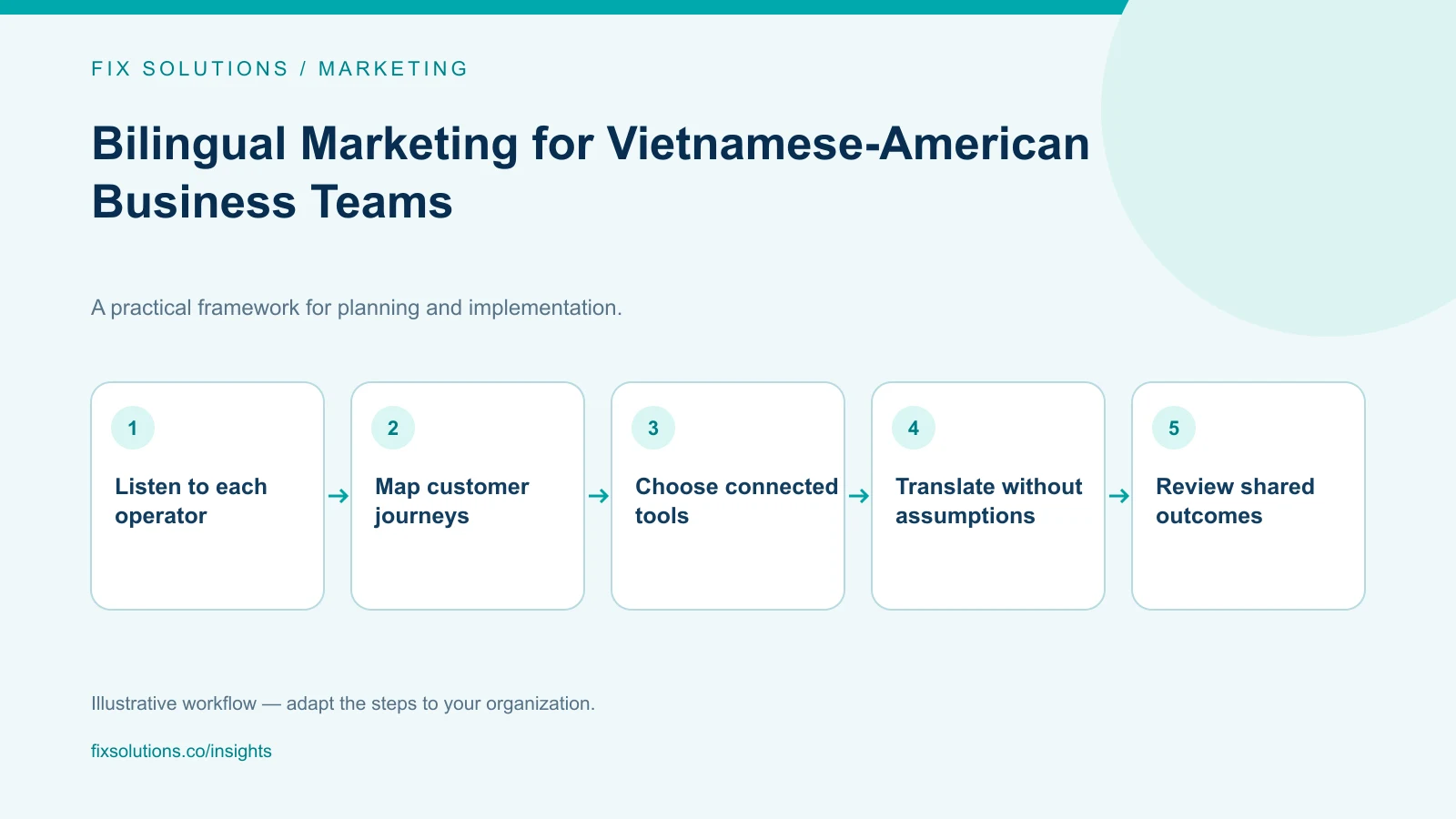
Start by asking each owner, employee and customer what they need from the workflow. One person may prefer phone calls and personal referrals; another may want online booking, reviews and automated reminders. Those preferences can occur at any age. Map the real customer journey, choose tools that fit the business and connect them through clear account and data ownership. A bilingual technology partner can translate decisions between languages without speaking over the people who own them.
In a family-run salon or restaurant, a software decision can also be a family decision. A parent who built a business through relationships may prioritize predictable costs and customer care. An adult child who handles online communications may want searchable bookings, digital payments and less manual follow-up. Both may be responding to valid constraints; neither viewpoint should be reduced to a generational stereotype.
The role of a technical translator is to make the options, tradeoffs and workflow consequences understandable in the language and format each person prefers. That includes asking whether the business needs the tool in the first place. A new marketing platform will not resolve disagreement about prices, appointment policies, customer service or authority to publish.
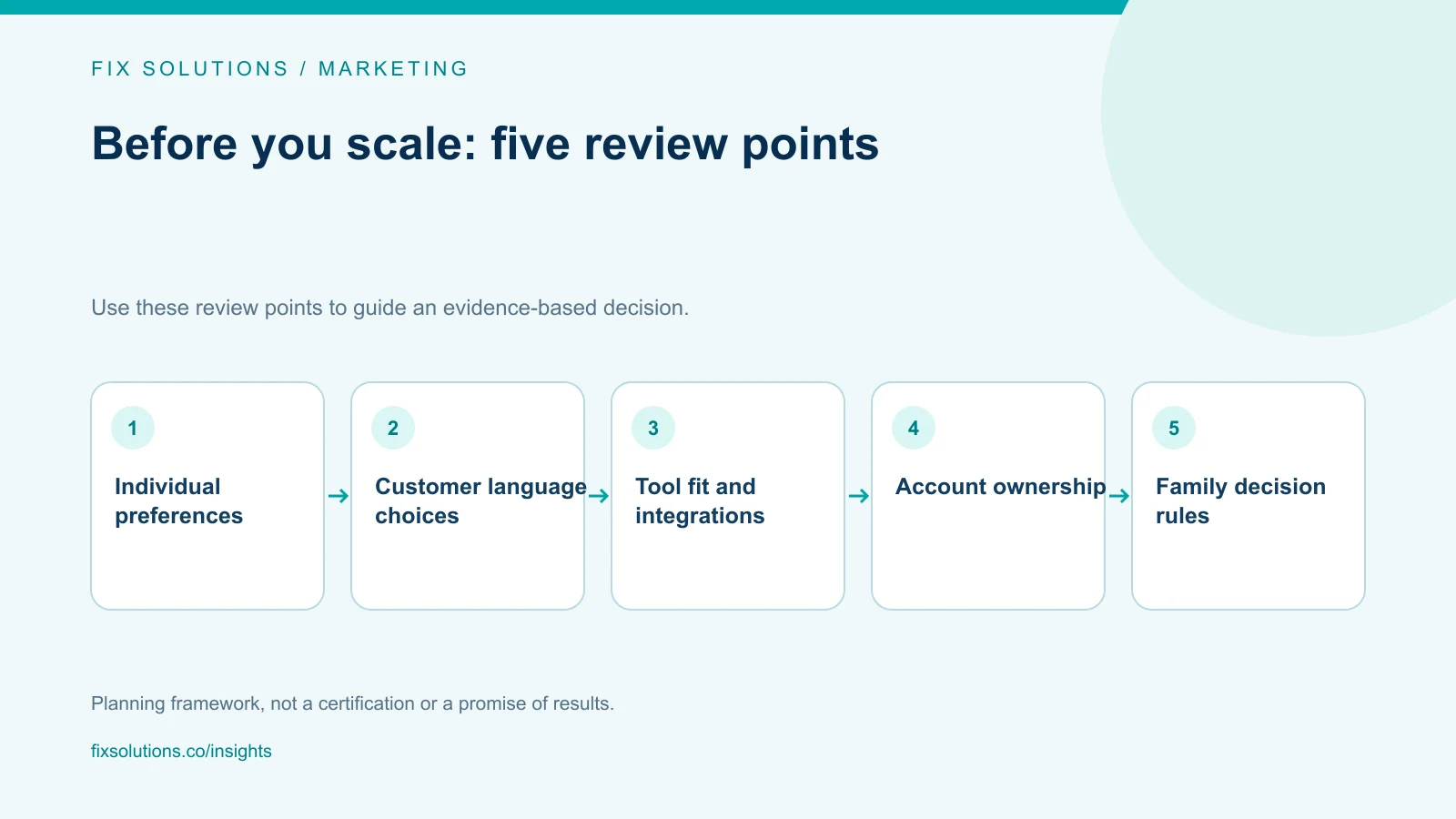
Replace assumptions with a short discovery process
Interview the actual people who operate the business. Ask them to walk through one ordinary task—from a customer asking a question, to a confirmed booking or order, to payment, follow-up and return visit. Notice where a notebook, phone call, message thread, spreadsheet or point-of-sale system becomes the unofficial source of truth.
Ask each person separately what matters and then compare answers together:
- Which customer questions consume the most time?
- What should still be answered personally?
- Where do missed calls, double bookings or forgotten follow-ups happen?
- Which languages do customers choose for signs, messages and service?
- Who may change prices, hours, promotions and booking rules?
- What monthly software cost can the business sustain in both busy and slow periods?
Use the differences as requirements to reconcile, not proof that one person is resistant or another is careless. A family owner may embrace online bookings but still need phone scheduling for walk-ins. A younger manager may want automation but choose to keep review responses personal. Let the workflow, not a generational assumption, drive the design.
Identify the tool that solves the actual problem
Tools often mentioned in local service businesses include scheduling and salon platforms such as Boulevard or Mindbody, and restaurant point-of-sale products such as Toast. They are examples to evaluate, not automatic recommendations. Availability, features, fees, integration support and suitability can vary by plan, location and business type. Verify current capabilities and contracts directly.
| Business task | Possible tool category | Questions to ask before buying |
|---|---|---|
| Appointment scheduling | Booking and salon-management software | Can customers book the right service, staff member and duration? |
| Walk-ins and payment | Point of sale | Does it fit the actual counter, device, menu and payment flow? |
| Customer reminders | Messaging or CRM tools | How is consent recorded, and who updates customer details? |
| Local discovery | Google Business Profile and search tools | Are hours, location and services accurate and owned by the business? |
| Social publishing | Meta or other social tools | Can the owner review content before it goes public? |
| Performance reporting | Analytics and campaign reporting | What decisions can the report support, and what is missing? |
Before purchasing, ask for a real end-to-end demonstration using the business’s service list and a typical customer. Test the booking or order path on a phone. Make sure a customer can find current hours, understand the prices and complete the intended task. Clarify payment processing, hardware, migration, cancellation and support costs.
Draw the information flow
Map where customer and business information begins and where it is copied. A booking platform may have the appointment; a point-of-sale system may have the transaction; a messaging app may hold a customer conversation; an analytics tool may record an ad click. Decide which source is authoritative for each fact.
Do not assume two systems are integrated because both use the same email address or offer an export button. Verify which fields transfer, how often, how errors appear and who fixes them. Minimize unnecessary copies of customer data. Follow the organization’s privacy policies and relevant platform rules.
Create a clear bilingual approval path
A bilingual workflow should allow the family to understand what is being proposed, review public claims and make a final decision. Agree on who can prepare a draft, who checks Vietnamese meaning, who approves the English publication and who can pause an active promotion.
Separate translation from authorization. A translator can make an offer clear in Vietnamese and English, but only the business can confirm that the price, service details, eligibility and dates are correct. Leave time for the owner to review words that affect policy, refunds, availability or customer expectations.
Use a shared content calendar and a simple status: draft, needs business details, ready for review, approved and published. Preserve the final approved text and asset. When someone sends a voice note, summarize the details in writing and read them back for confirmation. This protects the working relationship as well as the accuracy of the ad.
Respect language choice without forcing one identity
Some customers may prefer Vietnamese, some English and others a mix. Allow customers to choose when possible. Do not infer language preference from a name, age or family relationship. Test signs, booking confirmations and ad copy with people who actually use them.
Vietnamese text can vary by regional wording, tone and audience. Ask the owner whether the business prefers formal or conversational language and whether the copy should address a family audience, a younger customer or both. Treat comments as useful editing feedback rather than a debate about which generation has the “right” language.
English materials deserve the same editorial care. Confirm local references, spelling, product names, appointment terms and cultural context. A fluent review helps; translating word-for-word may still produce an awkward message.
Make the family’s decision process explicit
Technology disagreements may be about money, workload or control rather than technical features. Agree on a small decision framework before asking the family to select a tool:
- Name the customer problem. For example, callers cannot find current appointment availability.
- List constraints. Include budget, business hours, staff capacity, current equipment and language needs.
- Compare one simple option with one fuller option. Show recurring cost, setup, ownership and workflow differences.
- Try the least risky useful option. Use a demo, temporary pilot or limited service where available.
- Review together. Ask whether the tool reduced a real task without losing customer experience or financial control.
Agree who holds final responsibility and which decisions require both owners. Set a limit for recurring software expenditure that requires renewed approval. Keep the business owner in control of administrator accounts, domain, payment method and export access.
Avoid framing software adoption as a test of whether a parent is modern or whether a child understands the business. Instead, explain the proposed change in terms of specific work: fewer repeat scheduling calls, accurate service information, a clear trail for promotions or an easier way to remind an opted-in customer.
A four-step pilot for family businesses
Step 1: Map one customer journey. Choose an actual recurring task such as booking an appointment or calling ahead for restaurant information. Write down what happens today, including walk-in and exception cases.
Step 2: Select one tool and define the boundary. Pick the smallest product that could improve the journey. Document the monthly fee, payment and data terms, which system remains the record, and how customers can get help.
Step 3: Test across languages and roles. Have a family owner, staff member and several willing customers try the flow. Check Vietnamese and English content, accessibility, mobile usability, notifications and what happens when the information is wrong.
Step 4: Keep, change or stop. After a defined pilot, compare usage, successful bookings or orders, support effort, owner time and problems. Cancel or revise the tool if it adds cost without removing the stated friction.
Measure business usefulness without dismissing word of mouth
Digital tools can help people find hours, book services and leave honest feedback. They do not replace relationships, neighbor recommendations or a consistently good customer experience. A business can track online booking completion and still ask customers how they found it. These measures complement each other.
Avoid chasing reviews through incentives or posting invented testimonials. Ask for honest feedback using approved platform methods, and never expose private appointment or transaction details in a public reply. Respect customers who prefer an offline conversation.
For a local restaurant, online ordering may help some customers while a phone call remains easiest for others. A salon may benefit from reminders but still need staff to manage service changes personally. The right mix depends on observed customer behavior and operating capacity.
Frequently asked questions
Are first-generation parents less interested in digital marketing?
There is no reliable rule for an individual family. Preferences differ by person, business experience, language, customer base and risk tolerance. Ask each decision-maker what they want the business to accomplish.
Which booking or POS platform should a salon or restaurant choose?
Compare workflow fit, current features, fees, support, payment terms, data access, integration and exit options using the business’s own requirements. Product names are a starting point for research, not a recommendation.
What does a technical translator do?
A technical translator explains systems, cost, data flow and operational change in language the business owners can use to make decisions. They facilitate approval and clarify assumptions; they do not replace the owners’ knowledge or authority.
Sources and further reading
- Google Business Profile: Guidelines for representing your business
- WhatsApp Business Messaging Policy
- Federal Trade Commission: Consumer Reviews and Testimonials Rule
For a family-centered marketing-technology decision, begin with one shared customer journey. FIX Solutions’ marketing services can help map the tools and review process around the people who run the business.