Editorial disclosure: This is a hypothetical, fictionalized planning example. It does not describe an actual FIX Solutions client or report measured results. The requested “60% lower marketing cost” and “double table turnover” figures are not supported by client records and are not presented as outcomes. The example below shows how a restaurant could design, measure and adjust a local-marketing pilot; real costs and results depend on its operations and evidence.
What might a local marketing plan for a Houston pho shop include?
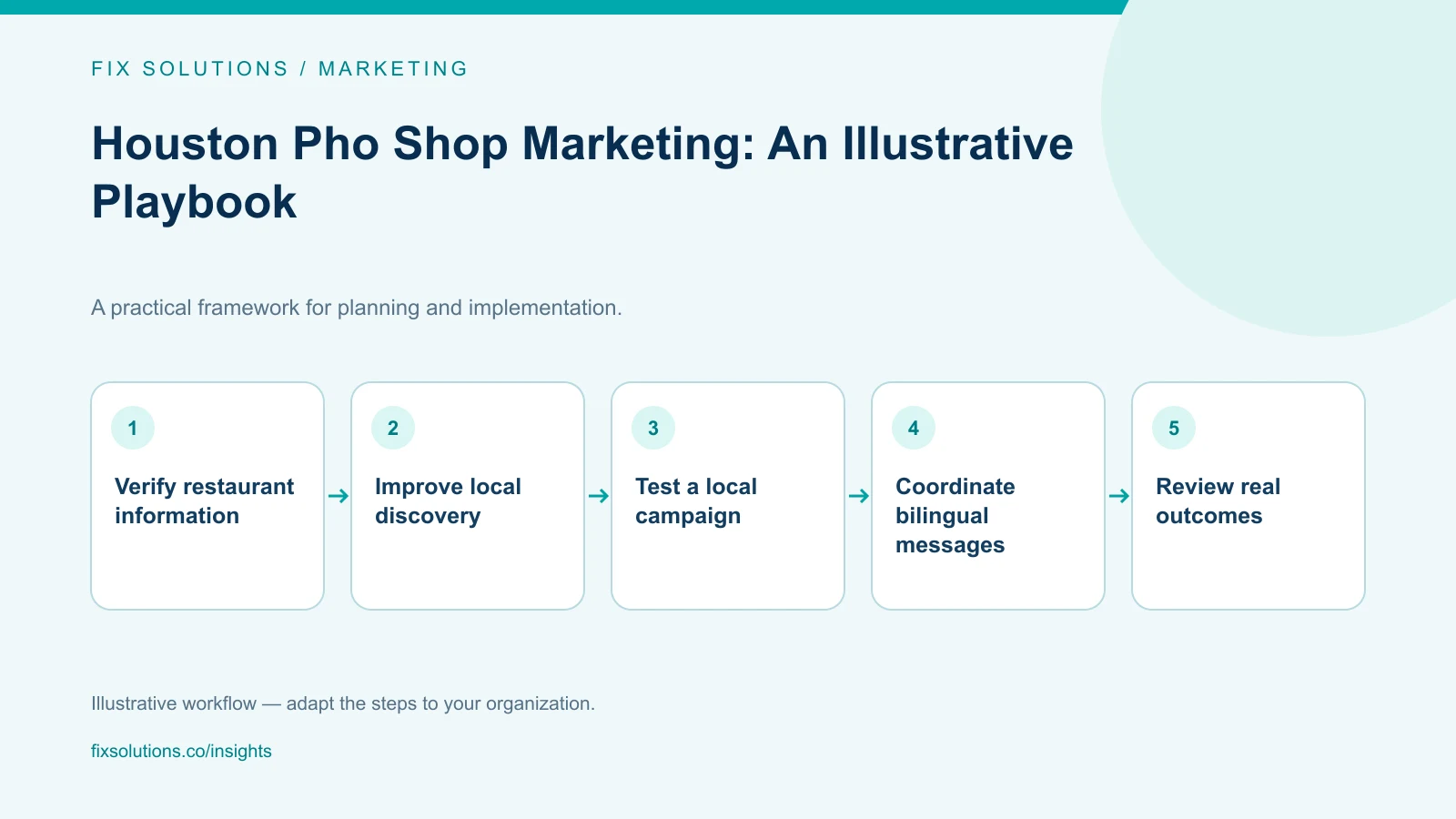
A local restaurant campaign can combine accurate Google Business Profile information, useful local-search pages, a carefully budgeted Google Ads test and customer communication through channels the restaurant can actually manage. The useful starting point is not a promised revenue result; it is a defined service area, current hours, a correct menu or ordering path, kitchen capacity and a baseline against which to evaluate change.
A five-mile radius may be a starting hypothesis for a restaurant with nearby customers, but it is not automatically the right boundary. Traffic, delivery coverage, neighborhoods, road access, competition and the restaurant’s own customer data matter. Google notes that location targeting uses signals and is not perfectly accurate in every case. The restaurant should check actual performance and adjust.
The steps below are an illustrative blueprint. A real restaurant should replace every placeholder with its own hours, menu, budget, capacity and customer preferences before publishing.
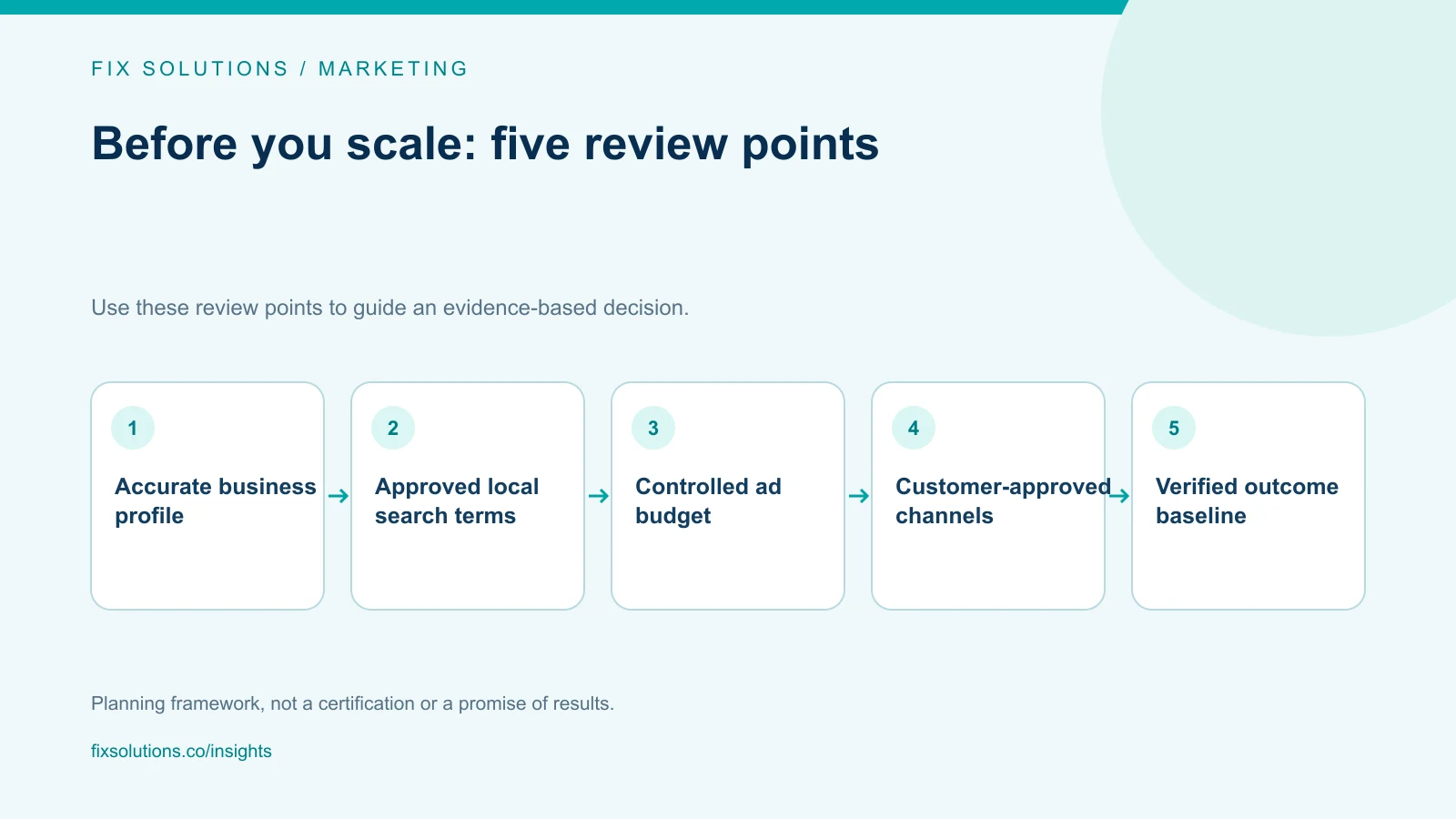
Start with the restaurant’s real operating constraints
Before creating an ad, confirm:
- The exact business name, address, phone, current hours and holiday schedule.
- Which menu items and prices are current and available.
- Whether the goal is dine-in, takeout, reservations, calls or online orders.
- Which days and meal periods have unused capacity.
- How many additional customers the kitchen and front-of-house team can handle.
- Who can respond to calls and messages while service is busy.
- What languages customers can choose for key information.
Ask the owner and floor manager to identify realistic slow periods, not simply the periods they wish were busier. A campaign that sends more customers during a full dinner rush may not improve the business. Table turnover is also not a result a marketing team can promise: it depends on seating, party size, meal duration, service pace and kitchen throughput.
Measure the current flow before changing it. The restaurant could track reservation requests, calls, online orders, dining parties and completed transactions by day and period, using existing systems and lawful business records. Document how the data is collected and what it leaves out.
Step 1: Improve local discovery accurately
Review the restaurant's Google Business Profile. Verify the name and address, primary category, hours, phone, menu link, ordering links and photographs. Correct inaccurate details rather than adding keywords to the business name or creating duplicate profiles. Google’s guidelines for representing a business emphasize accurate real-world representation.
Build or improve a website page that makes essential information easy to find on a phone: address, parking or access details where useful, current hours, menu and prices, language options, and a call or order action. Ensure menu content is readable and current. A search result that sends a customer to a missing ordering link or an old price can do more harm than having fewer keywords.
For Vietnamese and English information, have the owner or a qualified reviewer validate both versions. Ask whether customers should see the full menu in both languages or just essential information. Do not assume language from a name or neighborhood.
Respond to reviews professionally and without disclosing a person’s order history, appointment, contact details or other private information. Ask customers for honest reviews using permitted methods; do not buy positive ratings or offer an incentive for a favorable review. Treat feedback themes as an operational signal, not only a marketing task.
Step 2: Design a controlled local-search test
Define what a successful campaign should make easier: a customer finding accurate hours, opening a menu, calling about a service or placing an order through the restaurant’s approved path. Search terms should reflect actual menu offerings and service—not every nearby city or a competitor’s identity.
If the restaurant uses Google Ads, set an approved daily or monthly budget that the owner can sustain. Choose geography based on real service and likely customer reach. A five-mile radius can be tested, but compare it with a narrower or broader area where the restaurant has evidence of demand. Google Ads supports radius targeting, but its location-targeting guidance notes that delivery uses multiple signals and cannot guarantee perfect geographic accuracy.
Use a landing page with accurate information and a clear next action. Add call or order tracking only where the business understands what data is recorded and how the number or integration behaves. Distinguish clicks and calls from a completed order or attended visit. Check search terms and placement regularly; pause irrelevant traffic rather than increasing budget simply because impressions are growing.
Set a stop condition before launch. Examples include an expired offer, a full kitchen, an incorrect destination page, an unexpected spend limit or a customer-service issue. The owner—not an external marketing partner—should control billing and have access to pause the campaign.
Build the budget from the business case
There is no defensible universal price or return to assign to an example restaurant without a quote and baseline. Enter a real provider quote and the amount the restaurant is willing to spend. Estimate contribution margin with the owner's finance records, not gross sales alone.
Campaign contribution = attributable incremental contribution − advertising spend − provider fee − added operating cost
Attribution will remain incomplete: some people see an ad and later visit without clicking, while others may have visited anyway. Use the calculation as one planning lens, then compare the business's wider measures and customer feedback.
Step 3: Coordinate messages across channels carefully
Suppose the restaurant has Vietnamese-speaking family owners and customers who may prefer English. It can provide useful information in both languages, but should choose channels based on what customers actually use. A short Instagram or Facebook post, current menu page, Google profile update, and direct message can each have a different role.
If the family sends a special in a Zalo or Viber voice message, the marketing coordinator should confirm the item, exact dates, price, availability, location and next action in writing. The restaurant then approves the Vietnamese and English customer-facing versions. Do not assume one messaging platform automatically forwards messages to another.
Zalo, Viber and WhatsApp are separate products with separate controls and messaging rules. If the restaurant chooses to use WhatsApp Business, review the current business messaging policy. Obtain permission for the messages the restaurant sends, honor customer preferences and do not transfer message histories or contact details between platforms without a justified and authorized process.
Use the restaurant’s own business accounts and phone numbers. Provide team members with individual, limited access rather than sending passwords or login codes in chat. Set a process for removing access when responsibilities change.
Step 4: Measure actions the restaurant can verify
Use a short weekly report with:
- Campaign spend and schedule compared with the authorized budget.
- Search terms and locations that generated relevant activity.
- Calls, direction requests, order starts or booking requests, where reliable tracking exists.
- Completed orders, reservations or visits that the restaurant can attribute with reasonable confidence.
- Owner or staff time needed to manage messages and fulfill the offer.
- Capacity issues, menu errors or customer feedback that require an operational change.
Keep Google’s reported actions separate from restaurant sales. Do not count every click as a customer or every new customer as a result of the campaign. Ask customers how they heard about the business when appropriate, and compare responses with digital metrics rather than assuming either measure is complete.
Table turnover deserves special care. If the restaurant wants to understand this measure, define the metric—for example, seated parties per table during a service period—and track it consistently. Account for party size, reservations, dining duration and staffing. An increase may reflect operations, seasonality or a change in guest mix, not just advertising.
A transparent cost comparison template
The following table contains no invented market prices or saving percentages. Enter actual provider proposals and account for internal effort. Keep media spend separate from agency or team fees.
| Monthly cost | Local or U.S.-based agency | Dedicated Vietnam-based team |
|---|---|---|
| Creative and campaign service fee | Insert current quote and included scope | Insert current quote and included scope |
| Google/Meta advertising budget | Owner-approved account budget | Same owner-approved budget |
| Owner briefing and review time | Track actual hours | Track actual hours |
| Photography, video and menu updates | Include paid and staff time | Include paid and staff time |
| Translation and English-language review | Name the reviewer and cost | Name the reviewer and cost |
| Software or reporting tools | Include recurring charges | Include recurring charges |
| Comparable operating total | Quote plus tools, spend and owner time | Quote plus tools, spend and owner time |
| Useful result to review | Completed order, visit, booking or other defined action | Same defined action and measurement window |
Use the same deliverables and measurement period for both columns. A Vietnam-based provider can offer language alignment or asynchronous work if it has the people, schedule and quality process to support them. That does not automatically make its service half the cost or guarantee overnight response. Check capability, staffing, review and total effort in a small pilot.
A four-week hypothetical pilot
Week 1: baseline and access. The owner validates profile details, customer paths and current service capacity. The team records business measures for a comparable period and confirms which accounts the restaurant owns.
Week 2: local-search cleanup. Update inaccurate business information, verify the website and order paths, and prepare bilingual copy for owner approval. Do not change business identity or create duplicate listings for search visibility.
Week 3: controlled ads. If the owner approves, launch a small geographic and keyword test with an explicit spending cap and pause conditions. Review queries and customer path rather than assuming a radius reaches every nearby diner.
Week 4: decide using actual records. Compare spend, qualified actions, order or visit evidence, staff capacity and owner effort against baseline. Continue, change or stop based on what the restaurant can substantiate.
This schedule describes an example sequence, not a promise that a specific outcome will appear in four weeks.
What this example does—and does not—claim
It does not claim that a real Houston pho shop cut costs by 60%, doubled table turnover, gained a particular number of customers or used a particular backend integration. It does not imply a customer relationship or permission to publish customer information. Those claims require verifiable records, a clear measurement method and authorization.
It does show a repeatable approach: verify the business, target customers thoughtfully, protect the accounts, obtain the owner's approval for bilingual offers, measure real business activity and compare the total cost of each provider. A restaurant can then decide whether a local agency, remote team, internal hire or a mix of support is best for its operations.
Frequently asked questions
Should a Houston restaurant target ads within five miles?
It can be a test hypothesis, not a default guarantee. Consider traffic, service area, the restaurant’s actual customer geography and campaign performance. Check the advertising platform’s current location-targeting behavior and adjust using evidence.
Can Zalo messages be automatically managed through WhatsApp?
Do not assume the platforms interoperate automatically. They have separate accounts, policies and technical systems. Use approved integrations only where they exist and are appropriate; obtain authorization before sharing customer or message data.
Can a marketing agency guarantee more table turnover?
No responsible marketing team can guarantee a restaurant operations metric it does not control. Marketing may generate demand, but seating, service pace, kitchen capacity, pricing and guest choices also affect turnover.
Sources and further reading
- Google Business Profile guidelines
- Google Ads: Location targeting
- WhatsApp Business Messaging Policy
For a restaurant marketing pilot, start with accurate information, a spend limit and a business-owned baseline. FIX Solutions’ marketing services can help scope the work and review what the data can actually show.