How should Vietnamese-American business owners compare marketing providers?
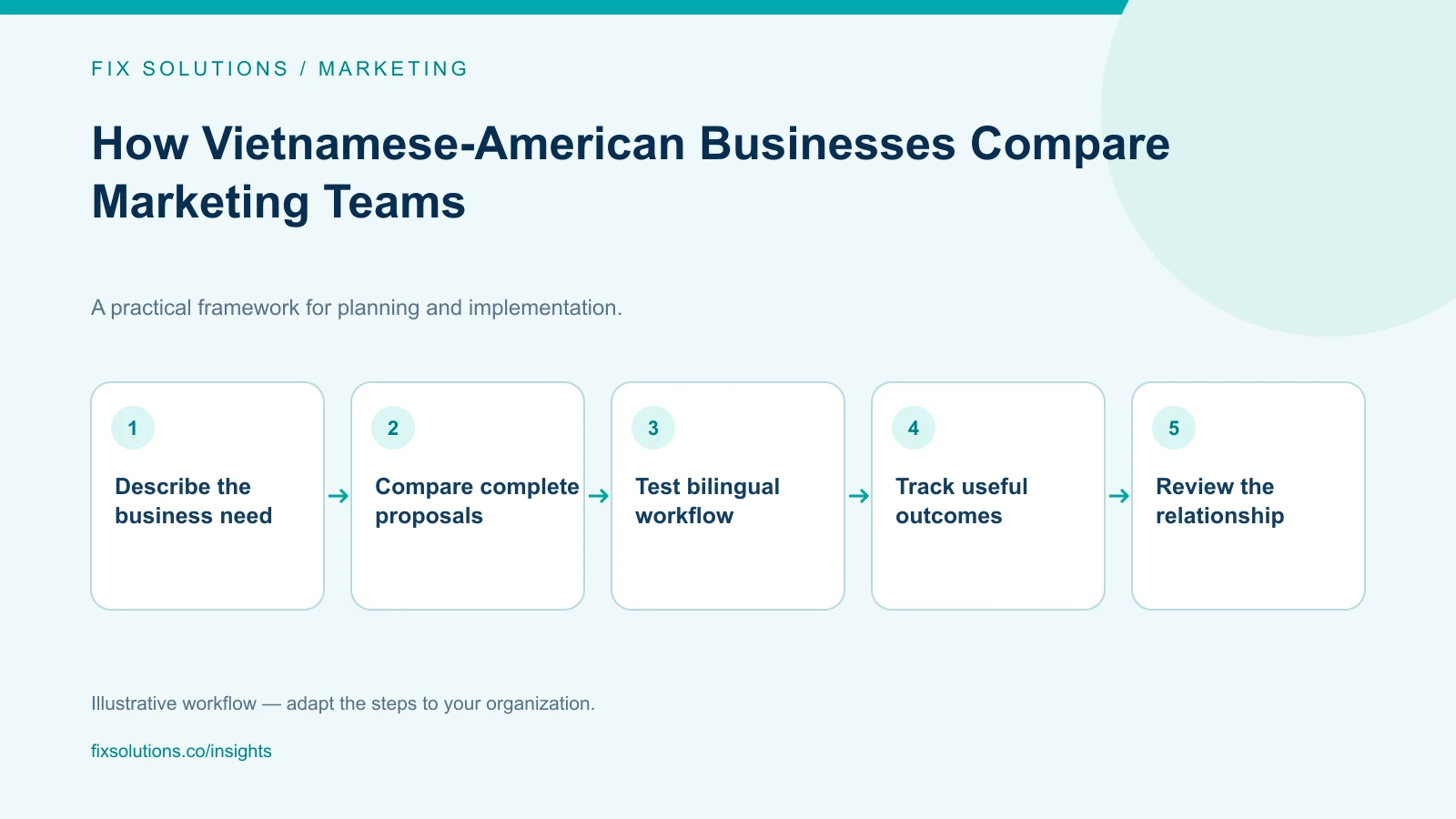
Do not assume a U.S. agency is overpriced or an overseas team is automatically better value. Compare the same deliverables, account control, communication, quality checks, response expectations and full monthly cost. A Vietnam-based team may be a good fit when it can reliably support Vietnamese-language briefs and English-language customer materials. Verify that capability through a small, paid pilot and measure work completed and customer-relevant outcomes.
The phrase “overcharge” makes a broad claim about U.S. agencies that prices alone cannot establish. Agency rates reflect different scopes, specialists, media budgets, service levels and business models. Likewise, a Vietnam-based provider’s lower quoted fee does not show the total cost, quality or fit. The useful question for a salon, restaurant or local service business is: What work will actually be done, by whom, at what cost, and how will we know whether it helped?
Local business owners often balance thin margins, family responsibilities, a packed service schedule and limited time to manage vendors. A workable marketing relationship should make that load lighter, not create another part-time job. Cultural and language accessibility can matter, but Vietnamese-American owners do not all share one language preference, business model or customer mix. Ask the owner how they prefer to communicate and who needs to approve public messaging.
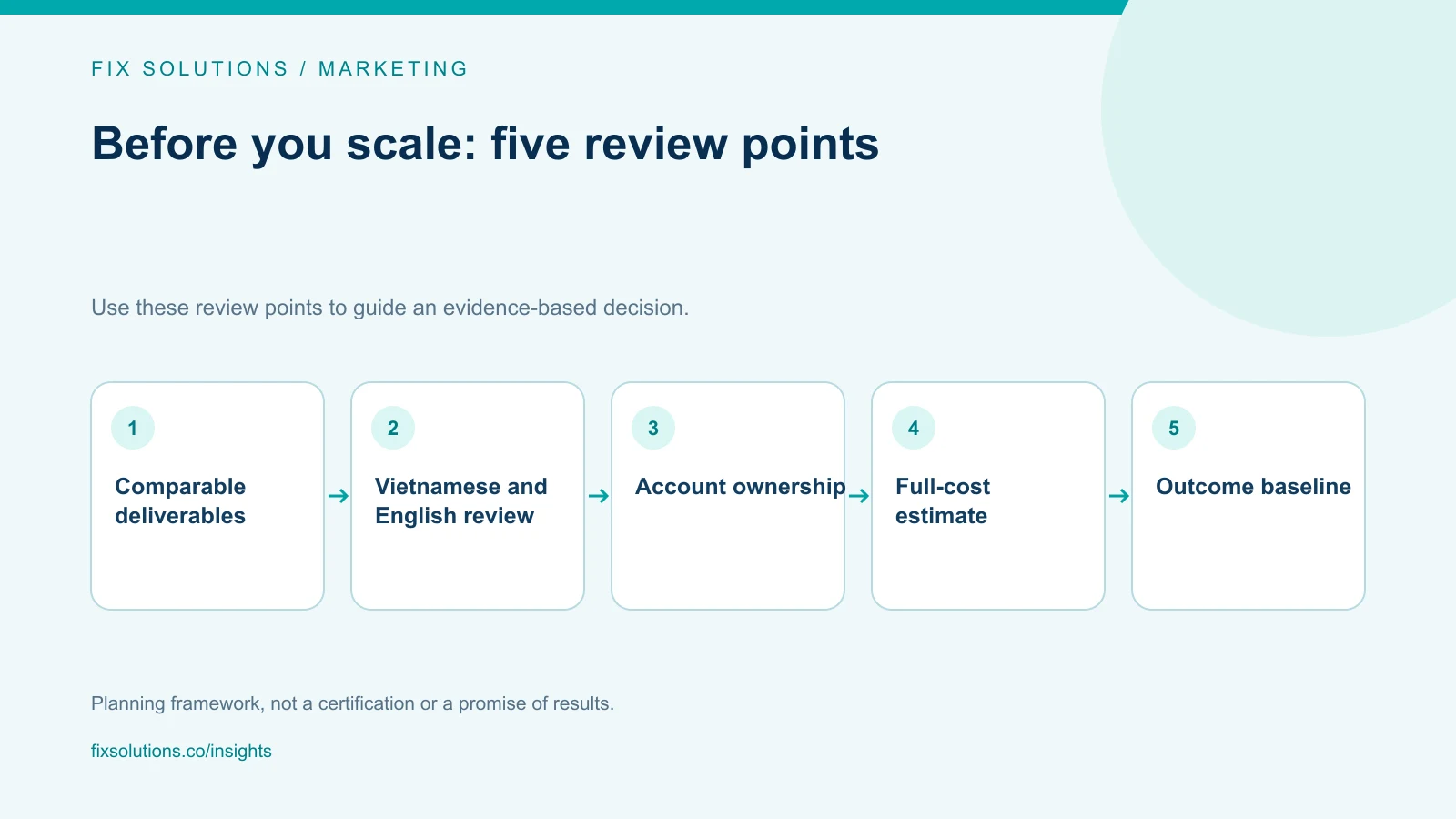
Why marketing proposals can be difficult to compare
A monthly retainer could include strategy, reporting, social content, profile management, search optimization, paid campaign work, customer responses or only a subset. Ad spend may be billed separately. One proposal may include original photographs; another may assume the owner supplies all media. A low fee can omit work that another quote includes.
Before comparing a U.S.-based and Vietnam-based provider, write a one-page brief with the outcomes you want and the work you need each month. Ask providers to price the same scope and list exclusions, revisions and response windows. Separate service fees from Google or Meta advertising budgets, photography, software licenses, taxes and the cost of the owner’s time.
| Comparison area | Questions for any provider |
|---|---|
| Monthly work | How many posts, campaign changes, profile updates or reports are included? |
| Paid media | Is the ad budget separate? Who owns the account and card on file? |
| Content | Who creates photos, video, offers and English/Vietnamese copy? |
| Reviews and messages | Does the team monitor, draft or publish responses? What requires approval? |
| Search visibility | What does the provider mean by “SEO,” and which changes are included? |
| Tracking | Which calls, forms, bookings or orders can be measured with consent? |
| Revisions and timing | How many reviews are included, and what turnaround is realistic? |
| Ownership and exit | Can the business retain its profiles, creative, analytics and customer data? |
No proposal should guarantee a specific search ranking, viral post or number of new customers. Ask what is in the provider’s control and how its work will be reported. A clear list of deliverables is more useful than a vague promise to “grow your brand.”
Compare the true cost, including coordination
Use the same cost model for both options. One practical formula is:
Monthly total = provider fee + advertising budget + tools + content production + owner review time + rework
Add onboarding and account transition separately. Estimate owner review time honestly: a lower fee can lose its advantage if the brief needs extensive rewriting or the provider requires daily management. Conversely, an experienced local agency may understand the neighborhood and supplier relationships well enough to save time that a distant team would need to learn.
| Cost line | U.S.-based provider | Vietnam-based provider |
|---|---|---|
| Service fee | Enter a current quote for the agreed deliverables | Enter a current quote for the same deliverables |
| Ad spend | Set and paid directly by the business where possible | Set and paid directly by the business where possible |
| Owner briefing and review | Track hours for a normal month | Track hours for a normal month |
| Translation and cultural review | Confirm who handles each language | Confirm fluency, editing and business-context review |
| Coordination across time zones | Include meeting and approval delay | Include planned overlap and asynchronous handoffs |
| Account transition and exit | Identify setup, data export and cancellation costs | Identify setup, data export and cancellation costs |
| Comparable total | Calculate from documented quotes and actual effort | Calculate from documented quotes and actual effort |
This table intentionally uses real quotes instead of a claim that one market charges a particular monthly amount. If a provider offers several packages, ask for a line-item proposal. Keep advertising spend on accounts owned by the business and give service providers only the access needed for their work.
Evaluate a Vietnam-based team on what it can demonstrate
Geography alone does not establish language quality, time-zone coverage or customer understanding. Ask who will receive the brief, who will write the English copy, who can review Vietnamese nuance, and who will be available when a question cannot wait. Some teams may support overnight handoffs; that is a staffing and service commitment to confirm, not an automatic property of outsourcing.
Ask for a pilot covering one real monthly cycle: a seasonal offer, a small set of approved social posts, or a tightly scoped local campaign. Agree on deliverables and review windows in writing. Check whether the provider asks useful questions about hours, service area, pricing, appointment capacity and brand voice rather than relying on assumptions about Vietnamese customers.
Review final English materials before publication. Good marketing copy should reflect the business’s actual menu, services, pricing and policies. A translated sentence can be grammatically correct but culturally or commercially inappropriate. Keep the owner’s approval for claims, discounts, health or beauty claims and customer replies.
Make time zones an operating advantage only when planned
A time difference can create an asynchronous production window: a provider drafts while the owner is serving customers, and the owner reviews at a scheduled time. It can also create delays if the team has no overlap with a person who can approve a promotion.
Agree on a recurring short overlap window for decisions, an approval deadline, and a fallback when a promotion’s details are unclear. Let routine work continue from a complete brief; pause anything involving prices, dates, eligibility, customer data or policy changes until the owner confirms the facts. Define urgency levels and response expectations instead of expecting either team to be available around the clock.
A four-step plan for selecting a partner
Step 1: Clarify the business goal and customer
Choose a practical goal: more completed appointment requests, better discovery for a specific service, more useful repeat visits or clearer information for customers. Record the geographic service area, ideal appointment availability, peak hours and any groups the business wants to reach. Avoid treating “more impressions” as a business outcome.
Ask how customers currently find the business. Use booking records, point-of-sale summaries and owner observations where available and appropriate. Identify busy and quiet periods before launching promotions. If capacity is already full at certain times, an additional campaign may create friction rather than value.
Step 2: Request comparable proposals and protect account access
Provide the same brief to each provider and request a list of included tasks, hours, fees, deliverables, revision limits and exclusions. Ask for the names and roles of the people who will work on the account. Confirm ownership of the website, domain, Google Business Profile, Meta page, ad account, pixels and creative source files.
Use the business’s own email and payment method for administrator accounts. Add individual provider accounts with appropriate roles and review access periodically. Never share passwords or one-time authentication codes in a chat message.
Step 3: Run a bounded pilot with approvals
Start with a small campaign or content set and a baseline. Confirm the offer, booking link, phone number, address, languages and service details before publication. If the provider uses an ad platform or automation tool, ask what customer information is collected and where it goes.
Set approval boundaries: which factual or creative changes the provider can make independently and which require the owner. Establish a way to pause ads if the schedule fills, the offer expires or the landing page is wrong. Review the work weekly during the pilot rather than waiting until the invoice.
Step 4: Review outcomes and decide
Compare completed tasks, owner effort and relevant outcomes with the baseline. For salons, useful indicators may include booked and attended appointments by service or time; for restaurants, these may include calls, directions, reservations or attributed redemption when the business can collect that information reliably. Do not equate likes, page visits or ad clicks with profitable customers.
Check attribution limits. Walk-ins may see an ad but never click it; many customers may hear about the business from a friend. Treat platform attribution as one partial measurement, not a complete count of marketing impact. Continue only if the engagement is understandable, operationally useful and economically defensible.
Keep the customer experience authentic
Bilingual content should help customers, not perform a stereotype. Let customers choose their preferred language where practical. Do not assume that an older Vietnamese-speaking customer wants only traditional messaging, or that a younger English-speaking manager represents every customer. Test information with actual customers and revise based on feedback.
For review requests, ask customers for honest feedback without incentives, selective gating or pressure. Follow the platform’s current policies. Respond publicly with care: do not disclose appointment details, order history or other personal information in a review response.
For business hours, address and local service descriptions, accuracy matters more than keyword repetition. Google’s Business Profile guidelines ask businesses to represent themselves accurately and keep location and service-area information precise. Changes should be based on the real business, not an invented address or a list of nearby cities the business does not serve.
Frequently asked questions
Are U.S.-based marketing agencies always more expensive?
No. Pricing depends on scope, team, expertise, media budgets and support model. Compare written proposals and total ownership effort rather than generalizing about agencies or assuming an overseas team is cheaper for equivalent work.
Can a Vietnam-based team write English-language campaigns?
Some teams may have strong English-language marketing capability; others may need editing support. Review work samples, assign a named copy reviewer and run a small pilot. Verify factual claims and local tone before publication.
How can a small business test an overseas provider safely?
Start with a bounded engagement, keep account and billing ownership with the business, limit access, agree on approval and response rules, and assess actual deliverables, coordination effort and customer outcomes before expanding.
Sources and further reading
- Google Ads: Location targeting
- Google Business Profile: Guidelines for representing your business
- WhatsApp Business Messaging Policy
For a marketing-provider comparison, begin with a shared brief and a small, measurable scope. FIX Solutions’ marketing services can help create a plan that fits the business and its customers.