How can personalization scale without adding latency?
Personalization should be a bounded decision layered onto a fast, reliable default experience. Set an end-to-end latency budget, use only signals available within that budget, cache content that is safe to share, and make nonessential decision services fail open to an appropriate default. Validate the design with realistic load, cold-cache, dependency-failure and privacy tests before expanding traffic.
“Personalize every interaction” sounds like a content strategy, but at enterprise traffic levels it is also a systems design problem. A request may depend on identity resolution, consent, profile retrieval, recommendation logic, inventory, pricing, experimentation and content delivery. Each dependency adds a chance of delay or failure. A design that performs well for a small demo can become fragile when millions of visits arrive through real devices and networks.
The answer is not to maximize data collection or to make every decision in real time. The answer is to decide which personalization meaningfully improves a user’s task, then pay for that decision only when it can be delivered within a defined operational budget.
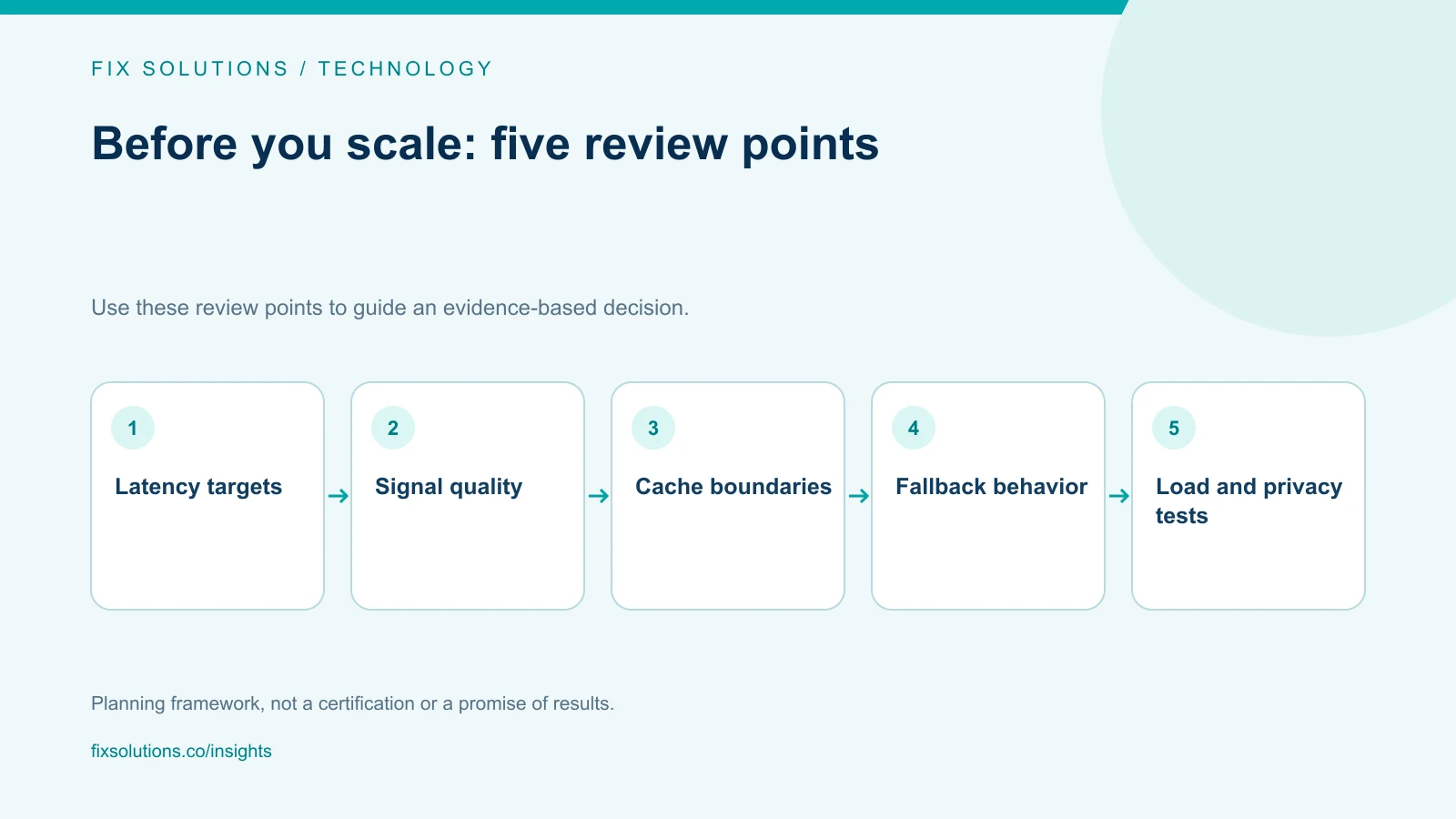
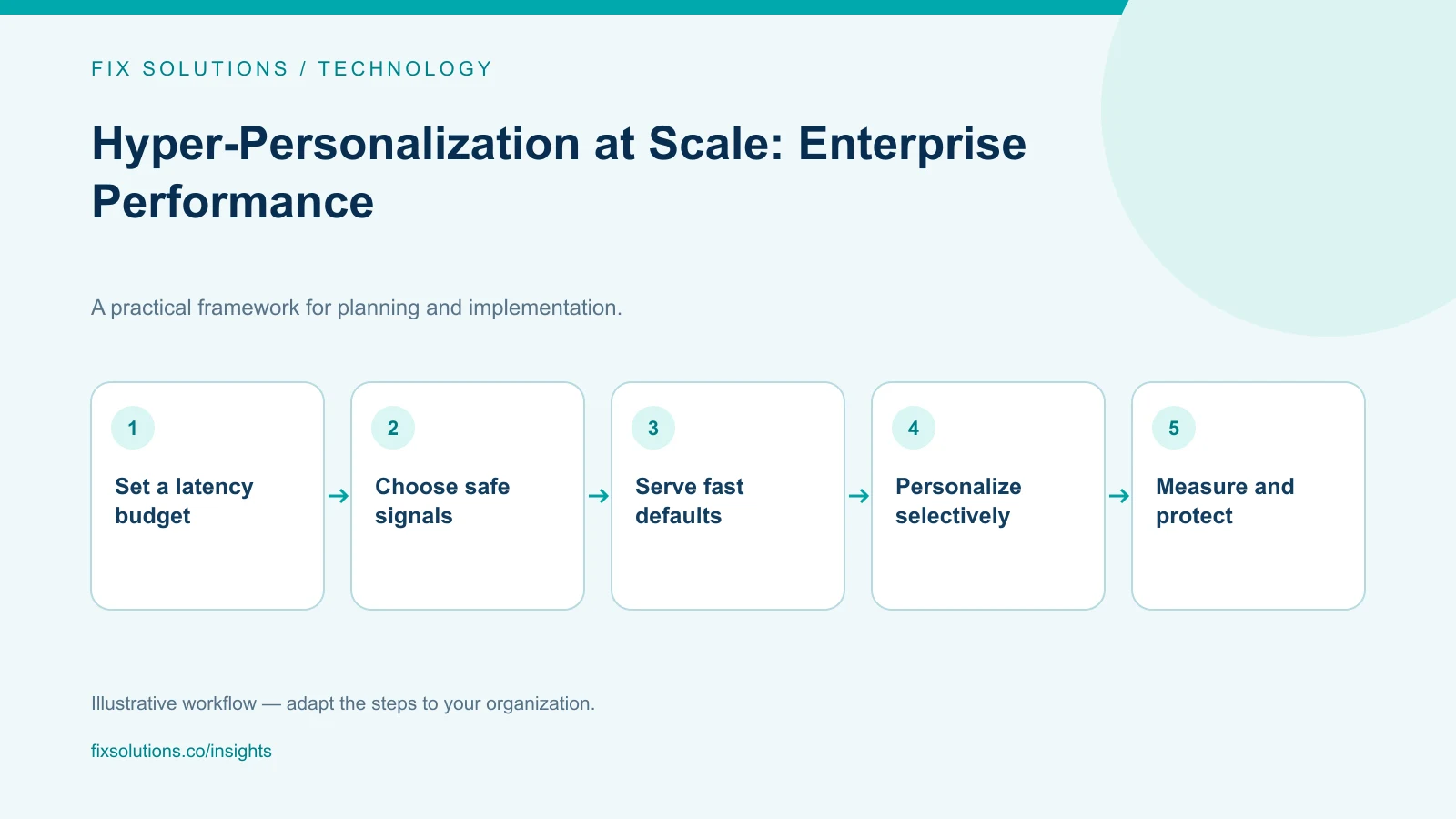
Start with the experience and its latency budget
Choose a page or action and define what a user must see immediately. The primary content, navigation and essential controls should not wait for a profile lookup if the experience can remain useful without one. Establish a response-time objective for the complete user journey, not just the average duration of one service call.
Decompose the budget across browser rendering, network transfer, content delivery and any personalization decision. Leave margin for variance. A chain of services with individually acceptable median times may still produce a poor tail latency when all must respond before the page can render.
Google’s Core Web Vitals provide user-centered measures for loading, interactivity and visual stability. They do not measure every aspect of a personalized experience, but they are useful alongside server-side latency, error rate and business-task completion. Avoid treating a single average as a service-level objective: inspect percentiles and segments such as mobile, geography and cold-cache requests.
Define the decision that is worth making in real time
Some choices need current context. A product recommendation may depend on available inventory; a service alert may need the customer’s current account status. Other choices—such as the order of evergreen educational content—may be precomputed or cached.
Write a decision table for each personalized component:
| Component | Freshness need | Possible strategy | Safe fallback |
|---|---|---|---|
| Navigation and core page | Immediate | Static or edge-cached | Always render |
| Product availability | Near-current | Bounded service lookup | Show availability check |
| Content recommendation | Minutes or hours may suffice | Precomputed segment or cached response | Popular or contextual items |
| Account-specific message | Current authorization required | Authenticated service | Hide the message |
The correct freshness depends on the business meaning. A stale recommendation is usually a nuisance; a stale price, eligibility decision or account permission can be harmful. Do not use the same caching rules for both.
Keep the hot path small
Use a request path that can return useful content even when the personalization platform is unavailable. Render the default experience first or in parallel where the architecture permits. Apply an enhancement when the decision arrives before its deadline; otherwise retain the default without blocking the user.
Avoid sequential waterfalls. If several independent signals are needed, retrieve them in parallel with explicit timeouts. Better still, remove signals that do not change the decision. Every profile field has a cost in collection, storage, access governance, quality and runtime retrieval.
Separate preparation from request-time work
Compute stable features and audience membership ahead of a page request when freshness allows. Batch processing can update a segment or recommendation index without forcing every visitor request to join large histories across systems. Keep the model’s refresh timestamp visible so operators know whether a result is fresh enough for its intended purpose.
Reserve online computation for decisions that truly depend on current context. Use an online feature store or decision service only with defined read latency, availability and capacity expectations. A feature that takes too long to calculate should not become a hidden dependency for the main page.
Prefer bounded data access
Do not query a production CRM or operational database directly for every anonymous visit. Use approved, purpose-limited projections with indexes and retention rules. Avoid unbounded scans, large responses and chatty per-user requests. Establish limits on payload size, concurrency and downstream query cost.
Where a central profile service is used, it should have a contract that defines which fields are available to which use cases. If a request needs only a coarse region or language preference, do not transfer a complete profile. Less data can mean lower latency and lower exposure if logs or caches are misconfigured.
Cache deliberately across identity boundaries
Caching is an important performance tool, but personalization can accidentally make cache keys too specific—or worse, expose one user’s response to another. Classify each response as public, segment-shared, account-specific or user-specific. Then define the cache key and lifetime accordingly.
Public content can often be cached broadly. Content for a coarse, non-sensitive segment may be shared if the key reliably represents the segment and the response contains no identifying information. Account-specific offers and authenticated data need stronger isolation and may be unsuitable for a shared edge cache.
Avoid using raw email addresses or other personal identifiers in URLs and cache keys. They can appear in logs, diagnostics and intermediary systems. Use opaque identifiers only where necessary and ensure cache controls and authorization are tested. A high cache-hit rate is not a success if correctness or privacy is compromised.
Bound staleness and invalidate safely
Set a time-to-live based on the consequences of stale content. Use explicit invalidation for high-impact updates if the system can support it, and design for invalidation failure. A reasonable stale response can preserve availability for a recommendation; it should not preserve revoked access or a superseded safety notice.
Make cache behavior observable. Track hit rates, misses, key cardinality, response size, age and the rate of personalized fallbacks. Unusually high key cardinality can signal a cache that is not reusable; unusually low cardinality can suggest under-personalization or a missing key dimension.
Design graceful degradation as a product behavior
Personalization vendors, profile stores and model services will have incidents. Define what happens when a dependency times out, returns malformed data, reaches a rate limit or exceeds its circuit-breaker threshold. A default page, popular content set or previously approved recommendation may be acceptable. A blank page or a spinner that waits forever is not.
Set a strict per-request timeout that is shorter than the end-to-end budget. Use concurrency limits, bounded retries and circuit breakers. Retries should not amplify an overloaded service; if a call is not safe to repeat or the deadline has passed, stop. Apply load shedding to optional enrichment before it affects core transactions.
Make fallback observable and actionable. Log a reason code and dependency timing, while avoiding sensitive profile data in logs. Alert on sustained fallback rates and user-impacting errors, not every isolated miss. A fallback is not necessarily a failure: users with no available signal should still receive a complete experience.
Protect data quality, consent and user trust
The value of a signal depends on its meaning and reliability. A stale preference, inferred interest or shared-device identity can produce a confidently wrong experience. Track freshness, provenance and confidence, and decide what to do when a value is missing or uncertain. Use conservative defaults for consequential decisions.
Do not assume that technical availability grants permission for every use. Document the purpose of each signal, the source, retention, access and the user choices that apply. Respect consent state before using optional tracking or profile data. Review whether a recommendation reveals sensitive attributes or creates unfair exclusions.
For systems serving users in multiple regions, confirm applicable privacy and data-transfer obligations with legal and privacy specialists. The NIST Privacy Framework can help organize privacy risk discussions; it is voluntary and does not replace jurisdiction-specific requirements or an organization’s own assessment.
Test beyond the happy path
Performance testing should reflect traffic shape, not only total request count. Include bursts, uneven geographic demand, large campaigns, bot traffic, cold starts, cache misses and downstream throttling. Test a mix of anonymous and authenticated users and high-cardinality profile lookups.
Exercise failure cases deliberately in a controlled environment: slow profile service, stale feature, expired credential, partial response and exhausted rate limit. Verify the default experience remains usable and that error handling does not leak data. Test page stability when a personalized module arrives late; content should not jump unexpectedly.
Use a staged rollout. Begin with internal testing or a small eligible cohort, compare latency and user outcomes with a control or baseline, and keep a kill switch that restores the known default. Monitor both system indicators and user-facing behavior. Roll back if the improvement is not worth the performance or reliability cost.
Useful measures include:
- Tail latency and error rate for the complete user-facing request.
- Core Web Vitals and task completion by device and network conditions.
- Cache hit rate, key cardinality, stale-response age and fallback rate.
- Dependency saturation, queue depth, timeout and retry count.
- Recommendation relevance or task outcome, evaluated separately from clicks.
The goal is not to optimize every signal at once. Set a minimum performance and availability bar first, then test whether the personalization earns its place.
A reference architecture in practical terms
Serve static assets and shared content through a CDN. Keep the core page independent of profile services. When appropriate, send a compact request to a decision API with an explicit timeout and minimal context. The decision service reads precomputed, approved features, applies business rules or a model, and returns a small response with a version and expiration. The browser replaces only the optional module if the response arrives in time.
For authenticated workflows, enforce authorization at the service boundary and keep user-specific responses out of shared caches unless the design explicitly proves isolation. For anonymous use, prefer coarse contextual signals and avoid creating a durable identity without a clear, approved purpose.
This is a pattern, not a prescription. A low-volume intranet, a global commerce platform and a regulated service have different requirements. Choose components based on measured needs, operational capability and vendor constraints.
Frequently asked questions
Does real-time personalization always require a real-time data platform?
No. Many decisions can use precomputed segments or cached results. Reserve real-time reads for cases where current context materially changes a useful outcome.
Should a personalization service block the page until it responds?
Usually not for nonessential content. Render the core experience independently and apply optional content only within a strict time budget. A high-impact decision may require synchronous verification, but it should be deliberately scoped and engineered for that dependency.
How do we know if a cache is safe for personalization?
Classify the data and response, define a cache key that respects identity and authorization boundaries, and test with multiple users and accounts. Confirm that shared caches cannot serve private content across identities. Review cache-control behavior after changes.
Sources and further reading
For a performance-focused architecture review, define the user task, service budget and fallback behavior first. FIX Solutions’ IT development services can support that design work.