Why does an enterprise data lake become a data swamp?
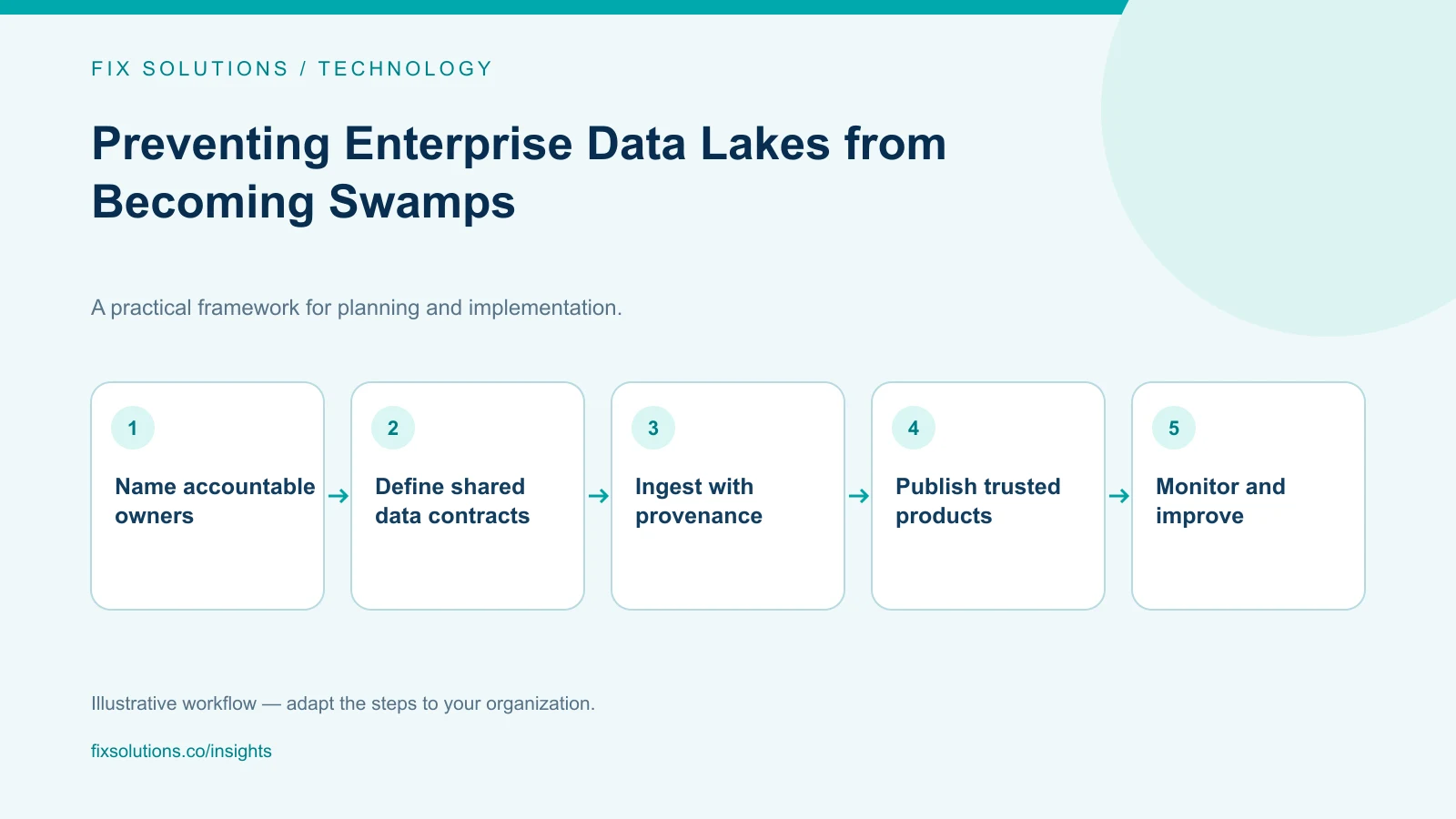
Centralized storage becomes a swamp when teams cannot reliably discover, interpret, trust or use what is stored. Files alone do not provide shared meaning. Assign accountable domain owners, publish schemas and change rules, retain source and lineage metadata, define quality expectations and access controls, and promote data through clear stages into supported data products.
A lake can hold structured tables, event streams, documents and other formats in a comparatively flexible way. That flexibility is valuable for exploration and changing needs. It also makes it easy to accumulate datasets that have no owner, unclear meaning or unknown freshness. Once users repeatedly find stale or contradictory records, they create private extracts and spreadsheets; the organization now has a lake and more silos.
The fix is not to force every dataset into one universal schema before it can be stored. Nor is it to declare every file a governed product. A useful operating model distinguishes exploratory data from trusted, supported datasets and makes the path between them visible.
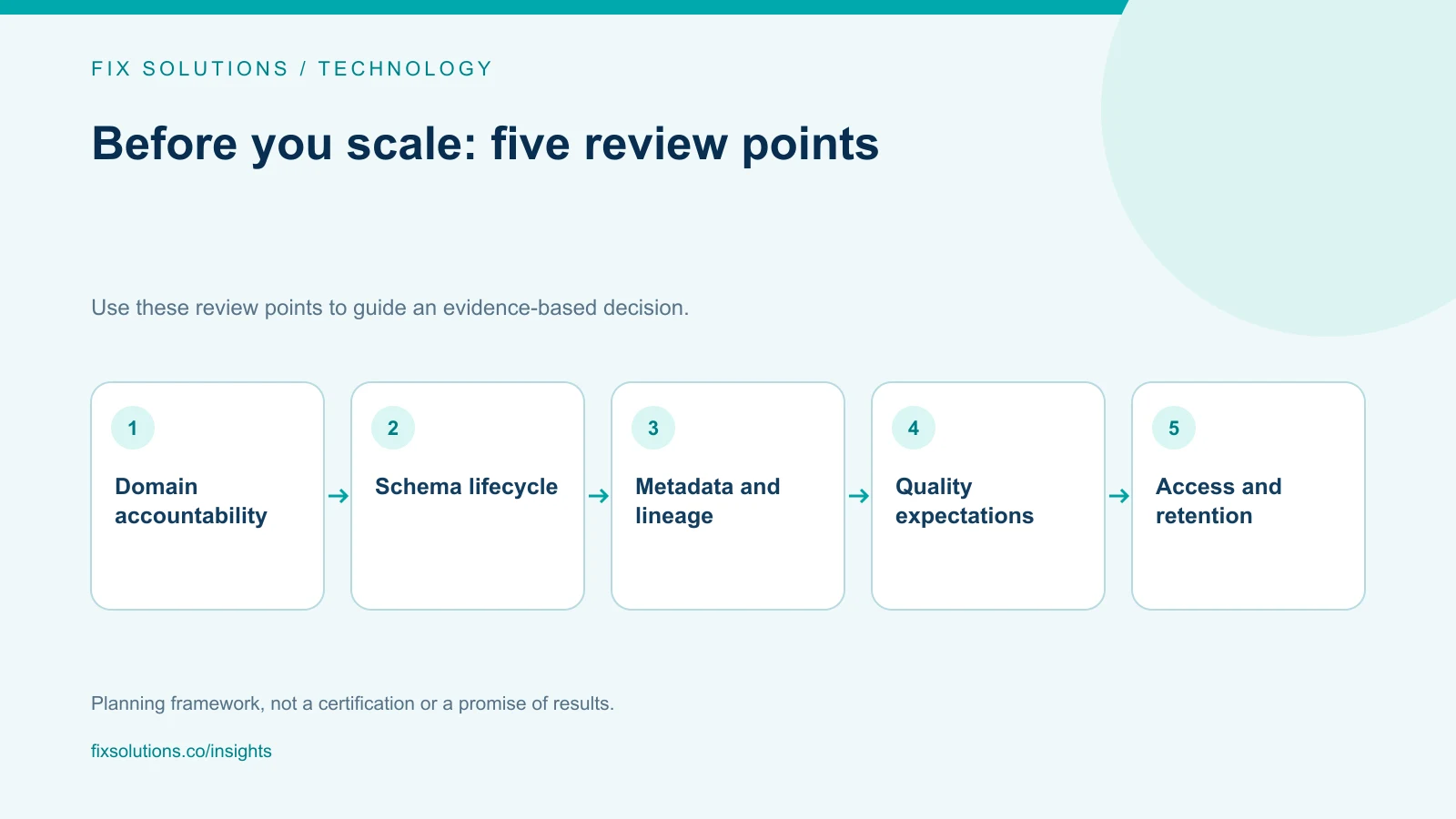
What makes a lake usable?
For a consumer to use data safely, they need to know what it represents, who owns it, how current it is, how it was produced, what quality checks apply, which data may be sensitive and whom to contact when it appears wrong. If those answers are missing, storage and query access do not equal usability.
Start by identifying the decisions and products the platform should support. “Put all enterprise data in one place” is a storage target, not a business outcome. A customer-support analytics product may need ticket history, account identity and outcome definitions; it may not need every sales note and raw web event.
Make ownership explicit
Assign a business data owner for meaning and allowed use, and a technical steward for pipelines and implementation. They may be in different teams. The owner approves definitions, quality rules and material schema changes; the steward maintains ingestion, lineage and operational monitoring.
Ownership should exist at more than one level. A domain can own customer or product concepts, while a specific dataset has its own steward and service expectation. Shared dimensions such as geography or organization identity may need a designated cross-domain governance group. If ownership is shared by everyone, in practice it may be owned by no one.
The owner is not expected to personally fix every row. They establish the contract, route issues and decide what “good enough” means for approved use. Data platform teams provide tools and standards, but should not invent business definitions on behalf of a domain.
Treat schema as a versioned contract
Schema includes more than column names and types. It includes definitions, units, valid values, nullability, keys, time semantics, sensitivity classification and relationships. A field named status can be technically typed as text while remaining useless if no one knows which lifecycle it describes.
For each shared dataset, document the intended consumer, producer, update cadence, key fields, definitions, quality checks and compatibility expectations. Use machine-readable schemas where practical and make them accessible alongside human explanations. Include a clear version and change history.
Govern change without freezing delivery
Schema governance should not require a committee meeting for every exploratory field. Distinguish experimentation from a shared production contract. A team can explore in a sandbox with time limits and suitable access controls; publishing a supported product requires an owner, documented meaning and a quality expectation.
For breaking changes, give consumers notice, offer a migration path and agree on a deprecation date. For compatible additions, communicate the change and test downstream assumptions. Do not silently rename a field or change its business meaning because a source application did.
Use schema registries or contract testing where they fit the architecture, but do not mistake a valid schema file for semantic agreement. Automated checks can detect a missing field or incompatible type; they cannot decide whether “active customer” means a paid account, a recently engaged contact or an account with an open opportunity.
Publish data in stages with provenance
A common pattern separates raw, standardized and curated data. Raw ingestion preserves a traceable representation of source data; standardized models normalize technical shape and quality; curated products serve an identified business or analytical use. Names differ by platform, and the layers do not need to be physically separate. The important part is that users can tell what they are consuming.
Preserve provenance: source system, source record identifier, ingestion time, source event time, transformation version and relevant processing history. This helps diagnose late-arriving records, reprocess a pipeline and explain why a report changed. For sensitive data, make sure provenance does not unnecessarily replicate personal information.
Keep corrections and deletions in the design. A source may correct a record, merge identities or request deletion. Define how updates propagate through raw, normalized and curated products, including backups and derived aggregates. Treat retention as an operational rule, not a storage tier default.
Make metadata discoverable
A catalog should help users find and evaluate a dataset, not just list its path. Include a readable description, owner, domain, classification, quality status, freshness, lineage, terms of use, example queries and a support contact. Record known limitations and excluded populations. A sample query can prevent people from inferring a join rule from a column name.
Capture technical metadata automatically where possible, but validate business metadata with the accountable owner. Use usage feedback to find stale or confusing descriptions. If teams search for a dataset and repeatedly choose a different one, investigate the catalog and product design.
Define quality in terms of intended use
Data quality is not a single universal score. A feed suitable for exploratory trend analysis may be unacceptable for billing reconciliation or eligibility decisions. Define checks according to the consumer and the consequence of an error.
Common dimensions include completeness, validity, uniqueness, consistency, timeliness and referential integrity. Pick specific tests: expected key coverage, allowable duplicate rate, valid code set, freshness threshold or reconciliation tolerance. Assign an owner to respond when a threshold is breached.
Avoid hiding a failed check by silently dropping records or coercing values. Quarantine invalid rows with a reason and a recovery path. Make the effect visible in downstream products. If a data product is stale, show its last successful update and, where appropriate, mark it unavailable for uses that require freshness.
Measure quality at the point where it matters. A pipeline can run successfully while a source field changes meaning or an upstream team stops populating it. Monitor business-level assumptions as well as infrastructure health.
Balance central standards with domain autonomy
Central teams can provide identity, access policy, catalog, lineage, orchestration, storage and common integration standards. Domain teams understand their own entities, processes and exceptions. A federated model pairs shared platform capabilities with clear local accountability.
Set a minimum bar for data products: owner, definition, classification, lineage, quality checks, consumer, update expectations and support route. Allow domains to choose implementation details within security and interoperability boundaries. Avoid central approval for details that have no cross-domain consequence, while requiring review when a shared identifier or metric changes.
Data contracts can formalize responsibilities between producers and consumers. They should cover expected availability, schema evolution, quality, deprecation and communication. A contract is useful only when teams know who can resolve a breach and what happens when it remains unresolved.
Protect data while keeping approved use possible
Classify information and apply access by role and purpose. Separate highly sensitive raw data from broader analytical views. Use masking, aggregation or tokenization where those techniques meet the use case, but do not treat them as substitutes for access controls or privacy review.
Document permitted purposes, retention and sharing restrictions. Audit access to sensitive datasets and periodically review entitlements. Avoid making a raw zone broadly accessible merely because it is technically convenient; it may contain data that users should not need for their task.
Where data concerns individuals, follow applicable privacy and sector requirements with qualified specialists. The NIST Privacy Framework offers a voluntary structure for privacy risk management. For dataset discovery and descriptions, the W3C Data Catalog Vocabulary (DCAT) provides a standard vocabulary. These references can inform an operating model but do not replace legal review or contextual engineering.
A practical recovery plan for an existing swamp
1. Pause indiscriminate expansion. New ingestion should state its owner, purpose and access class. Do not block a critical project, but make unmanaged growth visible.
2. Identify high-value consumers. Find reports, products and decisions that teams currently distrust or reproduce manually. Ask which datasets they use and how they validate them.
3. Triage the inventory. Group assets as supported, exploratory, deprecated or unknown. Find ownerless, duplicate, stale and sensitive datasets. Do not delete unknown data before checking retention, legal holds and dependencies.
4. Repair one data product end to end. Assign an owner, clarify meaning and lineage, add relevant quality checks, document access and publish a reliable consumer view. Prefer a high-value bounded use case over an attempt to catalog everything at once.
5. Establish lifecycle rules. Create review dates for exploratory assets, deprecation plans for unused products and a process for producer changes. Track whether users adopt the trusted product instead of maintaining shadow copies.
This sequence creates visible improvement while the broader inventory is assessed. It does not imply that every historical file can or should be made production-ready.
Common governance mistakes
Centralizing storage but not accountability. A central platform team cannot define every domain’s concepts. Give business owners real authority and an escalation path.
Treating the catalog as the governance program. Metadata is necessary but does not enforce quality, access or lifecycle. Connect catalog records to operational checks and owners.
Mandating a universal schema too early. Standardize shared entities and contracts that support reuse; allow domain-specific exploration where it is safe.
Publishing a quality score without context. Explain which checks ran, when, for what purpose and what failures mean to consumers.
Promoting every experiment to production. Define a boundary and expiration for exploratory assets. Production status should imply named support and expected behavior.
Frequently asked questions
Should every dataset have one enterprise-wide schema?
No. Shared concepts and interfaces need coordinated definitions, but not every domain field must be universal. Use common standards where interoperability and interpretation require them, and preserve local context where they do not.
Does a data catalog prevent a data swamp?
Not by itself. A catalog improves discovery when metadata is accurate and maintained. Ownership, schema governance, access controls, quality monitoring and lifecycle processes are also required.
Should we delete unused lake data?
Not based on a usage query alone. Check business dependencies, retention obligations, legal holds, recovery needs and source availability. Then follow a documented archive or deletion process with an owner.
Sources and further reading
For a data-platform assessment, start with the people using the data and the decisions they need to trust. FIX Solutions’ IT development services can support governance and integration planning.