Should a CTO refactor, re-platform or replace a legacy system?
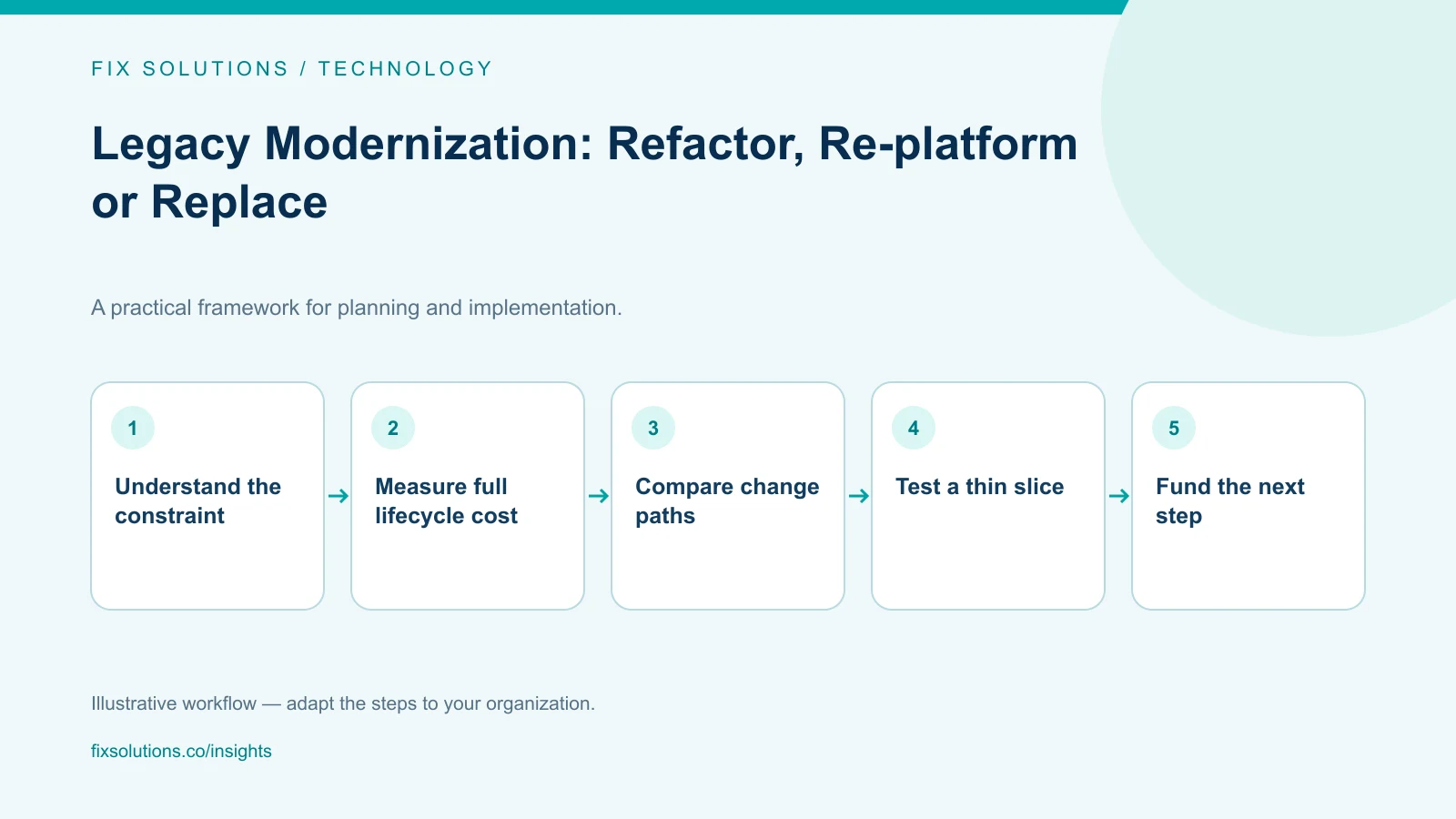
Choose the smallest change that removes the constraint the business actually needs to solve, while keeping transition risk and ongoing ownership affordable. Refactor when internal structure blocks safe change but the platform remains viable; re-platform when the operating environment is the primary burden; replace when business capabilities, supportability or economics cannot be restored incrementally. Validate the choice with evidence, a lifecycle-cost view and a reversible pilot.
“Legacy” describes age or reputation, not a modernization strategy. A decades-old system can be stable, understood and economically valuable. A recently purchased platform can be costly, difficult to integrate and poorly adopted. The decision is not whether old software looks dated; it is whether the system can meet business needs at an acceptable level of risk and cost.
Modernization proposals often compare the current maintenance budget with a proposed project estimate. That leaves out the ongoing cost of the new platform, migration, coexistence, retraining, data reconciliation and operational change. A credible decision includes both the cost of staying and the cost and risk of moving.
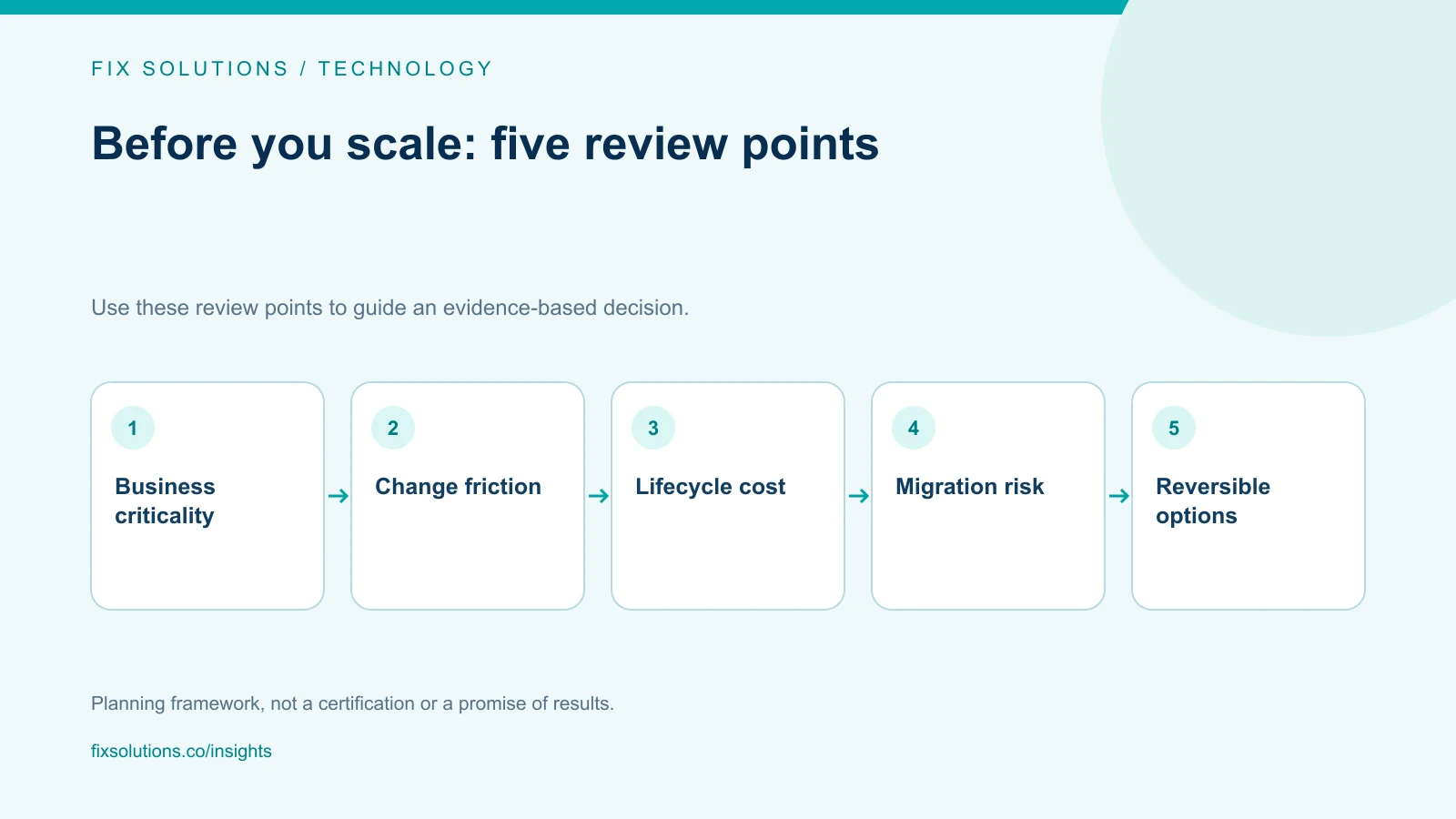
Diagnose the constraint before choosing a technology
Describe the business problem in observable terms. Is a release delayed because changes are hard to test? Is a platform approaching end of vendor support? Is the application too expensive to operate? Does it prevent a required integration or product capability? Different problems call for different interventions.
Build a current-state view that includes more than source code. Inventory the application’s users, critical workflows, data owners, interfaces, batch windows, service dependencies, vendors, operational procedures and recovery requirements. Identify what is known, what is inferred and what nobody currently understands.
Measure change friction
Collect evidence from recent changes: lead time, defect escape rate, deployment frequency, rollback effort, change failure patterns, incident recurrence and manual work. Add qualitative evidence from developers and users. A system with few releases may be stable by design, or the team may avoid changes because testing is difficult. The number alone cannot distinguish the two.
Observe a representative workflow from initiation to outcome. A screen that looks obsolete may sit on top of a dependable business process, while a modern interface may conceal a fragile batch dependency. Map critical behavior and exceptions before redesigning it.
Separate risk from inconvenience
Prioritize unsupported components, security exposure, failure concentration, recovery gaps and key-person dependency. An awkward report is inconvenient; a system with no tested recovery path may represent a business-continuity risk. Make risk statements specific enough to evaluate likelihood, impact and mitigation rather than labeling the entire application “high risk.”
Check vendor contracts and regulatory obligations with the appropriate owners. A rewrite does not automatically remove compliance concerns: the replacement inherits data, access, retention and operational responsibilities. Conversely, an older product may still be supportable if an upgrade or compensating control is viable.
Compare the three main paths
| Path | Best fit when | Typical work | Main tradeoff |
|---|---|---|---|
| Refactor | The platform remains viable, but code structure or tests impede change | Restructure components, add seams and tests, remove coupling | Benefits accrue incrementally; constraints outside code remain |
| Re-platform | The application still performs its business role, but infrastructure or operations are costly or unsupported | Move runtime, database or hosting with limited functional change | Migration can expose hidden assumptions without improving product capability |
| Replace | The business model or required capabilities no longer fit the system | Adopt or build a successor, migrate data and transition workflows | Highest change scope and coexistence risk; potential for a cleaner target state |
These are not mutually exclusive for an entire estate. One component may be re-platformed while another is replaced and a stable module is left alone. Some organizations use a gradual replacement pattern in which new capabilities take traffic over time and the old path is retired only after evidence supports the cutover.
When refactoring is the better investment
Refactor when the system’s core capabilities remain valuable and the organization can improve its structure without changing the user-facing behavior all at once. Typical triggers include duplicated business rules, brittle dependencies, slow testing or a feature that cannot be changed safely.
Make the goal concrete. “Clean up the codebase” is hard to prioritize. “Create a tested interface around the pricing rule so new channels can use it without duplicating calculation logic” defines a business-relevant seam. Add characterization tests for current behavior before moving logic, including edge cases and unexpected historical rules.
Refactoring is not risk-free. A small code change can alter subtle behavior if undocumented rules exist. Avoid combining a large functional redesign, database migration and team reorganization in the same step. Keep changes reviewable and observable, and measure whether the targeted friction actually falls.
Refactoring is a poor answer when the runtime is no longer supportable, the underlying product cannot meet critical needs, or changes are blocked by a vendor contract rather than code structure. It can still reduce transition risk while a replacement is built, but leadership should name that role explicitly.
When re-platforming is justified
Re-platform when the primary pain comes from the environment: end-of-support operating systems, data-center constraints, unreliable deployment infrastructure, operational burden or a suitable managed service opportunity. A re-platform aims to move the application with limited functional change, but “limited” must be verified.
Inventory dependencies that often remain hidden: local file paths, scheduled jobs, network allowlists, time-zone assumptions, transaction boundaries, licensing, printing, batch order and monitoring agents. A test environment that lacks production scale can conceal performance and cost differences. Use representative data and workload patterns, subject to security and privacy controls.
Estimate total operating cost after migration, including platform services, data transfer, observability, support, licensing, new skills and resilience. Cloud hosting does not automatically lower cost or remove maintenance. It changes what the team operates and how it pays for capacity.
Treat the first migration as a hypothesis. Select one workload with enough complexity to validate the important dependencies but low enough blast radius to recover. Define rollback, data reconciliation and acceptance criteria before moving production traffic. Consult provider-specific migration guidance such as the AWS migration strategies, then adapt it to the actual platform and constraints.
When replacement is warranted
Replacement becomes more credible when the current system cannot meet essential capabilities, the vendor or technology path is ending, operational knowledge is disappearing, or the cost of continued adaptation exceeds a viable alternative. A replacement decision still needs a bounded case: which processes change, which data moves, what remains, and who will own the new service.
First decide whether to buy, configure, extend or build. Buying a standard product may reduce custom code but constrain process fit or increase integration work. Building can preserve differentiation but creates a long-term ownership obligation. Compare the full capability and operating model, not just the feature list or license price.
Protect the business during coexistence
Large replacements rarely happen in one instant. Plan how old and new systems share responsibility during transition. Identify the authoritative record for each entity at every phase, how updates flow, how conflicts are resolved and how users know which application to use.
Dual writes can create divergence if the two systems accept changes independently. Prefer clear ownership boundaries and controlled synchronization. If temporary duplication is unavoidable, define reconciliation reports, exception ownership and an end date. A “temporary” bridge with no retirement plan can become permanent architecture.
Migrate in slices aligned with business boundaries where possible. Validate records before and after each move, including totals and relationships, not only row counts. Rehearse cutover and recovery using realistic conditions. Keep a way to stop or reverse a phase until the consequences of rollback are understood.
Calculate lifecycle cost, not just project cost
Compare options over a period long enough to show their different cost profiles. Include:
- Current operating, licensing, support and incident costs.
- Planned maintenance and required upgrades for the keep path.
- Delivery labor, vendor services, data migration and integration work.
- Parallel operation, training, process redesign and lost productivity.
- Ongoing support, hosting, licenses, security and resilience for the target.
- Risk exposure and the cost of delayed capabilities, described transparently.
Use ranges where estimates are uncertain. Identify assumptions and sensitivity: which number changes the recommendation most? If a replacement only makes sense under optimistic adoption or a large unverified saving, the next investment may be discovery rather than a full implementation.
Avoid fake precision in risk-adjusted calculations. A probability multiplied by an invented impact does not make an estimate reliable. Use expert judgment, incident history, scenario analysis and clear confidence levels. Have finance and technical owners review the same assumptions.
Use a decision matrix, then test the leading path
Score each option against business fit, supportability, security, ability to change, transition risk, total cost, time to value and capability to operate the result. Weight criteria according to the organization’s priorities. Record who set the weights and what evidence supports each score.
Then test the leading choice with a thin slice. A refactor pilot should prove that changes become safer or faster. A re-platform pilot should reveal real dependencies and operating cost. A replacement proof should test the hardest integration, data migration and user workflow—not just the easiest screen.
Set a decision gate before the pilot starts: what must be true to proceed, what would cause a redesign, and what evidence would stop the effort? A pilot without a decision attached is often a demonstration, not a risk-reduction activity.
Common modernization traps
Rewriting because the code is old. Age alone does not establish business value or risk. Trace the relevant operational or capability constraint.
Moving to microservices by default. Distributed systems add deployment, networking, data consistency and observability responsibilities. Choose service boundaries only when independent change or scaling justifies those costs.
Treating a vendor demo as a fit assessment. Validate edge cases, integrations, access control, reporting, export and exit terms with the people who will operate the product.
Ignoring the keep option. Continued investment can be rational if the system is stable and the capability is not strategic. “Do nothing” should still include security maintenance, recovery testing and a retirement trigger.
Funding delivery but not ownership. Every target system needs an accountable product owner, support model, monitoring and a funded plan for upgrades.
Frequently asked questions
How do we know when legacy code should be replaced?
Replacement is worth evaluating when a critical capability, support or risk constraint cannot be addressed economically through smaller changes. Compare lifecycle cost and transition risk, then validate the hardest assumptions with a limited pilot.
Is refactoring cheaper than rewriting?
It depends on the scope, constraints and time horizon. Refactoring spreads change and can preserve working behavior, but it may not remove platform limitations. A rewrite concentrates cost and transition risk. Compare options using evidence from the actual application.
Can we modernize without stopping operations?
Often, but continuity must be designed and tested. Use bounded releases, explicit ownership during coexistence, data reconciliation, rollback plans and operational acceptance. The safe method depends on transaction volume and recovery requirements.
Sources and further reading
- AWS Prescriptive Guidance: Migration strategies
- Martin Fowler: Strangler Fig Application
- Google Cloud Architecture Framework: System design
For a neutral modernization roadmap, begin with business constraints, evidence and a reversible first step. FIX Solutions’ IT development services can help scope that assessment.