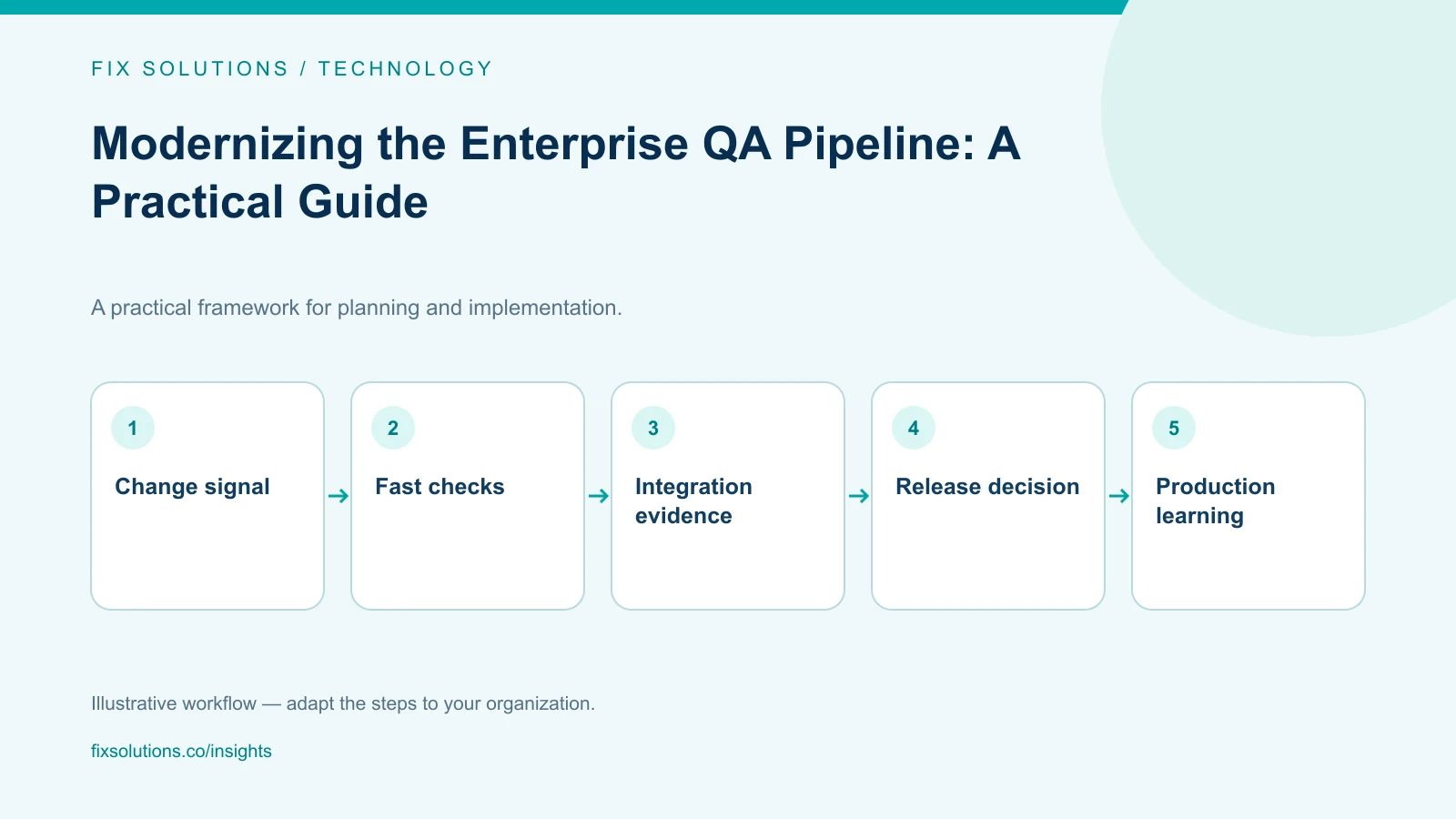
What does a modern enterprise QA pipeline need?
A modern QA pipeline gives teams fast, trustworthy evidence about change risk, then expands validation before release where needed. Use layered tests, stable environments, controlled data and actionable diagnostics. Align gates to business criticality and use production feedback to improve coverage. Adding more tools or stages without reducing uncertainty does not modernize quality.
Enterprise pipelines often reflect years of mergers, platform changes and release controls. Tests may be slow or flaky, environments may differ from production, and separate teams may own code, infrastructure and approval. The goal is not to force every application into one template; it is to make quality evidence consistent enough to support safe, timely decisions.
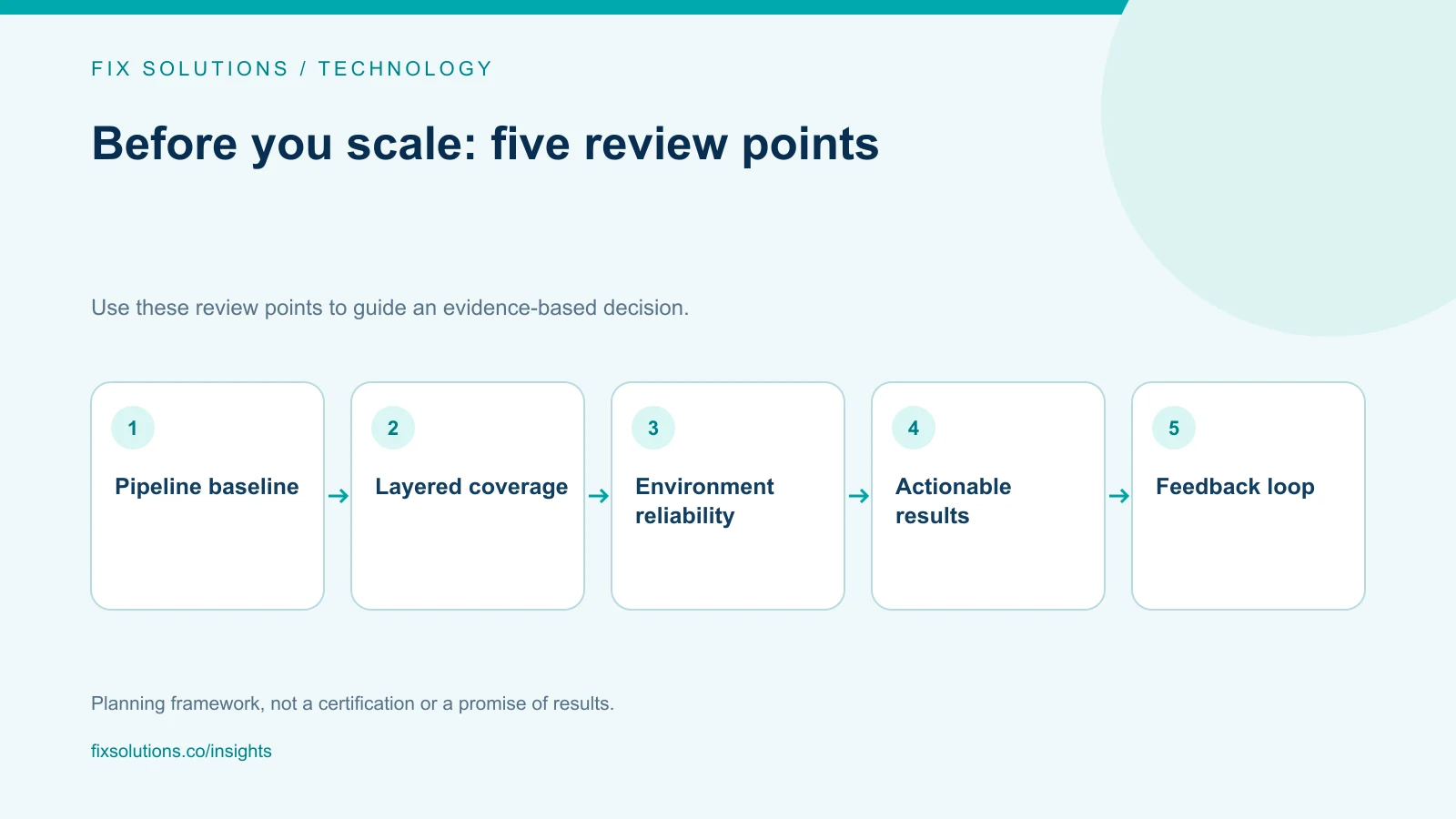
Baseline the current pipeline
Map the path from code change to production: build, static analysis, unit and component tests, integration checks, security review, acceptance, approval and deployment. Record where work waits, where failures occur and how teams diagnose them. Measure build duration, queue time, flaky tests, escaped defects, rollback frequency and time to understand a failed check.
Segment results by application type and criticality. A low-risk internal tool and a regulated transaction system may need different gates and evidence. Identify shared bottlenecks such as scarce test environments, manual data setup or approvals that arrive late. Establish a baseline before changing tools so the team can tell whether outcomes improved.
Design a layered test strategy
Run quick checks close to the code change: formatting, static analysis, unit tests and focused component checks. Add service and contract tests where they provide strong evidence about interfaces. Use integration environments for interactions that cannot be represented adequately by isolated tests, and reserve end-to-end scenarios for critical business journeys.
Tests should be placed where they are reliable and maintainable. A UI-level test is valuable when the interface itself is the risk, but it may be a poor way to assert every business rule. A service-level test can exercise a contract directly, but it may not catch a broken user workflow. Use layers together and document intentional gaps.
Define promotion rules for each stage. A failure should identify the owning team, evidence and next action. For known exceptions, require an owner, rationale and expiration rather than allowing a permanent bypass. Set release criteria based on system risk and agreed service needs.
Make environments repeatable and secure
Provision test environments with versioned configuration and controlled dependencies. Keep environment differences visible: data volume, identity setup, network routes, feature flags and third-party integrations can affect results. Use ephemeral environments for suitable workloads and shared environments where dependencies or licensing make that impractical.
Design test data intentionally. Use synthetic or approved masked data, isolate tests that mutate shared state, and define cleanup. Protect credentials with managed secret handling and least privilege. Establish a reliable refresh process so teams do not create unofficial copies of sensitive production data to get realistic tests.
For external systems, use stable contracts, test endpoints or simulators for fast feedback, then schedule appropriate integration checks against controlled environments. A stub is useful for isolating a change but cannot prove that the real partner endpoint still behaves as expected.
Improve pipeline speed and signal
Parallelize independent work where resources allow. Cache only inputs that remain valid, and invalidate caches when dependencies or configuration change. Select targeted tests based on affected components only when the selection logic is trustworthy and broader validation still occurs at appropriate milestones.
Separate test failures from infrastructure failures, but do not label a test “flaky” without evidence. Capture logs, traces, environment versions, screenshots where useful and test data identifiers. Track recurring failures to a named owner. Use retries sparingly and report the first failure so intermittent defects do not disappear from view.
Monitor both pipeline reliability and delivery outcomes. A shorter build is not an improvement if it omits critical checks; a green pipeline is not proof of quality if tests make weak assertions. Review whether teams can interpret results and resolve the failure without a separate investigation meeting.
Integrate security and release governance
Security checks belong in the delivery path, but they need clear thresholds and remediation routes. Run dependency, configuration and code checks at the stage where teams can act on them. Define what blocks release, who can approve exceptions and how unresolved issues are tracked.
Keep production approvals proportionate to risk. Automate repeatable policy checks and reserve human approval for decisions requiring context. Ensure deployment artifacts are traceable to source and test evidence. Include rollback or recovery validation for systems where release failure has material impact.
Learn from production and evolve incrementally
Review incidents, customer reports, rollback events and support issues to find missing tests or weak assertions. Feed representative failures back into test design. Maintain a small set of realistic pre-release journeys and add coverage where evidence shows it would have detected a meaningful issue.
Modernization should proceed in stages. Choose one representative application or service, remove a clear bottleneck, validate the revised pipeline and document reusable patterns. Avoid migrating every repository to a new platform before proving that the workflow works for different architectures and controls.
The Google testing blog’s article on test layers offers a useful discussion of feedback speed, test scope and maintenance trade-offs. Use it as a design reference, then set the pipeline shape based on your system’s architecture and risk.
Frequently asked questions
Should every test run on every pull request?
No. Run fast, relevant checks on each change and broader suites at defined milestones. Any selective strategy needs evidence that critical changes are not silently excluded.
Should QA own the entire pipeline?
Quality is shared. QA can lead strategy and test engineering, while developers own code-level checks and platform teams provide reliable pipeline infrastructure. Define responsibility for each gate and failure.
How do we handle legacy applications?
Start with their critical workflows and practical interfaces. Improve one stage at a time, preserve required controls and make the environment and data limitations explicit.
Modernize for evidence and learning
A QA pipeline is effective when it shortens the path from change to trustworthy feedback and makes release risk visible. FIX Solutions can help assess test strategy and pipeline improvements through quality engineering services.