How can an enterprise reduce its AWS or Azure bill?
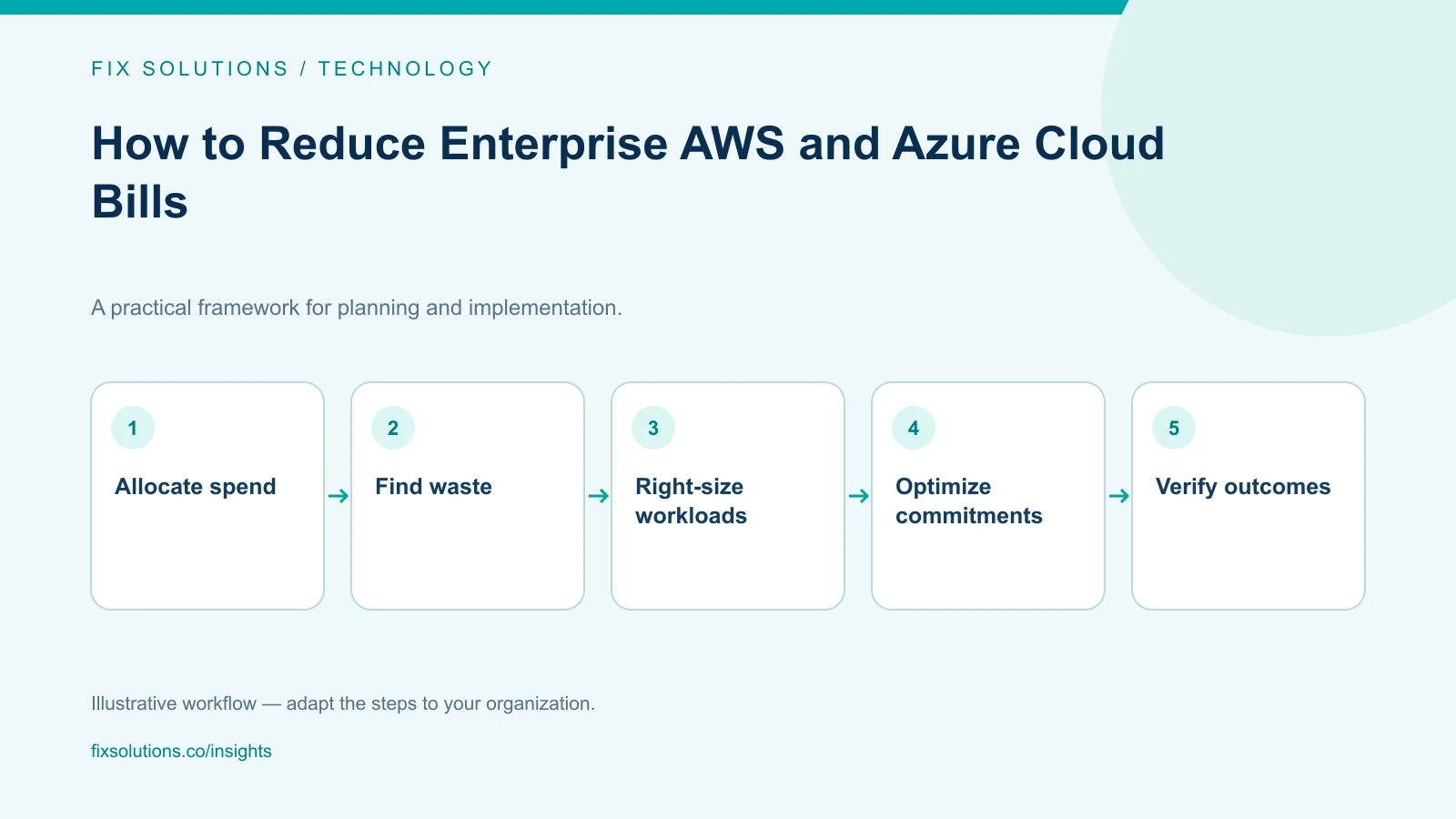
Start by making cloud spend attributable, then reduce waste based on measured workload behavior. Identify owners and business purpose, compare provisioned capacity with actual usage, review storage and data transfer, and assess commitments only after the workload is understood. Validate every change against reliability, security and performance requirements. Cost reduction should improve unit economics without creating hidden operational risk.
AWS and Azure offer different services, billing dimensions and commitment programs, so there is no universal list of switches that safely reduces every bill. The durable approach is an operating process: measure, assign, investigate, change, and verify. FinOps guidance from the FinOps Foundation describes this as a collaborative practice connecting engineering, finance and business teams.
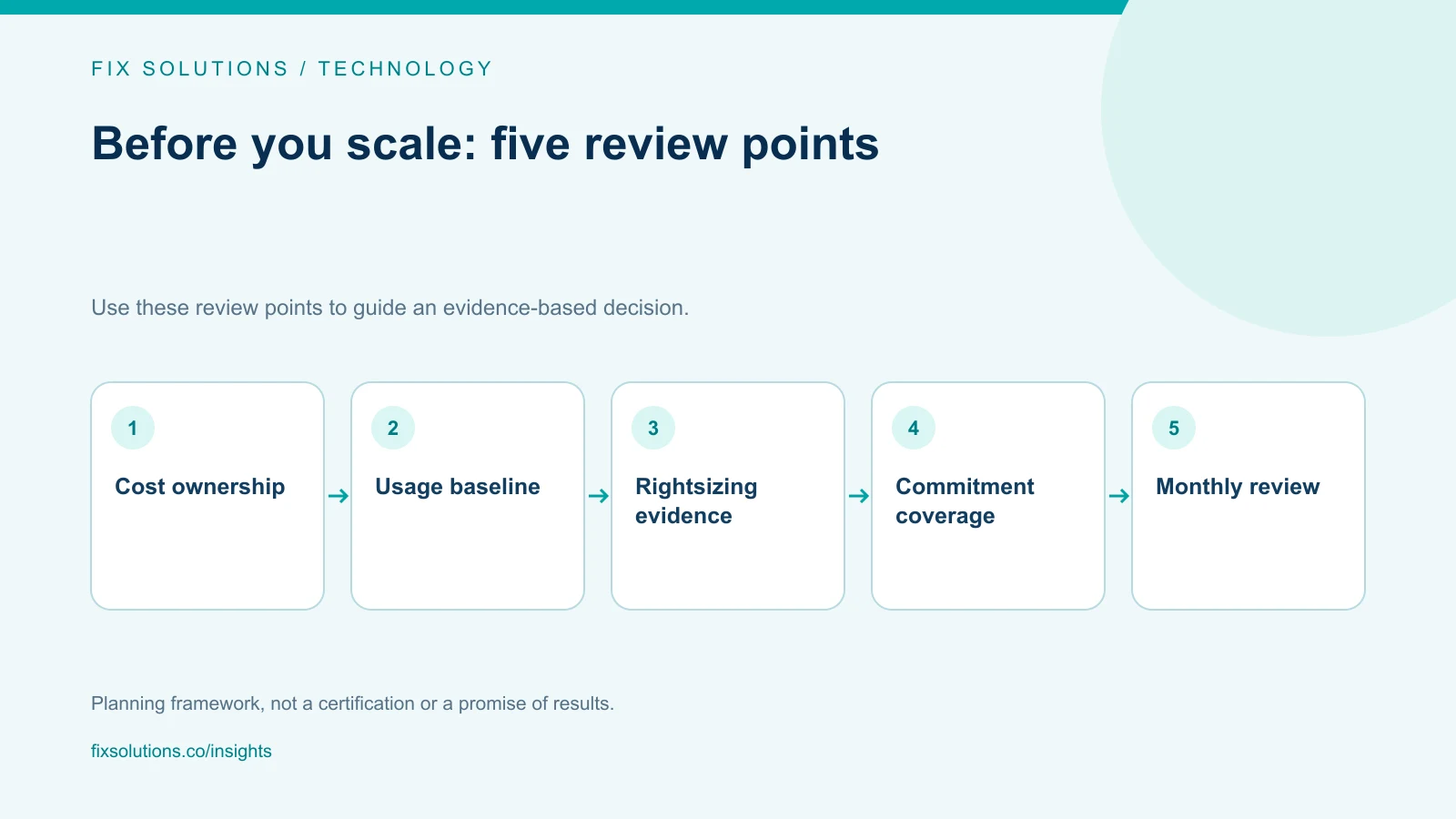
Establish ownership before optimizing
Organize billing data by account or subscription, product, environment, team and cost center where practical. Use tags or labels consistently, but do not assume tags alone solve allocation: some shared services need an explicit allocation rule. Identify an owner for unallocated spend and set a process to correct missing ownership.
Create a monthly baseline that distinguishes recurring services, one-time purchases, credits and taxes. Compare costs over equivalent periods and account for seasonality, growth and exchange rates where relevant. Report cost alongside a useful unit such as active customer, transaction, build or workload. A rising bill may be acceptable if usage and business value grew faster; a flat bill can hide a deteriorating cost per transaction.
Give engineering teams access to data they can act on. Finance reports can show where money went, while resource-level utilization and architecture context help explain why. Define a regular review with owners who can approve changes, not only people who can observe the invoice.
Find low-risk waste first
Review unattached disks, abandoned snapshots, unused public IP addresses, idle load balancers, stopped instances that still incur charges, forgotten test environments and duplicate logs. Confirm ownership and retention requirements before deletion. “Unused” is a hypothesis; production dependencies and recovery requirements must be checked.
Set schedules for development environments when they are not needed, provided teams can restore them reliably. Apply lifecycle rules to logs, backups and object storage according to compliance and recovery needs. Archive data only after validating retrieval time, restore procedure and total storage-plus-access cost.
Examine observability volume. Duplicate telemetry, unbounded debug logs and long retention can drive storage and query costs. Reduce noise through sampling, appropriate log levels and retention tiers, while retaining signals required for incident response, audit and security investigations.
Right-size compute and databases with evidence
Use utilization history covering normal demand and predictable peaks. Check CPU, memory, disk, network, request rates, queue depth and latency rather than choosing a smaller instance based on one metric. A low average can hide a sharp peak or a workload constrained by memory or I/O.
Test changes in a lower-risk environment, use gradual rollout where possible, and monitor service-level indicators after deployment. Confirm autoscaling boundaries and fallback behavior. For managed databases, examine provisioned capacity, storage growth, backup policy, replicas and query patterns. Avoid reducing resilience or recovery posture just to lower a line item.
For containers, connect cluster-level spend to namespaces, workloads and teams. Review requests and limits, bin packing, node utilization and idle capacity. A shared cluster may look efficient overall while a single workload reserves a disproportionate share.
Review network and architecture costs
Data transfer, NAT gateways, inter-zone traffic, cross-region replication, content delivery and managed service requests can be significant. Map high-volume paths and verify that traffic crosses only the network boundaries the design actually needs. Do not remove redundancy or move data across regions without checking latency, recovery and regulatory requirements.
Compare total system cost, not one service price. Moving compute to a cheaper region or service may increase transfer, support, or operational costs. For a change that affects customer experience, evaluate latency and availability alongside projected savings.
Use commitments carefully
Discount commitments can reduce the effective rate for predictable usage, but they can also create payment obligations for capacity that the organization no longer needs. First understand the baseline, planned migrations, product lifecycle and acceptable risk. Compare options using current provider terms and authoritative calculators; eligibility, flexibility and billing rules change over time.
Separate stable baseline usage from experimental or seasonal demand. Get finance, engineering and procurement agreement on coverage and ownership. Assign a person to monitor utilization and renewal decisions, and retain a decision record explaining the assumptions. Do not purchase commitments simply to improve a short-term dashboard.
Make savings measurable and safe
Each optimization should have a named owner, an expected cost change, a technical risk assessment and a verification period. Record the before-and-after configuration and the measurement window. Validate performance, error rates, availability, backup and recovery. If outcomes worsen, roll back and investigate rather than counting a nominal price reduction as success.
Use a prioritized backlog: quick cleanup, rightsizing candidates, architecture changes and commercial decisions. Rank by expected impact, confidence, engineering effort and risk. Make cost part of architecture reviews and deployment practices so new resources have owners, budgets and retirement plans.
For provider-specific guidance, consult the current AWS Well-Architected Cost Optimization Pillar and Azure cost optimization guidance. Validate pricing and service terms with each provider before making purchasing decisions.
Frequently asked questions
Can AWS and Azure costs be managed with the same process?
The governance process can be shared, but service-level analysis and billing details are provider-specific. Use each provider’s current cost-management tools and documentation for implementation.
Should we optimize production first?
Begin where the opportunity and risk are both understood. Non-production cleanup can be a lower-risk start, but production may contain the largest opportunity. Apply the same reliability and change controls to either environment.
How quickly will savings appear?
Timing depends on billing cycles, commitment terms, architecture work and validation. Track realized spend after changes and separate verified savings from forecasts, credits and one-time effects.
Make cloud cost a continuous engineering signal
Lower bills come from recurring ownership, workload-informed decisions and verification—not a single cleanup sprint. Connect spend to business value, let workload owners participate and protect reliability while making changes. FIX Solutions can help review cloud architecture and operational priorities through IT development services.