When should a business choose serverless architecture?
Serverless architecture can fit event-driven, intermittent or independently scalable workloads when managed services match the application's constraints. Evaluate execution limits, latency, integration dependencies, operating skills and total cost before migrating. Start with a bounded capability and retain a rollback path. Serverless changes who operates parts of the infrastructure; it does not remove application operations.
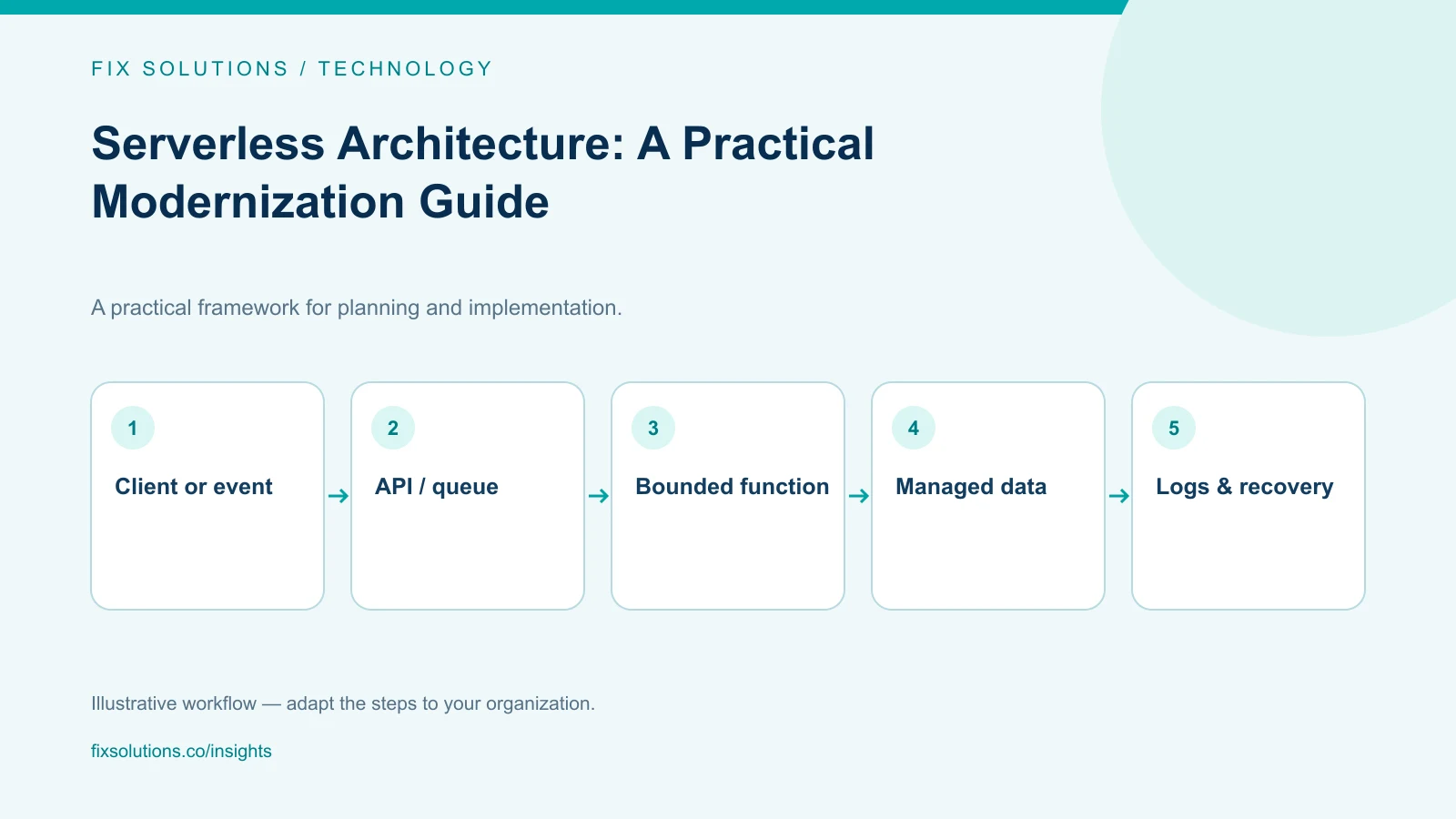
The label covers more than short-lived functions. An application may combine managed APIs, queues, databases, identity services and scheduled jobs. The design challenge is deciding where those services improve the workflow and where they introduce constraints the team cannot accept.
A modernization decision should be grounded in the existing application. Moving code into functions without changing its assumptions about state, retries and connections can create a more complicated system with the same original problems.
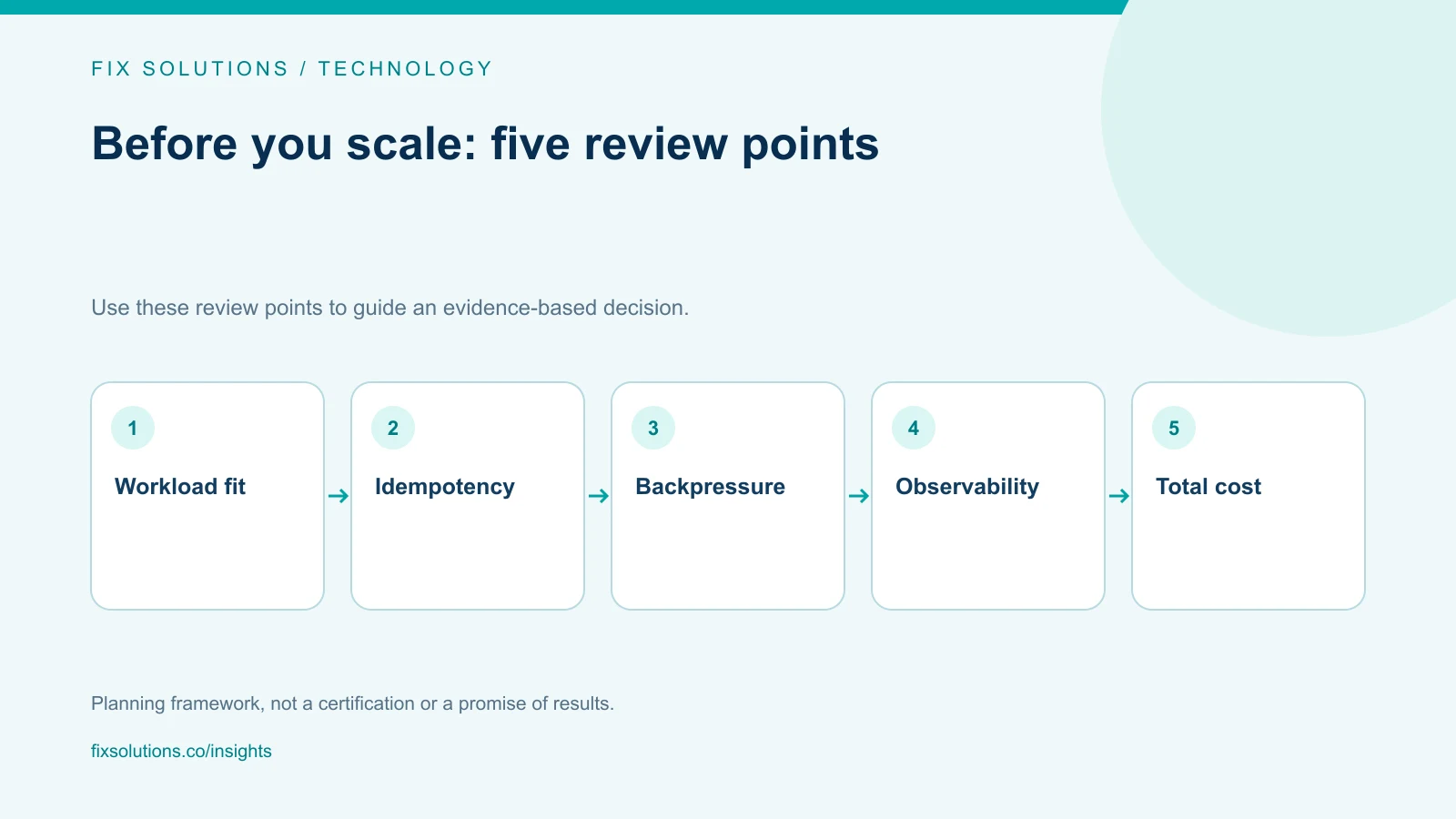
Understand what changes and what remains your responsibility
With managed compute, a provider operates underlying infrastructure according to the service contract. Your team still owns application behavior, data access, dependency configuration, deployment, monitoring and recovery. Service limits and provider outages remain part of the architecture.
The AWS Serverless Applications Lens is one provider-specific reference for reviewing serverless applications. Use equivalent documentation for your chosen platform rather than assuming limits and operational behavior are interchangeable.
| Responsibility | Still needs an application owner? | Example question |
|---|---|---|
| Business correctness | Yes | Can the transaction produce a duplicate result? |
| Access control | Yes | Which identity can invoke or read this resource? |
| Data lifecycle | Yes | Where is state stored and when is it deleted? |
| Capacity planning | Yes | What happens when downstream capacity is exceeded? |
| Incident response | Yes | How is failed work detected and recovered? |
Managed infrastructure can reduce some operational tasks, but those remaining responsibilities must have named owners and tested procedures.
Evaluate workload fit before choosing a platform
Workloads that may be good candidates
Asynchronous document processing, scheduled synchronization, webhook handling and small APIs can be useful starting points. They often have identifiable inputs, bounded work and a clear completion state. Traffic variability can also make independent scaling attractive.
For example, a document-upload event can enter a queue, trigger validation and store a result for review. The surrounding workflow can continue independently of the web request. See document-intelligence workflows for a business capability that can be decomposed this way.
Workloads that need closer scrutiny
Long-running processing, specialized hardware, tightly coupled transactions and strict latency requirements may require a different approach or a hybrid design. Check current provider limits, cold-start behavior, network requirements and execution models against representative workloads.
Do not compare only an idle server with a single function invocation. Compare complete architectures under realistic traffic, including the managed services, network paths and operating work each requires.
Design for events, duplicates and partial failure
Define the event contract
An event should identify what happened, the relevant record, its version and enough context for consumers to respond correctly. Avoid making downstream consumers infer business meaning from an undocumented payload. Version the contract when changes can affect existing consumers.
Decide whether ordering matters. If updates can arrive out of order, the consumer may need a version check or another reconciliation rule. A queue does not automatically establish the business ordering your application needs.
Make repeated processing safe
Delivery and retry behavior varies by service and configuration. Design for duplicate processing wherever it is possible. An idempotency key can help associate repeated requests with one business operation, but it must be stored and checked reliably.
The AWS Lambda best-practices guide recommends idempotent code and attention to execution and scaling behavior. Those recommendations support a broader engineering principle: a retry should not accidentally repeat a charge, notification or irreversible update.
Separate transient and permanent failures
A temporary network failure may justify a retry. Invalid business data usually needs correction or review instead. Define retry limits, delay behavior and a route for work that cannot complete. A dead-letter queue is useful only if someone monitors and resolves it.
Engineering note: record the difference between “received,” “processed” and “accepted by the downstream system.” Treating them as one status makes incident investigation and reconciliation much harder.
Keep state and transactions explicit
Functions should not assume that local memory or temporary storage will provide durable shared state. Store important state in a service designed for the required consistency, lifecycle and access model. Understand what happens when several invocations act on the same record.
Transactions spanning services require careful design. A workflow may need compensating actions, reservations or explicit intermediate states rather than one database transaction. Explain those states to operations staff so they can distinguish unfinished work from a permanent failure.
Consider connection behavior when many function instances reach a relational database. Uncontrolled concurrency can overwhelm a downstream dependency even if the compute layer scales successfully. Set limits and evaluate pooling or other provider-supported patterns where appropriate.
Model total cost under real operating scenarios
Serverless does not guarantee a lower bill. Include compute, requests, database operations, logs, queues, storage, network transfer and support effort. High-volume logging or repeated failed work can materially change the cost model.
Build at least three scenarios: typical demand, a peak period and a failure-driven retry surge. Use current provider pricing and service limits when creating the estimate. Record assumptions such as average duration, payload size and retry frequency.
| Cost driver | What to measure |
|---|---|
| Compute | Duration, memory or resource allocation and invocation count |
| Managed services | API, queue, database and workflow operations |
| Data movement | Transfer paths, payload sizes and regional boundaries |
| Observability | Log volume, retention and query usage |
| Human operations | Support, debugging and failed-work handling |
Use cost per useful transaction alongside the total bill. A cheaper invocation is not a business saving if it increases failed work, support effort or customer waiting time.
Modernize one boundary at a time
Identify a capability that can be separated with a stable interface. Establish its inputs, outputs, ownership and failure behavior. Keep the existing system available while the new path is tested, where the workflow allows that safely.
An initial release might move report generation or a document-processing step without replacing the main transaction system. This gives the team evidence about deployment, observability and support before taking on more consequential responsibilities.
Plan the migration sequence
- Map dependencies and current operating behavior.
- Define the new interface and acceptance criteria.
- Implement monitoring, retry controls and reconciliation.
- Test representative traffic and failure cases.
- Roll out to a limited workload with explicit ownership.
- Compare reliability, cost and operational effort.
- Expand, revise or roll back based on the results.
Avoid running both paths in a way that produces duplicate external effects. Shadow execution can be useful for read-only comparisons, but write operations need a clear single source of authority.
An illustrative modernization decision
Suppose an enterprise application generates customer reports during peak business hours. The work delays interactive requests, but each report can be produced asynchronously. A candidate design places authorized report requests in a queue and processes them independently.
The pilot defines job status, access to the generated report, maximum retries and how users are notified. It measures completion time, failed jobs, cost per completed report and impact on the main application. It also tests a slow database and unavailable storage destination.
If the new path reduces contention but creates an unmanageable support queue, the design needs improvement before expansion. If the workload is consistently heavy and predictable, compare it with a long-running service as well. The objective is a dependable reporting capability, not maximum use of functions.
Operate the system as a connected workflow
Use a correlation identifier across the API, queue, compute and data layers. Build dashboards around business completion and backlog age, not only function success counts. An invocation can finish successfully while the expected downstream result remains missing.
Document recovery procedures and practice them. Include how to replay a safe subset of events, prevent duplicate side effects and communicate an incident to the business. Review access policies and dependencies alongside application releases.
Teams evaluating a wider change can use our digital transformation recovery guide to connect technical work with workflow ownership and adoption.
Frequently asked questions
Is serverless always cheaper than containers or virtual machines?
No. Cost depends on demand, duration, data movement, managed-service usage and operating effort. Compare complete alternatives under realistic traffic and failure scenarios. A hybrid architecture may be the most suitable choice.
Can a legacy application move to serverless without a rebuild?
Selected capabilities can often move behind stable interfaces while the main application remains in place. Suitability depends on coupling, state and integration constraints. A full rewrite should not be assumed before examining those boundaries.
Does serverless remove the need for DevOps?
No. Deployment automation, access management, observability, incident response and cost control remain necessary. The work changes because some infrastructure responsibilities move to managed services, but application ownership remains with the team.
Choose architecture around the workload
FIX Solutions supports cloud and IT development, quality engineering and technology leadership. Bring the workload profile, integration map and operating constraints to an architecture discussion.
Contact our engineering team to scope a phased modernization and define the evidence needed before a wider migration.