What causes digital transformation to stall?
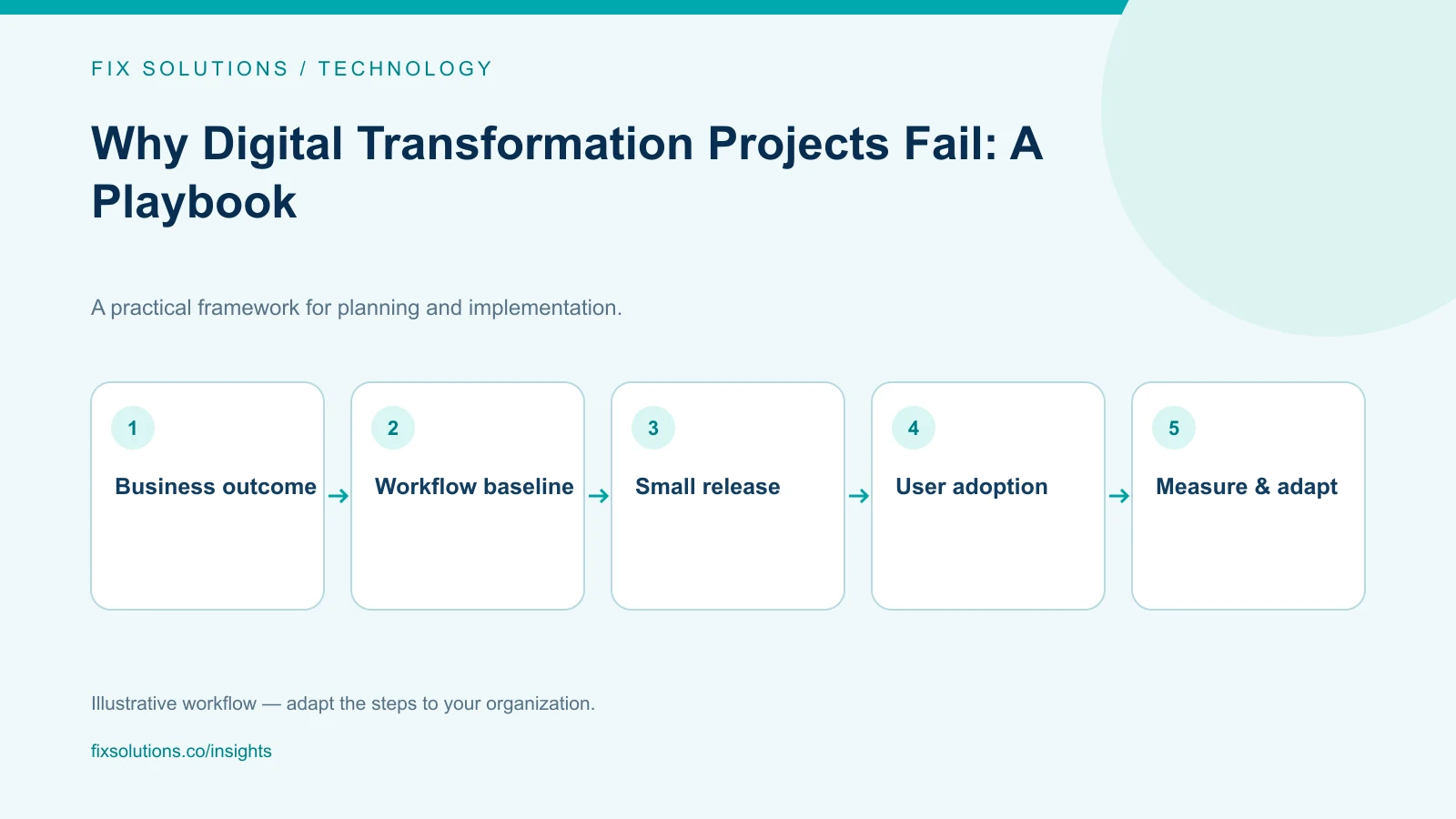
Digital transformation projects fail when technology delivery becomes disconnected from operating change. Common problems include unclear business outcomes, fragmented ownership, excessive scope, unresolved data dependencies and weak adoption. Recovery starts by identifying one measurable workflow improvement, giving it an accountable owner and delivering a small end-to-end release that people can actually use.
A new platform can launch on schedule while the organization continues working through spreadsheets and manual reconciliation. Conversely, a smaller improvement can be valuable even when it does not replace the entire technology stack. Transformation should be judged by changes in how work gets done.
There is no single failure percentage that reliably describes every industry, program size or definition of success. This guide focuses on observable warning signs and practical decisions rather than repeating an unsupported headline statistic.
Start with the operating problem, not the platform
“Move to the cloud” describes a technical direction. “Reduce the time needed to approve an order without increasing errors” describes an outcome. The second statement helps a team decide which interfaces, records and responsibilities need to change.
Write a problem statement that includes the affected users, the current limitation and the cost of leaving it unresolved. Validate it by observing real work. Interviews can identify frustration, but a workflow walkthrough often reveals exceptions that nobody remembered to mention.
The UK Government's discovery guidance emphasizes understanding the problem and users before committing to a solution. For a business transformation, this supports a practical discipline: discovery must be allowed to change the proposed scope.
Establish a useful baseline
Choose measures that can be collected before and after the change. Completion time, error rate, rework and cost per completed transaction can be useful, depending on the workflow. Pair speed with quality so a faster process is not rewarded for passing incomplete work downstream.
Define the measurement method in writing. If one team counts elapsed calendar time and another counts only active handling time, their numbers cannot be compared without explanation. Record exclusions, sample periods and data gaps before announcing a target.
Seven failure patterns and their warning signs
| Failure pattern | Early warning | Useful intervention |
|---|---|---|
| Vague outcomes | Success means delivering a list of features | Define a measurable operating change |
| Split ownership | Decisions circulate without resolution | Give each outcome a named accountable owner |
| Oversized scope | Everything depends on the final release | Deliver one end-to-end workflow first |
| Hidden dependencies | Integration work keeps appearing late | Map systems, data and external approvals |
| Poor data readiness | Teams disagree about core records | Assign data ownership and reconciliation rules |
| Weak adoption | Users maintain parallel manual processes | Test real tasks with users and redesign friction |
| No operating plan | Support begins after launch | Fund monitoring, training and service ownership |
These patterns often reinforce each other. Unclear ownership delays scope decisions; delayed decisions encourage teams to build assumptions; those assumptions then become integration and adoption problems. Fixing only the software defect may leave the original cause intact.
Clarify who owns outcomes and decisions
Separate sponsorship from daily accountability
An executive sponsor can secure resources and remove organizational barriers. A workflow owner decides whether the changed process meets the business need. A technical owner maintains architecture and operating quality. These responsibilities may overlap, but they should not be implicit.
Create a decision register for the choices that can block delivery. Record the decision, responsible person, evidence needed and date by which the answer matters. An unresolved customer-record ownership question deserves the same visibility as an unresolved API dependency.
Give scope changes an explicit tradeoff
When a new requirement appears, ask what it replaces, what risk it addresses and whether it is necessary for the next usable release. A backlog can grow indefinitely; the first release cannot. Product ownership includes declining work that does not support the current outcome.
Delivery note: an escalation route is useful only if it produces a decision. Repeated status meetings without a responsible decision-maker create the appearance of governance while leaving teams to absorb uncertainty.
Modernize around one complete workflow
Choose a bounded transaction that crosses the necessary systems and produces an observable result. For example, an order-approval pilot may need customer data, pricing rules, authorization and status reporting. It does not necessarily require replacing every sales and finance application.
Map the existing path, including manual exceptions. Identify where information changes meaning between systems. A field called “approved” may mean commercial acceptance in one application and financial authorization in another. Moving that field without understanding its semantics can automate the wrong decision.
Use coexistence deliberately
A phased modernization can leave old and new systems running together. Define which system owns each record, how updates propagate and how disagreements are resolved. Coexistence is a temporary operating model that needs controls, not merely an architecture diagram.
Specify reconciliation checks and a rollback route before migrating real records. Rehearse the migration on representative data. Make sure the business can distinguish an old transaction from a new one and identify which support team owns it during the transition.
Treat adoption as part of the product
Training cannot compensate for a workflow that makes routine tasks harder. Observe users completing actual work in a test environment and note where they need to switch tools, re-enter information or ask colleagues for clarification.
Recruit users with different levels of experience. A team member who helped design the interface may navigate it successfully while a new employee cannot. Test the ordinary task, the exception and the recovery path rather than only the happy-path demonstration.
- Make the new process discoverable where people already begin their work.
- Explain which existing process it replaces and which exceptions remain.
- Provide a named support route with an expected response process.
- Collect recurring workarounds and treat them as evidence of a design gap.
- Retire the old route only after users can complete essential work reliably.
Avoid using login counts as the only adoption measure. A user may open a system because it is mandatory and still perform the important work elsewhere. Look for completed tasks, reduced duplication and fewer unresolved exceptions.
A practical recovery plan for a stalled initiative
Step 1: Reconstruct the current state
List what is live, what is unfinished, which commitments remain and where the business is feeling the impact. Separate verified facts from assumptions. Do not begin by rewriting the entire roadmap before understanding the current operating constraints.
Step 2: Choose what to stop, continue and investigate
Pause work that cannot be connected to the next useful outcome. Continue items needed for stability or an agreed release. Investigate uncertainties that could invalidate the plan, such as missing data access or a dependency controlled by another organization.
Step 3: Establish a small acceptance contract
Write the tasks the pilot must support, the users involved and the evidence that will demonstrate success. Include failure recovery, accessibility and operational support. Get agreement from the people who will use and operate the release, not only those funding it.
Step 4: Deliver and inspect one end-to-end increment
Use a limited rollout to expose integration and adoption problems. Compare results with the baseline, explain measurement limitations and update the next investment decision. A pilot that disproves an assumption can save more effort than an impressive but inconclusive launch.
An illustrative order-approval recovery
Imagine a distributor replacing its order portal and finance workflow at the same time. Delivery slows because teams disagree about credit holds, customer records and exception approvals. The original plan treats every disagreement as another software requirement.
A smaller recovery release could focus on one customer group and one approval path. The business assigns ownership of credit decisions, the technical team defines a controlled integration, and operations reviews rejected transactions daily. Other product lines remain on the existing process during evaluation.
The review measures elapsed approval time, incorrect approvals, manual interventions and support effort. If the release improves speed while increasing financial exceptions, it has not met the acceptance contract. The next step should address the cause rather than expanding the rollout to meet a calendar milestone.
Measure value without inventing certainty
The UK Government's service performance measurement guidance provides a reference for connecting measures to service objectives. Select a small set that the organization can use to make decisions.
Report both outcomes and uncertainty. A short pilot may not represent seasonal demand, uncommon exceptions or every user group. Note those limitations, preserve a stable baseline and decide what additional evidence is needed before scaling.
Include the cost of operating the new process. Integration fees, support, training and manual exceptions may offset an apparent saving in software delivery. Business value should reflect the entire workflow, not only the development budget.
Frequently asked questions
Is a failed transformation usually a technology problem?
Technology can be a cause, but ownership, workflow design, data and adoption can also determine the outcome. Investigate the full operating process before assuming a new platform or supplier will resolve the issue.
Should we rebuild a legacy system or improve it gradually?
Compare the constraints, integration options, risks and transition costs. A phased approach can reduce disruption, but some systems have limitations that justify replacement. The decision needs evidence from the actual application and workflow.
How do we know whether to stop a transformation project?
Review whether the underlying problem remains valuable, whether the proposed solution is feasible and whether the next investment can produce useful evidence. Stop or reshape work when the assumptions no longer hold; document the decision and transition responsibilities.
Build the next useful release
Use IT development and modernization support to connect the technical plan with operating requirements. Pair it with quality engineering and appropriate technology leadership.
If cloud modernization is part of the roadmap, read our serverless architecture guide. To discuss a stalled initiative or a new workflow, contact FIX Solutions.