What data foundation helps an enterprise scale AI?
Enterprise AI becomes more useful when it can access data that is relevant, current, permissioned and traceable to its source. Start with one business workflow, identify the systems that hold its authoritative information, and build governed pipelines and APIs that make that information usable. A consolidated platform can help, but moving data into a lake does not by itself make it trustworthy or ready for an LLM.
An AI pilot can appear successful while drawing on a small, curated dataset. Production use introduces harder questions: which customer record is current, how quickly an order change becomes visible, whether an employee may retrieve a document, and who corrects a bad source value. These are data engineering and ownership questions as much as model questions.
Nordic organizations span different industries, languages, regulatory obligations and technology estates. There is no single reference architecture that resolves every legacy integration. A sound starting point is to map a valuable workflow and make its data dependencies explicit.
Start with the decision or workflow
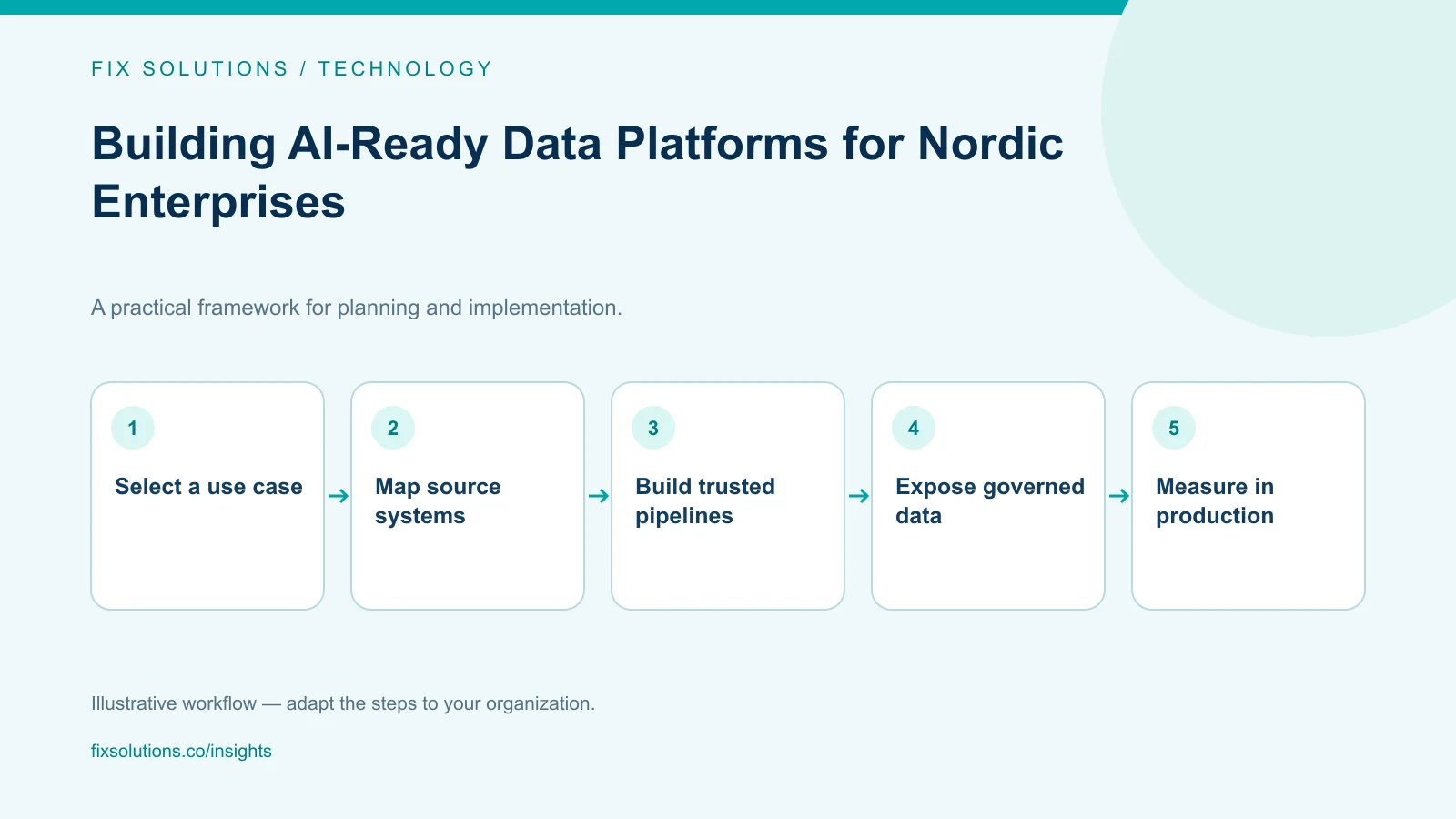
Choose a use case with a business owner and a clear consequence. Examples include preparing a service agent with approved customer context, helping planners investigate a supply exception, or enabling analysts to ask questions of governed operational data. Define what the user needs to decide or complete, what evidence is acceptable and which outcomes remain human-approved.
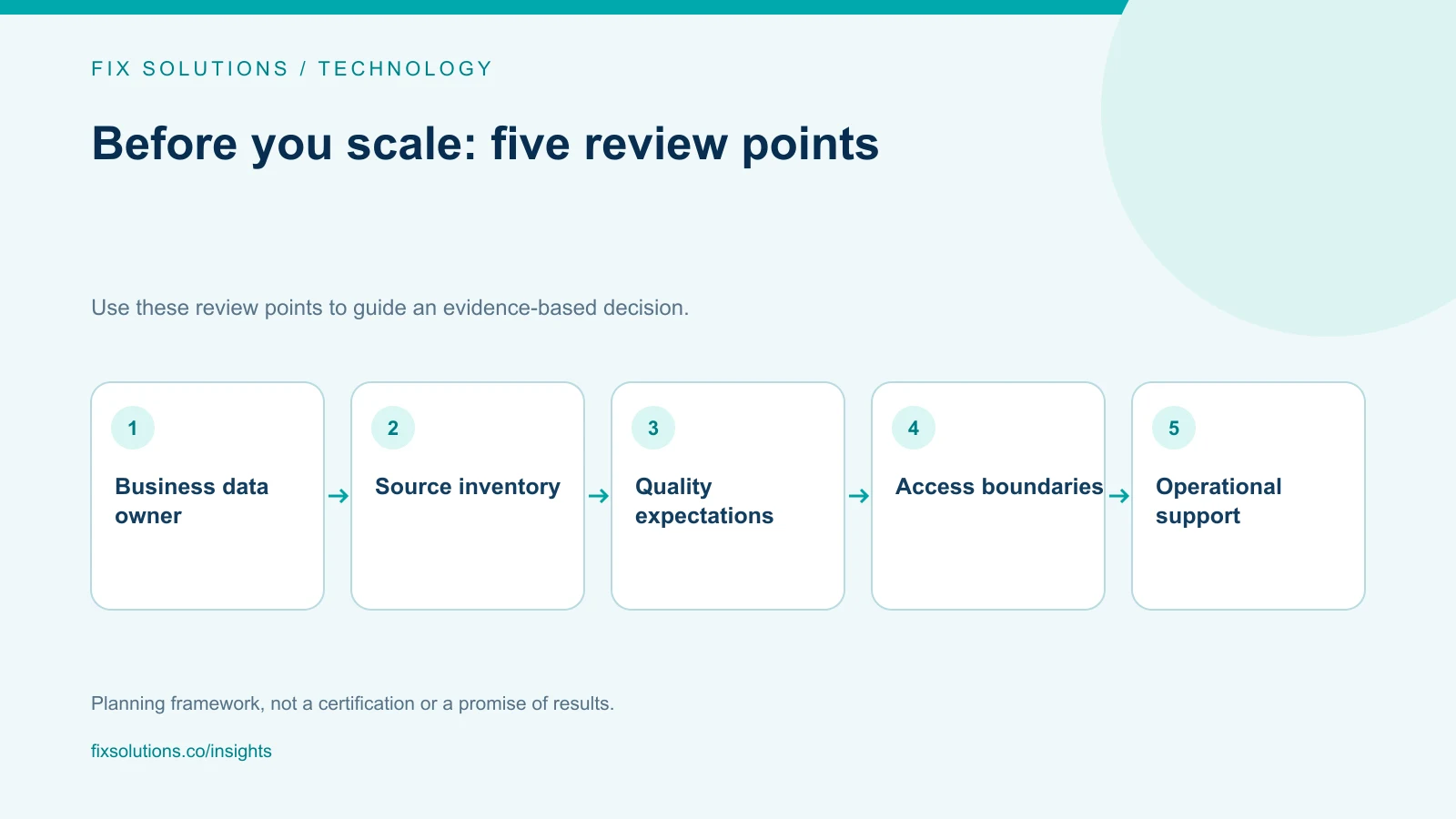
Write down the source of truth for each important entity and field. A CRM, ERP, warehouse, document repository and local spreadsheet may contain different versions of the same customer or asset. Record how identifiers are matched, which system owns updates and how conflicts are resolved. If the business cannot explain which value is authoritative, an AI layer is likely to make that ambiguity easier to query, not remove it.
Do not treat a general “over 50%” claim about companies failing to scale AI as established evidence without a named, relevant study and methodology. The business case should instead use the enterprise’s own pilot conversion, data quality, support and adoption observations.
Build an integration layer around trusted sources
Inventory the applications, databases, files, event streams and external services needed by the selected workflow. For each source, document its owner, interface, update cadence, data sensitivity, quality limitations and dependency on legacy infrastructure. This inventory helps distinguish what can be connected through an existing API from what needs a new adapter, change-data capture, event or batch pipeline.
An integration layer should make contracts explicit. Define schemas, identifiers, timestamps, versioning, retry behavior, duplicate handling and how consumers learn that data is stale or incomplete. Keep transformation logic visible and testable. When a pipeline changes units, joins records or applies business definitions, preserve enough lineage to explain how the resulting dataset was produced.
A data lake or lakehouse can consolidate access to diverse datasets, but platform selection should follow operational needs. Consider latency, volume, query patterns, data residency, skills, existing cloud commitments and recovery requirements. A central repository without stewardship and usable contracts can simply create a larger silo.
Use APIs or retrieval services that enforce identity and authorization for each caller. Avoid giving an LLM broad direct access to production databases or unrestricted document collections. For generated answers, return relevant source references and make missing or conflicting data visible. The model should not silently turn an absent value into a confident business fact.
Establish quality, governance and security controls
Define quality expectations for the data that supports the workflow: completeness, validity, uniqueness, consistency, timeliness and acceptable handling of late or corrected records. Set checks at ingestion and before critical downstream use. Route failures to an accountable data owner with enough detail to diagnose the source issue.
Classification and access rules should travel with the data. Use least privilege, purpose limitation, approved retention and auditable access. Sensitive information may need masking, filtering or exclusion from model context. Review model providers and deployment configurations against the organization’s data-processing, security and contractual requirements before sending data outside approved boundaries.
The NIST AI Risk Management Framework offers a voluntary structure for identifying and managing AI risks. The General Data Protection Regulation is an official EU legal text relevant to personal-data processing. These references do not replace legal advice or an organization’s assessment of its specific data flows and obligations.
Separate source-data quality from answer quality. A model evaluation can assess whether responses cite relevant records and acknowledge uncertainty; data checks can assess whether the underlying records meet agreed rules. Both layers matter, and each needs its own owner.
Move from pilot to a supported product
Keep the first production scope narrow enough to observe. Connect the minimum sources needed, agree on a service owner and data steward, and document the intended users and access boundaries. Prepare operational monitoring for pipeline freshness, failed loads, API availability, cost, retrieval quality and user-reported errors.
Evaluate the complete workflow with representative, approved examples. Include missing records, conflicting identifiers, delayed updates, permission denials and questions the system should not answer. Compare against a baseline such as investigation effort, task completion or data retrieval time. Avoid using model output volume as a proxy for business value.
Set recovery and change procedures before launch. Teams need to know how to replay a failed load, correct a mapping, roll back a schema change and disable an AI feature without losing the underlying business process. Record dependencies, escalation contacts and ownership of connectors, pipelines and prompts.
Scale by repeating the pattern where it fits, not by copying every implementation detail. Reuse shared identity, observability and data-quality capabilities, while allowing each domain to retain clear stewardship of its definitions. A federated approach can support common standards without pretending that one central team understands every business field.
Frequently asked questions
Do we need a new data lake before starting AI?
Not necessarily. A bounded use case may work with a governed API or existing warehouse. Assess access, quality, lineage, latency and operating needs before choosing a new platform.
Should an LLM query operational systems directly?
Usually, expose a controlled interface or retrieval layer instead. It can enforce authorization, limit the data returned, apply rate controls and provide traceable context.
Who owns data quality for AI?
Responsibility is shared across source-system owners, domain data stewards, platform teams and the AI product owner. Name the person responsible for correcting each material data issue.
Build the data path around a real business need
Trusted AI starts with clear ownership, reliable integration and governed access—not with a model connected to every system. Begin with one workflow, prove that its data can be used responsibly, and fund the operational work required to keep it dependable. FIX Solutions can help scope integration and data platform work through IT development services.