Does higher upfront software quality reduce total cost?
It can—when the additional investment prevents rework, outages, avoidable change effort and expensive ownership gaps. Compare delivery proposals over the product lifecycle, not by hourly rate alone. Include engineering, onboarding, QA, integration, support, maintenance, coordination and exit costs. Quality is not a promise of zero defects; it is a set of observable practices that help teams detect and correct problems before those problems become more expensive.
Swiss enterprises operate in a diverse business environment: organizations may need to serve multiple languages, integrate with established systems and meet demanding internal or sector-specific controls. Those requirements do not mean every Swiss project needs a large architecture exercise or an expensive supplier. They do mean that a headline rate cannot explain whether the delivered system will be understandable, testable and affordable to change.
The relevant question is not whether a higher-cost team is automatically better. It is whether the organization gets a system and working relationship that reduce the full cost of achieving the intended outcome over time. A low quote can be the best choice when scope is truly bounded, quality evidence is strong and the work has little hidden complexity. A low rate is a poor proxy when significant work has been left outside the quote.
Calculate the cost of ownership, not the rate
A useful comparison includes the initial delivery and the work required to operate, secure, integrate and change the software. A simple model is:
Lifecycle cost = delivery + internal coordination + onboarding + QA and remediation + integration + operation + maintenance + transition or exit
Use the same time horizon and outcome for each bid. One vendor may quote implementation only; another may include automated tests, deployment setup, knowledge transfer and a maintenance period. Comparing totals without reconciling scope rewards whichever proposal leaves more work unpriced.
| Cost area | Questions for the proposal |
|---|---|
| Discovery and delivery | Are requirements, architecture, implementation and acceptance included? |
| QA and remediation | Who writes and maintains tests? Are defects fixed within the agreed scope? |
| Integration and data | Are interfaces, migration, reconciliation and failure handling included? |
| Internal coordination | How much product-owner, architecture, security and review time is required? |
| Operations | Who provisions, monitors, patches, backs up and supports the system? |
| Change and maintenance | What does an ordinary enhancement or dependency update cost? |
| Continuity and exit | Can another team build, test, deploy and support the software? |
Ask for a resource plan, assumptions and exclusions. Estimate internal effort using the people who will actually be involved, not a fictional free allocation. Include the cost of decisions delayed because stakeholders cannot review work in time.
Compare like with like
Set a reference backlog or representative delivery slice. Ask each supplier to explain what they will complete, how quality will be demonstrated and what must be provided by the client. A request to “build the application” is too broad to evaluate when one bid assumes an existing API and the other includes a new integration.
Ask how change requests, ambiguous requirements, defects and security findings are handled. A low initial price can increase after every clarification if the commercial model makes routine discovery or remediation extra. Conversely, a fixed higher quote can be poor value if acceptance criteria are vague and the vendor is protected from the delivery outcome.
Understand why quality changes the economics
Quality practices lower particular forms of uncertainty. Automated tests can detect regressions in repeated workflows. Continuous integration can reveal broken builds earlier. Clear interface boundaries can limit the impact of a change. Code review can share context across the team. Monitoring and runbooks can reduce diagnostic time when a production issue occurs.
None of these practices guarantees an incident-free product. Their value is that teams can observe problems sooner, understand the affected behavior and make a change with better evidence. The NIST Secure Software Development Framework (SP 800-218) describes practices for integrating secure development into an organization’s lifecycle. DORA’s current delivery measures distinguish throughput and stability, including change lead time, deployment frequency, failed deployment recovery time, change fail rate and deployment rework rate. These are useful signals—not a simplistic team ranking.
Put tests around the business risk
Test depth should reflect consequences. A public marketing page and a billing calculation do not need identical coverage. Identify critical workflows, data integrity expectations, permission boundaries and failure modes. Prioritize regression tests for behavior that is costly or unsafe to break.
An automated test is only useful if it checks the intended behavior and remains reliable. Flaky tests, brittle UI scripts and unowned test suites can add cost without increasing confidence. Track test failures, time to diagnose and the proportion of important risks that are actually covered. Combine automation with exploratory testing, code review and operational checks where appropriate.
Ask a supplier to demonstrate a test pipeline on a realistic change: where a test runs, what failure looks like, who investigates, and how the evidence ties to a release. A screenshot of a green dashboard is weaker evidence than a working repository, documented test scope and sample failure-and-fix history.
Budget for architecture that makes future change affordable
Clean architecture does not mean maximal abstraction or a particular technology fashion. It means dependencies and responsibilities can be understood, tested and changed at a cost that fits the business. The correct design may be a well-structured monolith, a managed service, a modular application or several services. Choose based on the team’s delivery and operating needs.
Look for practical signs: documented data ownership, stable interfaces, manageable coupling, clear configuration, reproducible builds and an explicit path for replacing dependencies. A design document should show the decisions that matter and their tradeoffs. It need not become a large collection of diagrams that nobody maintains.
For multilingual or multi-region needs, decide deliberately how translation, currency, dates, time zones, data residency and customer support fit the system. These requirements should enter the domain model and acceptance tests, not be patched into templates at the last minute. Confirm the requirements with actual users and applicable specialist teams.
Estimate the cost of technical debt honestly
Technical debt is not a synonym for old code or any deliberate shortcut. It is a tradeoff that may create future work or constrain change. Record the specific consequence: slower release, extra manual reconciliation, repeat incidents, elevated exposure, or time spent maintaining a brittle integration.
Use delivery history and a planned change to estimate the impact. For example, compare the cost of implementing a normal new feature in the current structure with the cost after a targeted refactor. Do not assign arbitrary monetary values to hypothetical defects and add them to a spreadsheet as if they were certain savings.
Reserve capacity for dependency updates, test repair and architectural improvements where evidence shows that these reduce recurring work. Keep the improvement linked to an outcome. “Reduce coupling in the order workflow so two teams can release independently” is more useful than “modernize everything.”
Evaluate outsourced engineering as a delivery model
Outsourcing changes where work is performed and how responsibilities are contracted. It does not outsource the organization’s product ownership, risk acceptance or accountability for customer outcomes. A delivery partner should provide more than assigned capacity: it should collaborate within a defined scope, produce inspectable work and transfer enough knowledge for ongoing ownership.
Evaluate the team that will actually work on the product. Review engineering leadership, turnover arrangements, documentation habits, communication cadence, test strategy, access controls and continuity. Clarify who approves architecture changes and how internal teams can inspect the repository and pipeline.
Cross-border work can have data-transfer, contractual and access implications. Make decisions with legal, security and procurement specialists based on actual data flows and service arrangements. Do not assume the country label alone establishes risk or quality. Restrict access to what the team needs; use approved development environments and avoid unnecessary copies of production data.
Compare cost per accepted outcome, not only cost per developer-day. The model should account for rework, review delay, onboarding, knowledge transfer and coordination. If a partner’s lower price requires the client to provide a large undisclosed engineering and QA function, include that function in the comparison.
A transparent illustrative comparison
The following is a template, not a Swiss market benchmark or a claim about a supplier. Enter actual proposals, your internal loaded cost and a common delivery scope. Use the same expected release horizon.
| Cost category | Supplier A: lower initial quote | Supplier B: higher initial quality scope |
|---|---|---|
| Quoted implementation | Enter proposal amount | Enter proposal amount |
| Internal product and architecture time | Estimate client hours × internal loaded rate | Estimate client hours × internal loaded rate |
| QA automation and test maintenance | Include separately if excluded | Verify coverage and ownership in scope |
| Integration and production readiness | Add unpriced interfaces, monitoring and recovery | Confirm included deliverables and acceptance |
| Expected post-launch change | Estimate from a realistic change request | Estimate using the same change request |
| Knowledge transfer or exit | Add documentation, training and transition | Verify portability and handover terms |
| Comparable lifecycle total | Sum the evidenced cost items | Sum the evidenced cost items |
The comparison only favors Supplier B when the extra initial investment leads to a demonstrated reduction in later delivery and ownership cost—or a material reduction in risk that the organization is willing to fund. Require evidence, record confidence and show which assumptions would reverse the recommendation.
A procurement workflow for risk-aware Swiss enterprises
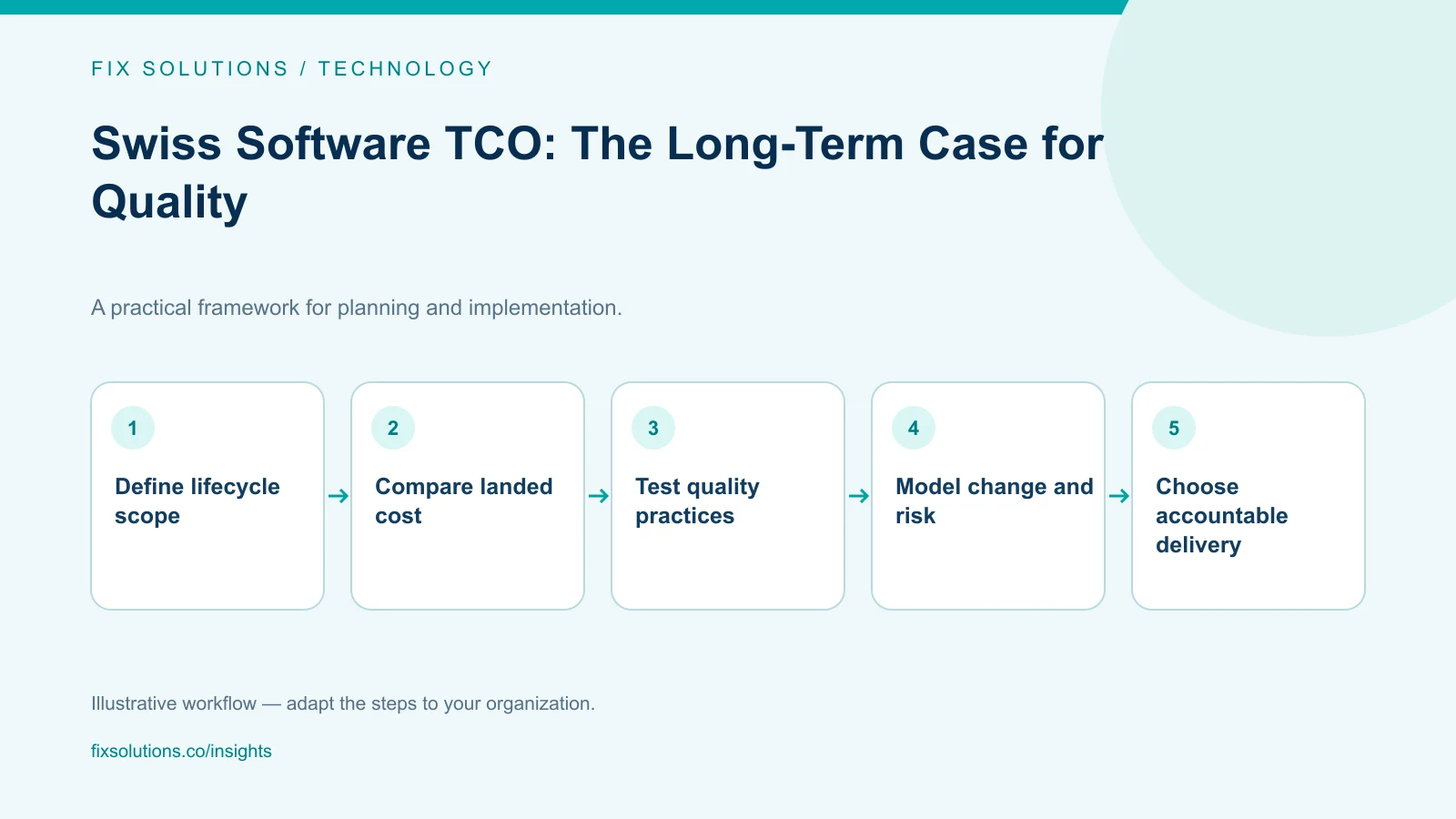
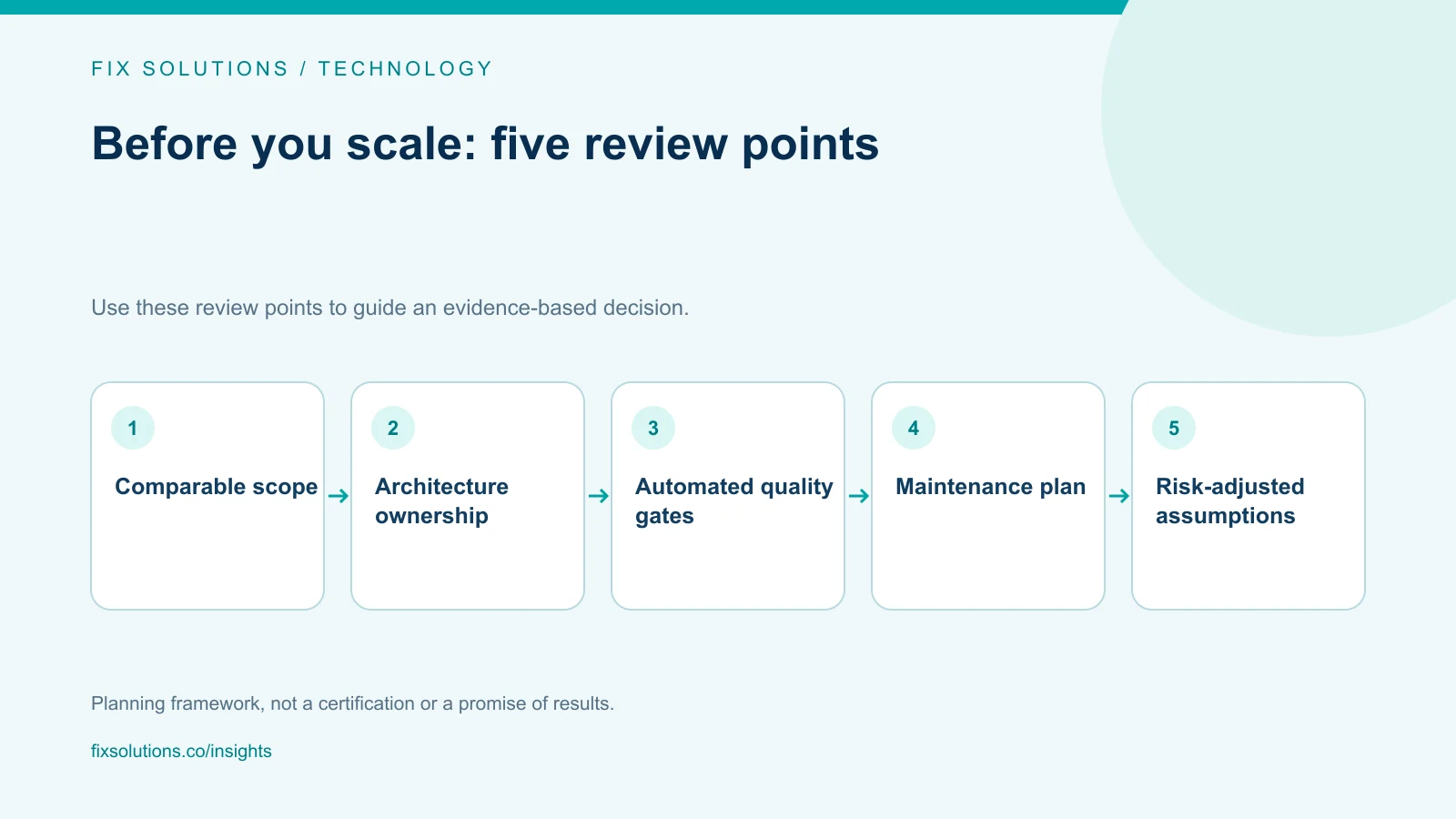
1. Define the outcome and operating context. State the business capability, users, languages, integrations and expected life of the solution. Document regulatory or contractual obligations that have been verified as applicable.
2. Request evidence, not just credentials. Ask for architecture decisions, a sample test strategy, a working build pipeline, dependency-management practices, operational ownership and the team’s approach to knowledge transfer. Use a short paid discovery or pilot when crucial assumptions cannot be verified in a proposal.
3. Evaluate the hard-to-change path. Have the vendor implement a bounded, representative change that exercises data, permissions, integration and deployment. Inspect maintainability and failure handling—not just the demo’s visual finish.
4. Price the whole lifecycle. Normalize scope, internal effort, operations, change and exit costs. Mark unknowns and separate one-time investment from recurring spend.
5. Set acceptance and operating measures. Agree on workflow behavior, performance needs, test evidence, deployment responsibilities, defect handling and documentation. Measure delivery and operational stability after launch, then revisit the model using actual data.
Frequently asked questions
Is higher-cost software development always better value?
No. Price alone proves neither quality nor waste. Compare the same scope, observable engineering practices, client effort, operating cost and realistic future change. A well-bounded low-cost engagement may be the right decision.
How can we estimate technical-debt cost?
Measure recurring effects such as extra testing, release delay, incidents, manual work and the cost of a planned change. State assumptions and uncertainty, then verify whether a targeted improvement changes those measures.
Does a Swiss enterprise need a different quality process?
Requirements depend on the industry, systems, data, contracts and business risk. Determine applicable obligations with the organization’s legal, security and quality owners; do not assume one national process or vendor claim applies to every company.
Sources and further reading
- NIST Secure Software Development Framework (SP 800-218)
- DORA: Software delivery performance metrics
- Federal Data Protection and Information Commissioner (Switzerland)
For an engineering proposal review, compare lifecycle assumptions and the system the team will actually leave behind. FIX Solutions’ IT development services can help shape a measurable delivery plan.